
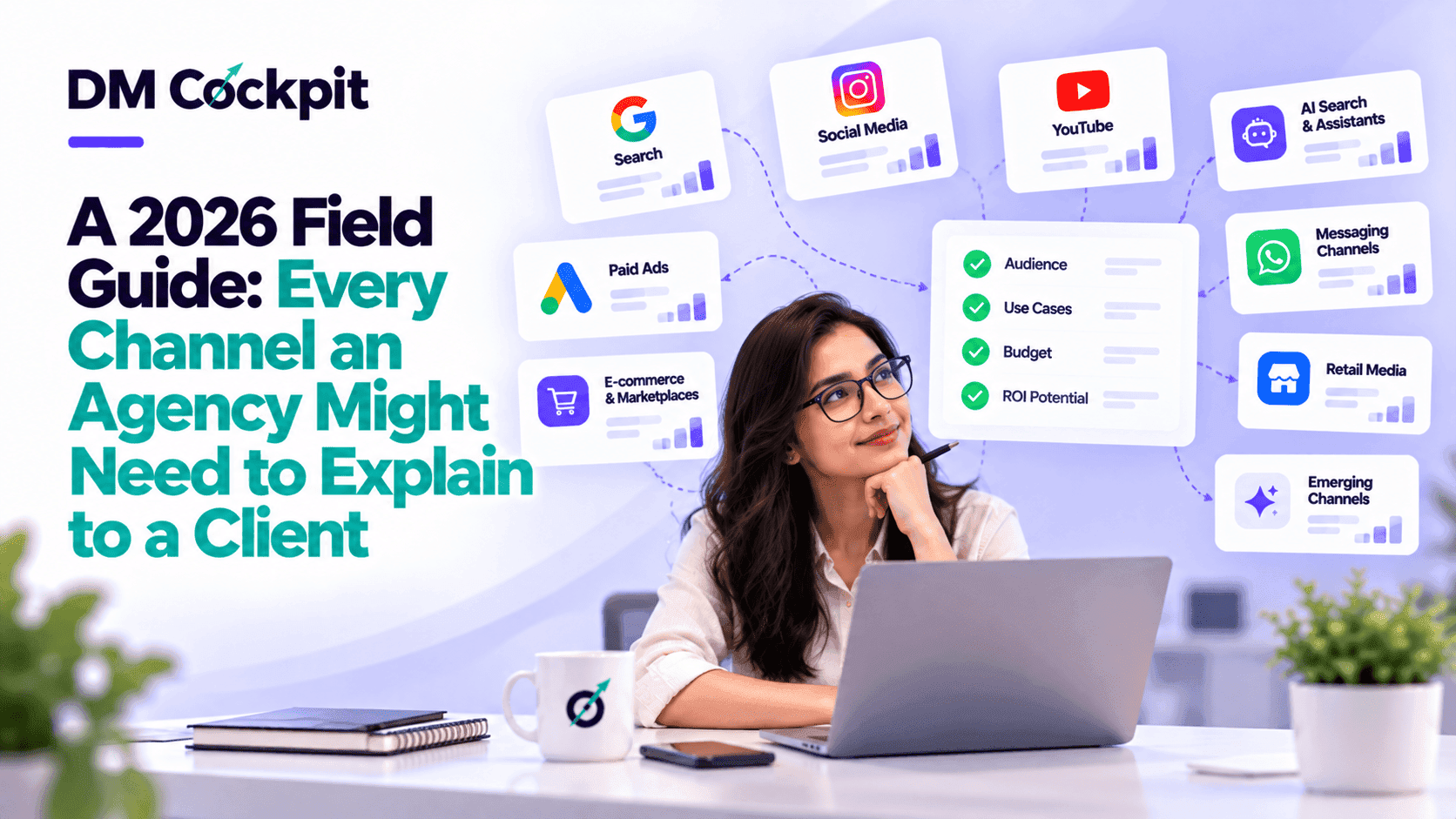
Marketing channels used to conform to a familiar classification. Search led to those who sought answers. Social media helped brands connect with audiences. Email was used to maintain the engagement of existing customers.
That familiar channel mix is no longer the whole picture.
In 2026, clients are asking about AI search, conversational advertising, retail media, creator partnerships and platforms they hadn't heard about a year ago. Agencies must be able to clarify where these channels fit in without opportunistically using any new development.
This new marketing channels guide for agencies brings together the major options worth considering. It provides the various functions of each channel, when to focus on each one, and what questions to ask before suggesting it to a client.
The 2026 Marketing Channel Directory
Different channels serve different purposes. Some of these attract the existing demand, others bring new product lines to new target groups, and a few are still finding the right metrics to track.
|
Channel |
Primary purpose |
What agencies should explain |
|
Traditional search |
Capture active demand |
Search intent, visibility, conversions |
|
AI search |
Influence research and discovery |
Brand mentions, citations, answer accuracy |
|
Paid search |
Reach people searching for solutions |
Campaign relevance and lead quality |
|
Paid social |
Build awareness and generate interest |
Audience targeting and creative performance |
|
Organic social |
Maintain engagement and visibility |
Content relevance and community response |
|
Conversational advertising |
Reach users within AI interactions |
Placement, measurement, and user context |
|
Retail media |
Reach shoppers on commerce platforms |
Product visibility and purchase intent |
|
Creator marketing |
Build trust through relevant voices |
Audience fit and authentic engagement |
|
Video and connected TV |
Reach audiences through video |
Attention, reach, and measurable outcomes |
|
Email and messaging |
Build ongoing customer relationships |
Retention, engagement, and consent |
The important thing is that these channels are not competing for attention simply because they are here. The relevance of their activities is dependent on the client's business.
Further Reading: Practical Guides for Agency Teams
When a client requires additional information on a specific marketing problem, you can use these related resources.
- AI search and vendor research: Understand how agencies can communicate what AI-driven discovery can do and enhance the information at the disposal of prospective customers.
- Emerging advertising channels: Explore how to identify competitor activity and evaluate unfamiliar marketing opportunities.
- Campaign creative and performance: Understand how to review AI-generated advertisements and identify declining creative effectiveness.
- Website auditing and reporting: Turn the technical information into actionable for the client.
- Agency operations: Discuss service planning, channel choice and reporting.
All of the resources address a different stage of the client planning process, from research, to ongoing campaign review.
1. Traditional Search: Still the Foundation of Digital Discovery
However, SEO continues to be relevant as people still rely on search engines to look for businesses, to compare services and seek solutions.
Agencies must engage in communication in three interconnected components with regard to SEO:
- Technical accessibility: Do major pages accessible and understandable to search engines?
- Content relevance: Is the content relevant to the website's target audience?
- Search performance: Are relevant pages getting visibility and attracting qualified visitors?
While rankings are significant, they shouldn't be the difference between business success and failure.
A webpage could be getting a lot of search traffic for a question that doesn't relate to the business's offerings.A website may be ranking for a more niche term, but not getting any type of queries that can be acted on. While the visits may be lower on a different web page, the closer that visitors may be to making a decision could be higher.
For further reading, visit the DM Cockpit blog library for some real-world insights on SEO, rankings and search performance.
2. AI Search: Visibility Beyond Traditional Rankings
For some people, AI-driven search is revolutionizing their product and service research, as well as the vendor selection process.
A person may not need to visit multiple websites to compare software providers, or to describe which software is best for a specific business, but instead, they can use an AI assistant to handle these queries.
This brings another question regarding visibility.
The agency should check to see if the brand the client called does not appear in one of the answers that were created by the AI or whether one of the descriptions is accurate or whether one of the sources supports the description.
What should agencies monitor?
- Brand appearances across relevant research prompts
- Accuracy of product and service descriptions
- Competitor mentions in the same answers
- Sources cited by AI search systems
- Important questions the brand's website fails to answer
AI search visibility shouldn't be a replacement for current SEO reporting, but rather an addition.
Agencies shouldn't promise to be included in AI-generated answers, either. These systems can return different responses when the question is given, the context is used, and the time is when it is used.
3. Paid Search: Where Immediate Intent Matters
When people are actively searching for a solution, paid search is relevant.
For instance, a person seeking enterprise accounting software might be more advanced in the decision-making process than an individual that is simply watching a business video.
That's a distinction that impacts campaign planning.
It is important for agencies to communicate the importance of matching the ad, the intent behind the search, and the landing page for the search to be successful.
A good client report ought to be able to separate out campaign activity from meaningful outcomes.
Clicks show interaction. Strong business relevance through qualified inquiries.
The two should not be talked about without taking into account what occurs once someone arrives at the site.
4. Paid Social: Creative Performance Is Becoming More Important
Examples of social advertising platforms are Instagram, Facebook and LinkedIn.
They target different consumers and purchase scenarios.
Instagram could be more appropriate for visual product discovery. If the business has a specific audience of professionals it is looking to target, LinkedIn may be more relevant.
A platform may reach the right audience without necessarily delivering meaningful results.
Performance is impacted by creative quality, message clarity, campaign goals, and landing page experience.
There's also one more thing to consider about using AI to create advertising creatives: agencies can make more variations, but at least those variations have to be monitored.
A campaign with a lot of different creatives can feel productive, but conversions and engagement slowly drop until it drops.
Agencies need to communicate to the client the difference between making an ad that is "efficient," and making an ad that will keep on delivering.
5. Organic Social: More Than a Publishing Calendar
Social media is still valuable for relationship management, passing on knowledge, and developing familiarity.
The answer to this question relies on the different expectations audiences have on the various platforms.
A B2B software company may take advantage of LinkedIn to provide technical issues. Instagram could be a good platform for a consumer brand to showcase products or answer customer queries.
Agencies should assess:
- What content does invite meaningful interaction?
- Are people taking the time to ask questions, or just viewing posts?
- Is there a wider marketing purpose for the content?
- Will the team be able to publish on a regular schedule?
Growth of followers is not the complete picture.
6. Conversational Advertising: A Developing Category to Watch
Advertising in an AI-powered conversation puts you in a different context than a regular search or social feed.
When an ad is served, a user may be in a situation where they are looking for a comparison, performing research or answering follow-up questions.
The agencies need to know the difference between commercial advertisements and experimental or new ads, which are being slowly introduced.
Before recommending the conversational advertising opportunity, check that the opportunity is available, has adequate targeting, reporting capabilities and is suitable for the client's audience.
It might be useful to start with this question:
What is the purpose of the ad and how will we measure it?
If it's not clear, the channel might need to be monitored instead of adopting it right away.
7. Retail Media: Advertising Closer to Shopping Decisions
Retail media is advertising on retailer's websites, apps, and advertising networks.
Works well for brands that sell online on commerce sites.
Retail media can often be a more targeted way to reach consumers who are already in a product category or looking to compare products.
Agencies should take into account the availability of products, whether the target audience of the retailers is relevant and whether the sales reporting is good.
This channel might not be particularly useful for service-based companies that don't have a significant retail aspect.
8. Creator Marketing: Relevance Before Reach
Creator partnerships can bring a business to an audience via a trusted personality or subject matter expert.
But having a lot of followers doesn’t guarantee that the creator will have the influence on the right buyers.
If you're looking for B2B clients, a smaller industry-specific expert is more relevant than a general-interest influencer with a much wider following.
Agencies should review audience fit, content authenticity, engagement level and proper ad disclosures before suggesting a pairing.
The aim is to determine a feasible link between the creator, the audience, and the client's offering.
9. Video and Connected TV: Understanding Different Viewing Environments
Short form social media ads, YouTube ads, streaming services and connected TV are all covered by video ads.
These environments shouldn't be treated as interchangeable simply because they all use video.
Social media posts are generally brief and more often than not compete for viewers' attention while web browsing. With Connected TV ads, users are viewing ads in a context that may be different from others.
Agencies should not compare the performance of one format to another unless they know what each one is designed for.
Remember that the metric that is used for a brand awareness campaign may differ from the metric used for a direct-response search campaign.
10. Email and Messaging: Channels Agencies Should Not Overlook
New advertising environments get the attention but old customer relationships are still important.
Repeat engagement can be achieved with email newsletters, customer messaging and permission-based communication.
You have to make them relevant, timely and expected by the audience to make them effective.
Agencies need to consider trends and meaningful customer activity instead of open rates and delivery counts when evaluating engagement.
Consent, platforms and policies for messaging, privacy policies need to be considered.
How to Decide Which Channels Deserve Attention
A second purpose of this new marketing channels guide that agencies can leverage is to simplify channel selection during client conversations.
It helps with a simple classification system.
|
Classification |
Meaning |
Recommended agency action |
|
Core channel |
Already contributes to established business objectives |
Continue measuring and improving |
|
Growth opportunity |
Relevant audience and reasonable measurement options |
Develop a controlled test |
|
Watchlist |
Promising but limited evidence or access |
Review developments periodically |
|
Low priority |
Weak audience or business alignment |
Explain why it is not recommended |
Five Questions to Ask Before Adding a Channel
- Is this channel used by the target audience of the client?
- What particular business goal would it help achieve?
- Is there a reasonable degree of confidence in the ability of the performance to be measured?
- Can the agency efficiently deal with it?
- What will be their evidence to support their decision to continue or discontinue the activity?
These questions help agencies avoid reacting impulsively to industry news.
Build Client Reports Around Outcomes, Not Platform Names
A client report should be useful over a range of marketing mix changes.
Agencies can structure reports around business goals without creating an entirely new reporting framework for every emerging platform.
For example:
- Visibility: Search presence, relevant reach, and brand discovery
- Engagement: Meaningful interactions and qualified website visits
- Conversions: Inquiries, purchases, or other agreed business actions
- Retention: Repeat engagement and customer relationships
- Experiments: New channels being tested and lessons learned
This will enable agencies to add channels without breaking up the bigger performance story.
It also provides a space for clarifying limitations of measurement. Some new channels may give you engagement data but not full conversion data.
Reports should explain these limitations rather than hide them behind attractive performance figures.
Keep the Channel Strategy Clear as Marketing Evolves
The challenge for agencies in 2026 isn't tracking every new platform. It's identifying which developments matter to their clients. It is being aware of which changes are relevant and telling their clients about them, but without getting too complicated.
A useful channel strategy combines established performance data with carefully evaluated experiments.
At DM Cockpit, we have numerous tools and features that help agencies to structure their digital marketing tasks, including SEO tracking tools, advertising tools, social media management tools, and reporting tools. See our digital marketing features to understand what we can do to help you get a better picture of your marketing. And check out our agency solutions.
Frequently Asked Questions
1. What are the most important marketing channels for agencies in 2026?
Traditional search, paid search, social media, email, and video remain important. AI search, conversational advertising, and retail media are additional areas worth evaluating. The right combination depends on the client's audience and business objectives.
2. Should agencies recommend every new advertising channel?
No. Agencies should first confirm audience relevance, campaign availability, measurement options, and business fit. A new channel should solve a specific marketing problem rather than simply follow an industry trend.
3. How is AI search different from traditional SEO?
Traditional SEO focuses on website visibility within search results. AI search visibility also considers how brands are represented, referenced, or cited in AI-generated responses. Both approaches benefit from accurate, useful, and accessible website content.
4. How can agencies explain emerging channels to non-technical clients?
Start with the business purpose, target audience, and expected learning. Avoid overwhelming clients with platform terminology. Explain what is known, what remains uncertain, and how the agency will evaluate performance.
5. How often should agencies review their marketing channel mix?
A quarterly review can provide a useful starting point, with additional checks when campaign performance, audience behavior, or platform availability changes significantly. The review schedule should reflect the client's marketing activity.
6. Can agencies manage several marketing channels through one dashboard?
Some marketing management tools bring reporting from multiple supported channels into one workspace. However, integration availability and reporting depth vary. Agencies should verify that their chosen solution supports the platforms and metrics they need.