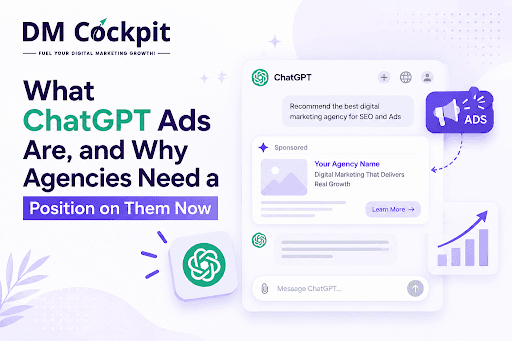
A client forwards your agency a screenshot from ChatGPT. There is a sponsored placement sitting beneath the answer. The message that follows is predictable: “Should we be advertising here?”
That question can arrive before the client has a budget, campaign idea, or even a clear understanding of how ChatGPT advertising works. They may simply have seen a new place where competitors could potentially appear and want to know whether they are falling behind.
For agencies, that creates an unusual responsibility. You do not need to treat every new advertising format as the next major acquisition channel. You do, however, need a defensible answer. That means understanding what is live, what is still developing, how the experience differs from conventional paid search, and what clients should realistically expect.
That makes ChatGPT ads for agencies an important subject to understand before clients begin asking whether the channel deserves a place in their media strategy.
ChatGPT Ads in Plain English
The subject of ChatGPT ads for agencies is worth looking at as a new advertising environment rather than another version of a search results page.
Ads can appear below ChatGPT responses and are visually separated from the answer. Current ad units can contain an advertiser name, headline, description, landing page, image, and advertiser branding. OpenAI says advertisements do not influence the answers ChatGPT generates.
That distinction is important.
If a user asks ChatGPT for help comparing options, the answer itself is not supposed to become more favorable because a company paid to advertise. Instead, a relevant sponsored placement can appear separately beneath the response.
OpenAI also says advertisers do not receive access to users' private conversations. Ad selection can consider signals such as the intent and context of the current conversation, alongside advertiser information and, when personalization is enabled, selected signals from the user's broader ChatGPT experience.
For an agency explaining the format to a client, three points therefore matter immediately:
- The advertisement and ChatGPT's answer are separate.
- A sponsored placement is not an endorsement from ChatGPT.
- Conversational context creates a different advertising environment from a conventional keyword-triggered search results page.
The Rollout Matters as Much as the Format
ChatGPT advertising moved quickly during 2026, so agencies should avoid explaining it using information from the earliest pilot alone.
January 16, 2026: Testing announced
OpenAI announced plans to begin testing ads in the United States for users on the Free and Go tiers.
February 9, 2026: U.S. pilot begins
Testing started in the United States with logged-in adults on Free and Go. The initial rollout was deliberately limited while OpenAI gathered feedback.
May 2026: Buying and management options expand
OpenAI introduced a beta self-service Ads Manager, CPC bidding, and additional measurement capabilities, moving the product beyond its initial managed-advertiser model.
August 2026: International rollout accelerates
ChatGPT Ads expanded into markets including the United Kingdom, Mexico, Brazil, Japan, and South Korea. OpenAI subsequently announced expansion into 31 European markets.
August 31, 2026: India and EMEA become directly accessible
OpenAI launched self-service Ads Manager access across India, Europe, the Middle East, and North Africa. Its current availability list includes India and numerous European and MENA markets.
What is still developing?
The advertising product is not standing still. On September 16, OpenAI announced further AI-powered advertising capabilities, including testing Sponsored Agents that can allow a user to move from an ad into a conversation with a business-sponsored agent.
For agencies, the lesson is simple: a presentation about ChatGPT advertising can become outdated quickly. Availability, formats, buying tools, and measurement capabilities should be checked before they are presented to a client as settled facts.
Why Agencies Cannot Wait for the Channel to Mature
Clients Will Ask Before They Are Ready to Spend
Clients rarely wait for an agency's quarterly planning meeting before asking about a new platform.
They see industry coverage, competitor activity, or a sponsored placement themselves. Their first question is often not “Can we launch tomorrow?” It is “What do you think?”
An agency needs enough knowledge to separate genuine opportunity from novelty.
Search Behavior Is Spreading Beyond Traditional Search Engines
People use conversational AI differently from a standard search box. They may describe a problem, refine requirements, compare alternatives, and ask follow-up questions within the same interaction.
That matters to advertisers because commercial intent can emerge during a conversation rather than appearing as one neatly phrased search query.
It does not make conventional search advertising obsolete. Instead, agencies may increasingly have to understand intent across more than one discovery environment.
Agencies Need a Position Without Inventing a Track Record
A new advertising environment creates a temptation to sound more certain than the evidence allows.
Agencies do not need to claim that ChatGPT advertising will outperform Google Ads, Meta Ads, or another established channel. Nor should they dismiss it simply because long-term benchmarks are still developing.
A defensible position can be much simpler:
Here is what is currently available. Here is what we know. Here is what we would need to test. Here is how we would decide whether the channel deserves a larger role.
That answer is more useful than pretending mature benchmarks already exist.
What Should an Agency's Position Actually Cover?
Before recommending or rejecting the channel, build a point of view around four questions.
|
Question |
Agency Needs a Position On |
|
Inventory |
Where can the advertiser actually appear? |
|
Audience |
What behavior or intent makes the placement relevant? |
|
Measurement |
Which results can currently be measured and reported? |
|
Testing |
What would have to happen for an experiment to justify expansion? |
This framework also prevents agencies from evaluating ChatGPT Ads in isolation.
Established paid-search campaigns still provide useful performance context. Agencies using the DM Cockpit Google Ads Monitoring Tool can continue monitoring existing Google Ads performance while separately evaluating what emerging conversational advertising contributes.
The goal is not to force two different channels into identical reporting. It is to understand what job each channel is doing.
Don't Treat Conversational Ads as Google Search Ads With a New Interface
Traditional search advertising usually begins with a relatively compact expression of intent: a query.
A ChatGPT conversation can develop that intent over several exchanges.
Someone might begin by asking how to solve a business problem, add requirements in the next message, reject one approach, and then ask for suitable products or services. The commercial context develops progressively.
OpenAI's current advertising documentation reflects this difference. Advertisers can provide context hints describing relevant conversations, topics, or keywords, but OpenAI explicitly notes that these are not exact-match keywords and do not guarantee delivery within particular conversations.
That is why agencies should resist simply transferring a paid-search playbook and changing the platform name.
For additional context on how advertising is moving into AI-driven interfaces more broadly, agencies can also read DM Cockpit's analysis of Google placing ads inside AI chats.
A Five-Question Client Conversation Agencies Can Use
When a client asks whether they should advertise in ChatGPT, there is no need to begin with a yes-or-no recommendation. Start with five questions.
- What are we trying to achieve?
Awareness, qualified traffic, product discovery, lead generation, and conversion are different objectives. - Does our customer's decision process naturally involve research or comparison?
Conversational environments may be particularly interesting when people need information before making a decision. - What would make a test successful?
Agree on the outcome before launching instead of choosing success criteria afterward. - What will we compare the results against?
Existing paid-search, paid-social, analytics, and conversion data can provide useful context without assuming the channels work identically. - What don't we know yet?
Put uncertainties on the table. New inventory deserves testing discipline, not artificial certainty.
These questions turn the conversation away from “everyone is talking about ChatGPT” and toward whether the channel has a defined role in the client's acquisition strategy.
Build the Position Before You Need the Pitch
ChatGPT advertising has already moved beyond a U.S.-only experiment. With self-service advertiser access now available in India and across many European, Middle Eastern, and North African markets, agencies have a practical reason to understand it now rather than waiting for a client brief to force the research.
For ChatGPT ads for agencies, the practical priority is to understand the format, measurement expectations and testing rationale before clients begin asking whether the channel belongs in their media plans.
At DM Cockpit, we see this as part of a broader agency challenge: paid media is becoming more fragmented while clients still expect a clear picture of performance. Our role is to help agencies keep established digital marketing data visible and manageable while they evaluate where emerging channels fit. A strong agency position on ChatGPT Ads does not need hype. It needs current information, sensible expectations, and a clear reason for testing.
Frequently Asked Questions
1. What are ChatGPT Ads?
ChatGPT Ads are sponsored placements that can appear separately from ChatGPT's responses. They give advertisers an opportunity to reach users in a conversational environment while keeping paid content distinct from the answer generated by ChatGPT.
2. Are ChatGPT Ads available to advertisers in India?
Yes. As covered in the article, self-service advertiser access has expanded to India alongside a wider rollout across European, Middle Eastern, and North African markets. Agencies should still check current availability and advertising requirements before recommending the channel to a client.
3. Do ChatGPT Ads influence the answers users receive?
OpenAI states that advertisements do not influence ChatGPT's answers. Sponsored placements are presented separately from the response, so advertisers are paying for advertising visibility rather than influencing what ChatGPT says.
4. Should agencies recommend ChatGPT Ads to every client?
Not automatically. Agencies should consider the client's objectives, audience behavior, customer journey, available advertising formats, measurement capabilities, and existing channel performance before deciding whether a test makes sense.
5. How are ChatGPT Ads different from traditional search ads?
Traditional search advertising typically responds to a relatively concise search query, while commercial intent in ChatGPT can develop across a longer conversation. Agencies should therefore avoid treating conversational advertising as simply another version of keyword-based paid search.
6. What should agencies prepare before testing ChatGPT Ads?
Agencies should establish the campaign objective, understand available inventory and measurement capabilities, decide what a successful test would look like, determine how results will be compared with existing channels, and explain any current limitations to the client before launching a campaign.