
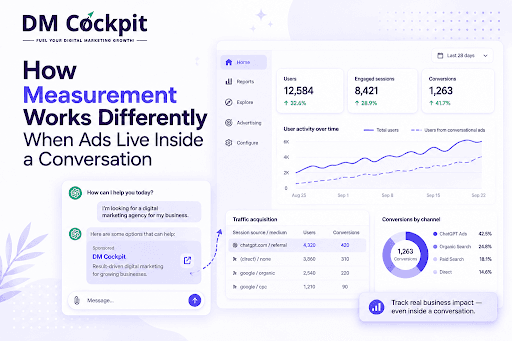
The campaign has been running. The client opens the reporting call and asks a familiar set of questions: How many people saw the ads? How many clicked? Which visits are converted? What happened after those visitors reached the website?
For years, paid search has trained advertisers and clients to think in a fairly recognizable trail:
- Impression
- Click
- Session
- Conversion
The arrival of advertising inside conversational AI does not make those questions irrelevant. It does, however, change the environment in which the ad is discovered.
That distinction matters when discussing ChatGPT ads measurement reporting. ChatGPT Ads already provides familiar performance metrics, including impressions, clicks, CTR, average CPC, average CPM and conversions when conversion measurement is configured. But an ad encountered during a conversation exists in a different user experience from an ad displayed on a conventional search results page.
For agencies, the job is therefore not to throw away familiar PPC measurement. It is to understand what those numbers can and cannot tell a client about the surrounding conversational journey.
Traditional PPC Has Trained Clients to Expect Granularity
Standard PPC reporting gives agencies a familiar set of dimensions and metrics to work with. Depending on the platform and campaign type, teams can examine impressions, clicks, conversions, CTR, campaign performance, keywords, devices, locations and other signals.
That depth has shaped client expectations.
A client may reasonably expect an agency to move from an overall campaign result into increasingly specific explanations. DM Cockpit's Google Ads Monitoring Tool, for example, brings campaign-level metrics such as impressions, clicks and conversions together while also providing views across campaigns, keywords, devices and locations.
The mistake would be assuming every emerging advertising environment must reproduce exactly the same reporting structure.
A Conversation Is Not a Search Results Page
A traditional search often starts with a short query. The search engine returns a results page, the user evaluates the available options and may click an ad.
Conversational AI can involve a different pattern.
Multi-Turn Context
A person may begin with a broad question, add a constraint, ask a follow-up and gradually narrow the requirement.
The commercial context can therefore develop across several turns rather than being expressed in one isolated search query.
Different Discovery Behavior
Someone using an AI assistant may initially be trying to understand a problem rather than actively looking for an advertiser.
An advertising opportunity can emerge as that conversation becomes more commercially relevant.
Ads Sit Beside a Conversational Experience
OpenAI states that ads are separate from ChatGPT's answers. That distinction is important: advertisers are participating in an advertising environment around the conversation, rather than purchasing the assistant's response itself.
Attribution Can Still Continue Beyond the Click
Once someone clicks through to an advertiser's website, familiar web analytics become useful again. OpenAI supports static tracking parameters such as UTMs on landing-page URLs, and conversion measurement can connect eligible ad clicks with configured conversion events.
The measurement challenge is therefore not “there is no measurement.” It is understanding the boundary between platform reporting, conversational context and downstream website behavior.
The Measurement Gap Agencies Need to Explain
The clearest way to prepare clients is to separate what they may assume from what the advertising platform currently reports.
|
Client may expect |
Reporting reality |
|
Familiar impression and click reporting |
ChatGPT Ads currently reports impressions and clicks |
|
CTR and media-performance metrics |
CTR, average CPC and average CPM are currently available |
|
Conversion reporting |
Available when conversion measurement is properly configured |
|
Full visibility into the user's conversation |
Advertisers should not expect access to people's private ChatGPT conversations |
|
Familiar search-query reporting |
A conversational environment should not automatically be treated like conventional keyword-based search |
|
A mature, fixed reporting system |
Ads Manager remains in beta and its measurement capabilities continue to evolve |
OpenAI says Ads Manager Beta provides reporting at campaign, ad-group and ad levels. Reports can also be downloaded as CSV files for selected date ranges.
That is substantial reporting capability. What agencies should avoid is promising dimensions or user-level conversational insight simply because those details are familiar from another advertising ecosystem.
What a New Reporting Environment Changes
Optimization
Optimization depends on the signals a platform makes available.
An agency can already examine delivery, clicks, CTR and conversion results in ChatGPT Ads. As data accumulates, those signals can support decisions about campaign and ad performance.
However, agencies should optimize against the data that actually exists rather than recreate a Google Ads reporting model inside a different platform.
Attribution
A click is only one stage of the journey.
OpenAI's conversion measurement can use the OpenAI Pixel, Conversions API or both. A conversion can be reported when an eligible ad click can be connected with an appropriate configured event within the applicable attribution window.
Agencies should therefore distinguish between platform-attributed conversions and the wider customer journey observed through analytics and business systems.
Client Reporting
Good reporting needs interpretation.
Instead of sending clients a collection of unfamiliar metrics, agencies should explain:
- What the platform measured
- What happened after the click
- Which outcomes were attributed
- What remains outside the available data
- What the agency plans to test next
That makes effective ChatGPT ads measurement reporting useful for decision-making rather than simply adding another dashboard to the monthly report.
Benchmarking
Early benchmarks deserve caution.
A mature search campaign may have years of account history behind it. A newer conversational advertising environment does not automatically provide an equivalent historical baseline.
Compare like with like wherever possible. Establish campaign-specific baselines first, then examine how performance develops over time.
Build Reporting Around Questions, Not Just Metrics
A useful report should answer a sequence of business questions.
Did people see us?
Start with delivery and impressions.
Did they engage?
Look at clicks and CTR while considering the campaign objective.
Did qualified traffic reach the website?
Use tracking parameters and analytics to understand the traffic generated after an ad click.
What happened after arrival?
This is where website analytics becomes especially valuable. Agencies can examine sessions, landing-page behavior, engagement and conversions. DM Cockpit's Google Analytics Reporting Tool brings website traffic, session sources, landing pages, user behavior and conversion information into a more accessible reporting view.
Did the activity contribute to a business outcome?
The final question should move beyond exposure. Depending on the campaign, that might mean a lead, registration, purchase or another meaningful conversion.
The sequence prevents one metric from carrying more meaning than it deserves.
A Better Client Reporting Model
Rather than forcing everything into one attribution story, agencies can organize reporting into three layers.
A practical ChatGPT ads measurement reporting framework can therefore separate platform performance, website behavior, and the business outcomes that ultimately matter to the client.
Layer 1: Platform
Start with what the advertising platform directly reports:
- Impressions
- Clicks
- CTR
- Average CPC
- Average CPM
- Conversions, when configured
These numbers answer questions about campaign delivery and platform-attributed performance.
Layer 2: Website
Then examine what happened after visitors arrived.
Look at relevant sessions, landing-page engagement, user behavior and conversion activity. UTMs or other supported tracking parameters can help preserve campaign identification after the click.
Layer 3: Business Outcome
Finally, connect advertising activity with the result the client actually values.
A strong report does not pretend every business outcome can be explained by one metric. It shows what each measurement layer contributes to the overall picture.
Set the Expectation Before the First Report Arrives
Conversational advertising does not eliminate familiar performance measurement. The better way to explain the shift is that familiar metrics are now being generated inside a different discovery experience. Agencies that establish that distinction early are less likely to face unrealistic requests for reporting dimensions the platform does not provide.
At DM Cockpit, we focus on helping marketers turn established advertising and analytics data into a clearer view of digital performance. As emerging advertising channels develop, we believe that discipline becomes even more useful: understand what each platform actually tells you, connect it with what happens on the website, and report the business story without filling the gaps with assumptions.
Frequently Asked Questions
1. What metrics are currently available for ChatGPT Ads?
OpenAI's Ads Manager Beta currently reports impressions, clicks, spend, CTR, average CPC, average CPM and conversions when conversion measurement has been configured. Reporting is available across campaign, ad-group and ad levels.
2. Can advertisers track conversions from ChatGPT Ads?
Yes. OpenAI supports conversion measurement using the OpenAI Pixel, Conversions API or both. Conversion events must meet the platform's attribution requirements to be connected with eligible ad clicks.
3. Can agencies track ChatGPT Ads traffic in website analytics?
OpenAI allows static tracking parameters, including UTM parameters, to be added to landing-page URLs. These remain on the URL after an ad click and can help analytics tools identify traffic originating from the campaign.
4. Do advertisers receive access to people's ChatGPT conversations?
Advertisers should not expect access to users' private conversations as part of advertising measurement. OpenAI has stated that its expanded advertising tools are designed to provide campaign measurement without sharing conversations or personal details with advertisers.
5. Should agencies compare ChatGPT Ads directly with Google Ads?
They can compare relevant business outcomes, but direct metric-for-metric comparisons need context. The platforms involve different discovery experiences, and a newer advertising channel may not yet have the historical benchmarks an agency has developed for established search campaigns.
6. Why should agencies combine ad-platform and website reporting?
Platform reporting explains campaign delivery and attributed actions, while website analytics helps show what visitors do after arriving. Looking at both provides clients with a more complete picture than treating impressions, clicks or conversions as isolated numbers.