
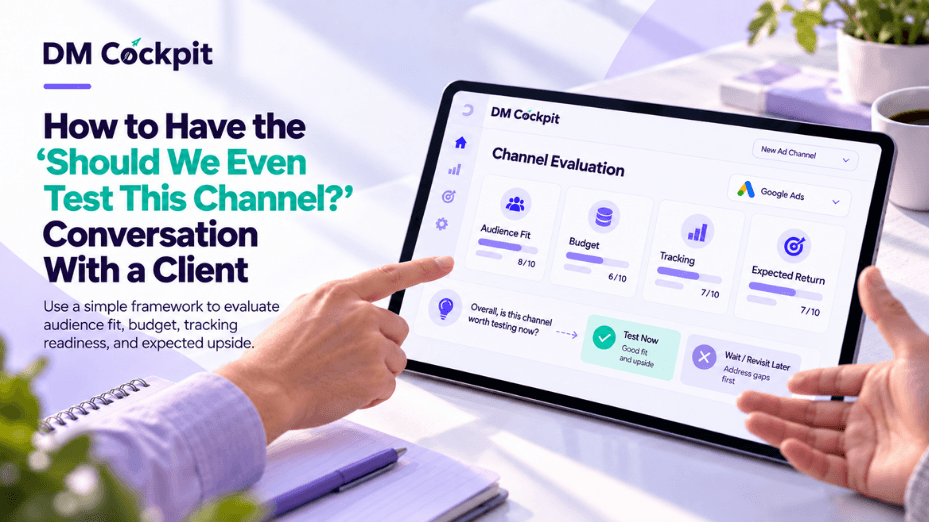
A client sees competitors talking about a new advertising platform. A founder hears about it on a podcast. Someone sends a screenshot to the marketing group chat with the inevitable question:
“Should we be advertising here too?”
The challenging part for an agency is not finding a new platform, it is finding the right one. It is determining whether to allocate their client's time, money, and manpower to the opportunity. That's why evaluating new ad channels for clients should begin with a conversation about the business, not a campaign setup screen.
The goal is not to be first everywhere. It is to know when a channel has earned the right to be tested.
Start With “Why This Channel?”
Find out why the client wants to discuss targeting, creative or campaign structure before discussing it.
The difference is:
- “Our customers are starting to use this platform.”
- “A competitor has started advertising there.”
- “Everyone seems to be talking about it.”
- “Our CEO wants us on it.”
- “Our current channels are getting harder to scale.”
Only some of these are strong reasons to test.
A useful response is:
“We can explore it, but first let's establish what this channel could add that our current mix doesn't.”
That changes the conversation. You are examining a marketing issue and you are looking at the possibility of solving it with this.
The Five Questions to Put on the Table
Agencies must have a method to assess new prospects that they are not familiar with. The first filter comes from these five questions:
1. Is the Client's Audience Actually There?
A large user base does not automatically equal a relevant audience.
Look for evidence around:
- user demographics
- geographic availability
- business versus consumer usage
- typical user behavior
- content or conversations happening around the client's category
What works for a B2B software firm is not necessarily the best for a direct-to-consumer fashion brand.
If there is no reasonable audience overlap, this is an important finding itself.
2. Does the Platform Support the Client's Objective?
Ask what the campaign would actually need to accomplish.
|
Client objective |
What the channel needs to support |
|
Awareness |
Useful reach and audience relevance |
|
Website traffic |
Clear paths from ad to site |
|
Lead generation |
Trackable actions and suitable targeting |
|
Sales |
Conversion journey that can be measured |
|
Retargeting |
Reliable audience and tracking capabilities |
|
Experimentation |
Enough reporting to learn from the test |
A channel can be fun to interact with but not effective for direct leads. This doesn't mean it's ineffective. It implies that the goal of the campaign needs to be aligned with what the platform is able to accomplish.
Ask What You Can Measure Before You Ask What You Can Launch
The question is particularly significant with new advertising media.
It is hard to fairly judge the effectiveness of a campaign when there is a lack of visibility into what comes next.
Set expectations on what the platform is reporting before suggesting a test.
Can you see:
- impressions?
- clicks or interactions?
- click-through rate?
- conversions?
- audience information?
- placement or creative performance?
- referral traffic?
- campaign-level trends?
Then look beyond the ad platform.
Can website analytics identify incoming traffic? Can landing-page actions be tracked? Can leads be connected back to a source with reasonable confidence?
Measurement need not be exact. However, the agency and the client should be aware of what the blind spots are prior to the campaign.
Separate “New” From “Useful”
New channels create urgency, because no one wants to feel "late".
This sense of urgency can skew decision-making.
Every digital marketing trends for 2026 we are looking at is evolving at a rapid pace. Areas like AI, conversational search, video commerce, retail media and new measurement approaches are all changing at a high speed.
However, a trend that is gaining in importance isn't immediately relevant for all clients.
When evaluating new ad channels for clients, classify the opportunity instead:
Relevant now: Audience fit, clear objective, sufficient measurement to warrant a controlled test.
Worth watching: User base is good, but targeting, reporting, availability and campaign capabilities are not quite as mature.
Low relevance: The platform does not seem to have a high degree of relevance to the client's audience and existing business objectives.
The term “Worth watching” is a valid recommendation. Not every new platform is a campaign. Not every new platform is a campaign for agencies.
Define the Test Before Asking for Approval
If a channel passes the first filters, do not propose an open experiment.
Define what the test is supposed to teach you.
For example:
“We want to find out whether this platform can generate qualified visits from this audience and whether those visitors complete our primary landing-page action.”
That is much clearer than:
“Let's run ads for a month and see what happens.”
A useful test plan should identify:
- One primary objective
What are you trying to learn? - The target audience
Who should see the campaign? - A defined testing window
When will you review the evidence? - A measurement plan
Which platform and website signals will you monitor? - A continuation rule
What grounds would justify the expansion, adjustment or discontinuance of the test?
It's not a test to determine whether the agency did the right thing to recommend the channel. Its aim is to collect sufficient evidence to arrive at a better next decision.
Don't Compare an Experiment With a Mature Campaign
This is an easy reporting mistake.
Go back to the last time a client has been running Google Ads for a number of years. The team is familiar with keywords, landing pages, conversion behavior, and creative, as well as historical benchmarks.
Now the agency tests a new advertising environment for the first time.
Comparing both channels after a few weeks as though they had equal maturity can produce a misleading answer.
The established channel has years of learning behind it. The experimental channel does not.
Early evaluation should therefore ask:
- Are we reaching the intended audience?
- Is the traffic behaving as expected?
- Are people engaging with the offer?
- Are tracking signals reliable?
- What did the first creative variations teach us?
- Is there enough evidence to justify another testing cycle?
Eventually, business outcomes matter. But early tests also need to tell you whether the channel has enough potential to keep learning.
What If the Client Still Says, “Our Competitors Are Already There”?
Competitor activity is evidence worth investigating, not an instruction to copy them.
You usually do not know:
- what their campaign objective is
- how well their ads perform
- how much emphasis they place on the channel
- whether the campaign is experimental
- what happens after users click
- whether they consider the campaign successful
Use the activity of competitors as a research signal.
Then bring it back to the client's audience, goals, measurement options and current channel mix.
Give Clients Three Answers, Not Just Yes or No
The strongest agency recommendation does not always need to be binary.
Try framing the decision as:
Test now: There is enough evidence and measurement capability for a controlled experiment.
Watch and prepare: The opportunity looks relevant, but one or more important pieces are not ready.
Not a priority right now: The channel does not currently solve a meaningful problem for this client.
This will provide a reasoned position to the client rather than reacting to hype.
It also allows for the recommendation to be revised as the platform evolves.
Make Channel Decisions Part of an Ongoing Process
Evaluating new ad channels for clients is becoming a recurring agency responsibility rather than an occasional strategy exercise.
But now it's not just about whether this platform is popular, it's also about whether it's useful.
It is:
Does it provide this specific client any real shot at a credible opportunity that can be tested, measured and learned?
Whether it's AI advertising, social, retail media, video, search, or a new platform that hasn't even been invented yet, that question will work.
Keep the Experiment Connected to the Bigger Picture
At DM Cockpit, we believe new channels are easier to evaluate when agencies can keep the rest of the client's marketing activity visible and organized. We bring core agency work such as SEO, ads, social activity, project workflows, and reporting into a connected client environment.
A new platform may deserve a test, or it may deserve another six months on the watchlist. Either way, we want agencies to make that decision from evidence rather than pressure to chase the newest thing.
Frequently Asked Questions
1. How should an agency decide whether to test a new advertising channel?
Start with audience fit, campaign objective, available targeting, measurement capability, and how the channel complements the client's existing marketing mix. A platform being new or popular is not enough on its own.
2. Should clients advertise on every platform their competitors use?
No. Competitor activity can justify further research, but it does not prove that the channel performs well. The decision should still be based on the client's own audience, objectives, and ability to measure meaningful results.
3. How long should a new advertising channel be tested?
There is no universal testing period. It depends on campaign volume, objective, sales cycle, available data, and the maturity of the platform. Agree on the review point and decision criteria before launching rather than choosing an arbitrary period afterward.
4. What should agencies measure on a new ad platform?
Begin with the metrics the platform reliably provides, then connect them with website and business outcomes where possible. Depending on the campaign, that may include impressions, clicks, engagement, landing-page activity, conversions, leads, or sales.
5. What if a new platform has limited reporting?
Be transparent about the measurement gap. Use available platform data alongside website analytics and clearly defined landing-page actions, but avoid claiming a level of attribution that the available data cannot support.
6. When should an agency recommend waiting instead of testing?
Waiting can make sense when audience fit is unclear, important advertising features are unavailable, measurement is too limited, or the channel does not address a current client objective. Monitoring the platform until those conditions change can be more useful than testing simply because it is receiving attention.