
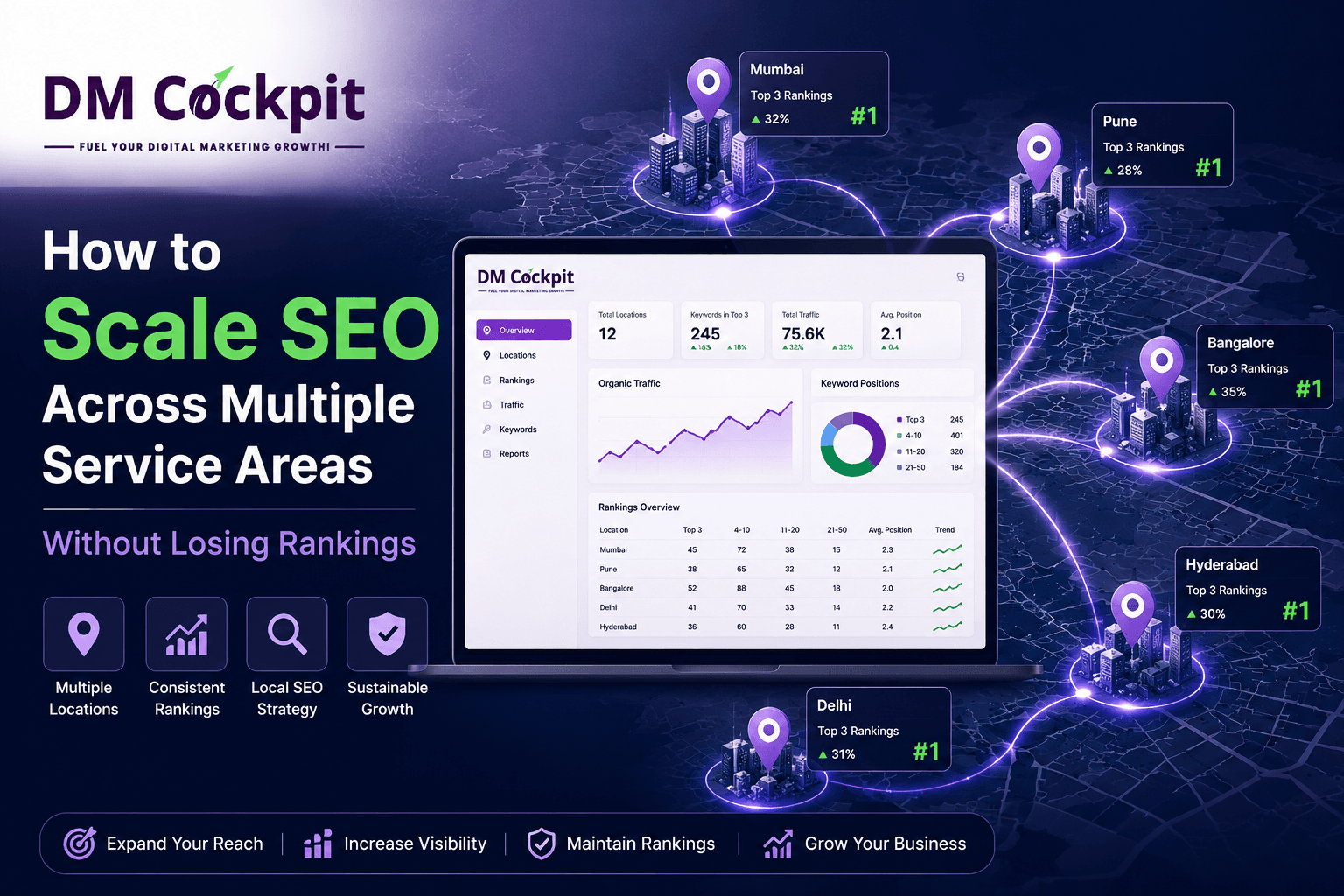
The Strategy That Got You Here Won't Get You There
There is a specific moment most growing businesses experience — and almost none of them see it coming.
Organic traffic is steady. Rankings for your core service keywords are holding. The phone rings from Google. The leads are real. The system is working.
And then, quietly, it stops growing.
Not because something broke. Not because Google penalized you. Not because competitors suddenly got better. The traffic is still there. The rankings are still there. But the ceiling is very clearly there too.
This is the SEO growth plateau — and it is one of the most misunderstood problems in digital marketing, because it feels like an SEO failure when it is actually a signal of SEO success.
You ranked where your current strategy could take you. Now your strategy is too small for where you want to go.
Why Businesses Stop Seeing SEO Growth
When a business first builds its SEO foundation, the goal is singular: get found by customers across your area for your core service. A focused strategy — one location, one set of keywords, consistent content, steady link building — is exactly right for that stage.
But growth changes the equation.
A business that ranks well across one area starts receiving inquiries it cannot fulfill. Or starts operating across a second area it cannot rank for. Or adds new service lines that customers are actively searching but the website does not mention. Or watches a competitor enter the market and immediately begin capturing search volume across multiple locations.
The ceiling is not Google's limit. It is the limit of a strategy built for a smaller version of the business. The most common ceiling-causing constraints are predictable:
- A single targeted location captures only the searches across that geography — every customer outside it is invisible to you.
- A limited keyword set covers your core services but misses adjacent searches your customers make before they are ready to buy.
- Thin content across a small number of pages limits your topical authority, making it harder to rank for competitive terms.
- Basic AI visibility becomes insufficient as AI-generated answers increasingly direct buyer decisions across complex queries.
None of these constraints are permanent. All of them are solvable. But they require a different system — not a bigger version of the same one.
The Growth Gap Most Businesses Never Notice
Here is what makes the SEO ceiling particularly costly: the opportunity exists. The searches are happening. The customers are there. They are simply finding someone else — not because that business earned the ranking, but because your website has not been built to appear for those queries yet.
Consider a business that ranks confidently across Pune for its core service. Every month, customers across Pimpri-Chinchwad, Wakad, Baner, and Kothrud search for the same service. Some of them would prefer a provider specifically near Pune. Many would work with anyone credible across the broader area. All of them search. None of them find you — because your SEO strategy addresses one geography and these are different ones.
Or consider a business that ranks for its primary service keyword but has never built content around the questions its customers ask before they are ready to buy. The customer who searches "how to choose an SEO agency" today becomes a buyer next week. The business that helped them understand the answer is the one they trust when they are ready to act. If your website is not present during the research phase, you are not in the consideration set when the purchase decision happens.
The gap between where your current visibility ends and where your potential customers' searches begin represents more monthly search volume than your existing rankings currently capture.
The DM Cockpit Growth Plan: Built for Businesses Ready to Scale
Starter SEO solves the visibility problem. It answers the question: can customers find me at all?
Growth SEO solves the expansion problem. It answers the question: how do I capture the demand I am currently invisible to?
These are not the same question. They require different strategies, different resources, and different infrastructure.
The DM Cockpit Growth Plan is the managed SEO system for businesses that have established their foundation and are ready to expand their market reach. At ₹9,999 per month with no long-term contracts, it is built for the specific stage where a starter strategy has proven itself and the next constraint is the size of the system.
The Expansion Matrix: Starter vs. Growth
|
Strategic Element |
Starter Plan |
Growth Plan |
The Expansion Impact |
|
Primary Keywords |
20 |
40 |
Captures early-research and adjacent service buyers. |
|
Tracked Keywords |
50 |
100 |
Maps the full competitive multi-market landscape. |
|
Target Locations |
1 |
2 |
Opens a complete secondary geographic revenue stream. |
|
Authority Blogs |
4 / Month |
6 / Month |
Accelerates topical authority and long-tail traffic. |
|
External Links |
4 / Month |
6 / Month |
Builds the multi-geography trust Google requires. |
|
AEO Implementation |
Basic |
Advanced |
Optimizes for conversational queries in ChatGPT & Gemini. |
|
Campaign Leadership |
Standard Oversight |
Dedicated Multi-Location Strategist |
Prevents cannibalization and scaling errors. |
Every increase is deliberate. Each number represents a specific expansion in market reach.
The Challenge of Expanding Into Multiple Locations
Scaling into a second location and doubling your keyword count introduces a massive technical risk: Self-Cannibalization. If you simply throw more pages and keywords at a website without a strict architecture, your pages will start competing against each other, confusing Google and dropping your existing rankings.
Most businesses don't lose rankings because Google changes its algorithm. They lose rankings because expansion is executed incorrectly.
This is why the Growth Plan doesn't just hand you software—it provides a Dedicated SEO Manager.
Software tracks data, but an expert human strategist orchestrates the collision of multiple service lines across multiple geographies. Your manager ensures that your Pune landing pages do not cannibalize your Pimpri-Chinchwad landing pages. They guide the content architecture. They oversee the technical routing.
You are hiring an accountable expert who navigates the complexities of multi-market scaling while you focus on running your expanding operations. Here is exactly how they execute this expansion.
Expansion Starts With Search Demand
The Growth Plan's keyword expansion from 20 to 40 Primary Keywords is not simply a larger list. It is a systematically broader map of how your customers search across their entire buying journey.
Where a starter keyword strategy focuses entirely on high-intent purchase terms, a growth keyword strategy layers in the full demand landscape:
- Research-phase queries bring in customers earlier in their decision process.
- Adjacent service keywords capture customers who need a related offering they did not initially associate with your business.
- Comparison queries capture buyers actively evaluating their choices.
- Geographic variants across your expanded service areas map the demand that currently exists across markets your visibility does not reach.
Intent mapping ensures every keyword is matched to the right page — so research queries land on educational content that builds trust, and purchase-ready queries land on service pages that convert. With 100 keywords tracked daily in your live dashboard, you see exactly where momentum is building and where competitive pressure is increasing in real time.
Why Multiple Locations Need More Than Copy-Paste Pages
The most common multi-location SEO mistake is also the most understandable one. A business that ranks across one city assumes that creating the same service page for a second city — same content, different location name — will produce the same results.
It rarely does. Google easily detects thin, duplicated location pages. Genuine location authority is built from signals that tell Google your business has real relevance to a specific geography, not just a page that mentions the city name.
The Growth Plan's 2 Targeted Service Locations approach treats your second location as a distinct SEO entity:
- Unique, locally relevant content mapping for the new geographic area.
- Local Schema markup establishing the precise service area boundaries.
- Individual Google Business Profile optimization for the new location's presence.
- Expanded local citation building across directories that matter for that specific geography.
The result is not a website that claims to serve two areas. It is a website that Google recognizes as genuinely relevant and trustworthy across two distinct geographies.
Building Topical Authority Faster
Authority in any subject is built through depth and breadth of coverage. A website with one strong article on a topic is credible. A website with twelve interconnected articles covering every angle of a topic becomes the reference point.
6 authority blogs per month accelerates this authority building. The structured topic cluster approach — grouping articles around central themes with deliberate internal linking — builds topical depth that signals to Google your website is a comprehensive authority on your subject.
The real power of content is the compounding effect of consistent publishing. Content that begins attracting visibility today can continue building authority and traffic for months or years. Each new article expands the number of searches your business can potentially appear for, creating a visibility footprint that compounds month after month.
Unlike a paid ad that produces traffic only while the budget is active, every piece of content becomes a permanent traffic asset. A competitor who starts six months after you is six months behind.
The AI Search Advantage Is Growing
In competitive markets, market share is no longer won on Google alone. While your competitors optimize solely for traditional search, AI answer engines are quietly creating a second search ecosystem.
Advanced AEO (Answer Engine Optimization) implementation at the Growth Plan level goes significantly beyond foundational schema markup. It includes optimization for conversational search — the way queries are phrased when typed into ChatGPT, Gemini, or Perplexity rather than a traditional search bar. Conversational queries are longer, more specific, and asked by buyers who are closer to a decision.
Expanded AI search tracking monitors your business's appearance across the major AI answer engines. The businesses investing in advanced AI visibility today are building a lead that compounds. The businesses waiting are ceding ground to competitors who are not.
Building Market Trust at Scale
Authority is not built to a threshold and then maintained. It is built continuously, because the competitive landscape is building continuously.
6 article submissions per month across two target geographies means more contextual backlinks and faster accumulation of external authority signals. Combined with expanded local citation building for the second target location, this off-page program builds a trust profile that reflects the scale of a business operating across multiple markets — not just a local provider with a single area presence.
Expansion Never Happens In Isolation
While you are deciding whether to enter a second market, competitors are already building visibility there.
Search engines do not hold spaces open. Every day you wait to optimize for a secondary location or an adjacent service line is another day a competitor establishes topical authority, earns backlinks, and captures the local map pack.
The businesses that dominate multiple service areas do not wait until they have saturated their first market entirely; they begin planting flags in their next market early, so the compounding effects of SEO are already maturing by the time they are ready to scale operations.
The Economics Of Expansion
The most important question about scaling SEO is not whether a second location will rank. It is the Opportunity Cost of remaining single-threaded.
Consider the reality of market share:
- A business visible across 1 location captures a fixed pool of searches.
- A competitor visible across 2 locations captures double the geographic demand.
Who gets more inquiries? Who has the pricing power? Who ultimately becomes the category leader?
The second location already has demand. Customers are actively searching. The question isn't: Will people search? The question is: Will they find you or your competitor?
|
Current State (Starter) |
Scaled State (Growth Plan) |
The Expansion Reality |
|
Visible across 1 Geography |
Visible across 2 Geographies |
Unlocks an entirely new market. |
|
20 Core Service Terms |
40 Buyer-Journey Terms |
Captures buyers earlier in the funnel. |
|
Basic AI Tracking |
Advanced Conversational AEO |
Secures future market share. |
|
₹4,999 / Month |
₹9,999 / Month |
Costs less than the revenue of 1 lost customer. |
The Growth Plan costs ₹5,000 more per month than the Starter Plan. It does not need to double your business to justify itself. It needs to unlock the demand in your second service area that you are currently invisible to — and deliver enough additional customers each month that the incremental cost is covered many times over.
Signs Your Business Is Ready for the Growth Plan
The Growth Plan is not for every business at every stage. It is the right choice when specific conditions exist:
- You are already ranking across one location and receiving consistent organic leads (the foundation is proven; the constraint is scale).
- You are operating in or actively expanding into a second service area.
- Your traffic has plateaued despite consistent SEO activity because you have captured most of the available demand within your current keyword scope.
- You are adding new service lines that customers are actively searching for.
If any of these describe your situation, the Growth Plan is the logical next stage.
Frequently Asked Questions
1. When should I upgrade from the Starter Plan to the Growth Plan?
When your Starter Plan rankings are stable and generating leads, but growth has plateaued — or when you are actively expanding into a second service area. The Starter Plan builds a foundation; the Growth Plan expands it.
2. Is multi-location SEO significantly harder than single-location SEO?
It requires more resources and a stricter architecture to prevent pages from competing with each other. The key difference is that each location must be treated as a distinct SEO entity — with its own intent mapping, content signals, and local authority building — rather than a copy of the first location. Your dedicated manager handles this complexity.
3. How long does multi-location SEO take to show results?
The second location typically begins showing ranking movement within the same 6 to 10 week window as a new campaign for lower-competition local terms. Competitive market positions in the second geography typically take 3 to 5 months for meaningful traffic.
4. What makes the Growth Plan different from simply adding more keywords?
Keywords alone do not create multi-location authority. A Growth campaign adds location-specific content strategy, second-location Google Business Profile optimization, expanded citations for the new geography, advanced AEO implementation, and a dedicated manager to oversee the architecture.
The Systems Built Today Determine the Rankings of Tomorrow
The demand already exists.
The searches are already happening.
The customers are already looking.
The only variable is whether they find your business or someone else's.
You have already built the business. Now build the system that helps customers across every location find it.