
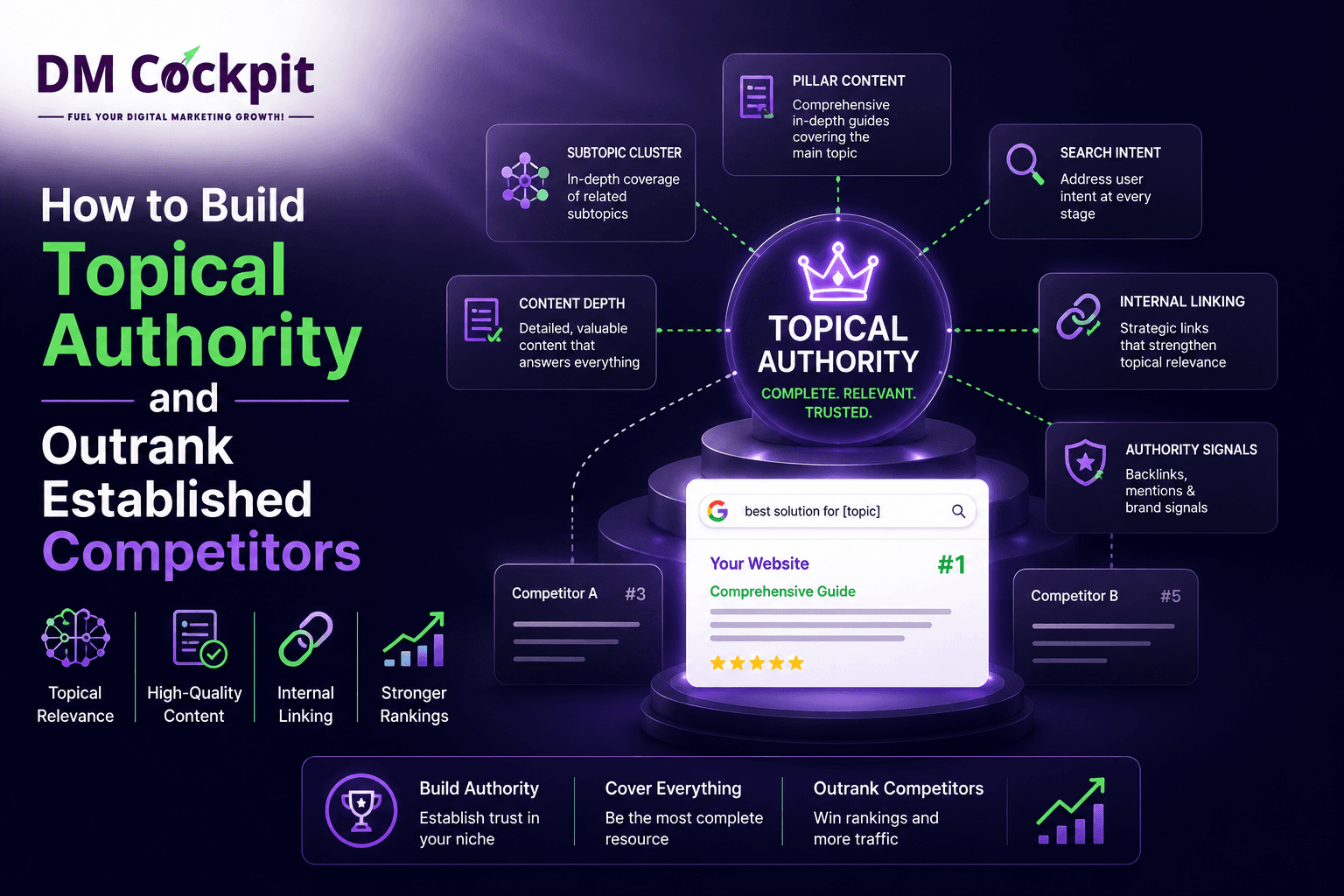
Why Visibility Alone Eventually Stops Working
There is a second ceiling most businesses never anticipate. It only appears after the first one is broken.
You were invisible. You fixed it. Rankings came. Leads arrived. The system worked.
But now, growth has slowed. Rankings fluctuate. Certain page-one positions belong to the same massive competitors month after month, regardless of what you publish. And when customers ask ChatGPT for recommendations, the businesses cited are not yours.
You are visible. But in highly competitive searches, you are not winning.
This is the authority ceiling. It separates businesses that rank from businesses that dominate.
Visibility gets you into the race. Authority wins it.
The Authority Gap Most Businesses Never See
Imagine two businesses targeting the same keyword.
Business A has been doing SEO for eighteen months. Fifty blogs published. A hundred backlinks built. Rankings are decent for moderate terms, but they struggle with highly competitive keywords.
Business B has been doing SEO for four years. Three hundred pieces of content covering every angle of their industry. A thousand backlinks from authoritative sources. Content repeatedly cited in AI-generated answers. Google treats their website as the definitive reference point for their category.
Both target the same keyword. Business B wins easily.
Not because their service is better. Because over time they built something Business A lacks: authority.
Authority is the accumulated sum of trust signals telling Google: this business knows its subject completely, is referenced credibly by the wider web, and is the most reliable source to recommend.
Why Google Trusts Some Businesses More Than Others
Google’s purpose is simple: give users the most reliable answer to their query.
Google applies an evaluation framework—internally known as EEAT (Experience, Expertise, Authoritativeness, and Trustworthiness)—that goes far beyond simply counting keywords.
- Depth of Knowledge: Do you cover your topic comprehensively?
- External Credibility: Do respected sources link to you?
- Consistency: Does every page demonstrate genuine expertise?
This explains why older, larger competitors rank above you, even if your newest blog post is technically better. They have accumulated more proof over a longer timeline.
To break this ceiling, you cannot just outspend them for a month. You must out-build their authority consistently.
The DM Cockpit Advanced Plan: Built for Competitive Markets
The Starter Plan solves visibility. The Growth Plan solves expansion. The Advanced Plan solves authority.
At ₹14,999 per month (no long-term contracts), this is the managed SEO system for businesses ready to own the most valuable positions in their market.
The Authority Engine
|
Authority Pillar |
Advanced Plan |
|
Search Intent Coverage |
60 Primary Keywords |
|
Content Authority |
8 Blogs Monthly |
|
External Trust |
8 Article Links Monthly |
|
AI Authority |
Full AEO Implementation |
|
Regional Authority |
3 Service Locations |
|
Competitive Intelligence |
Strategic Monitoring |
Here is how your dedicated SEO manager executes this engine to break through the competitive ceiling.
1. Winning More Search Intent Than Your Competitors
Authority is built by owning an entire topic.
The Advanced Plan's 60 Primary Keywords represent a deliberate expansion across the full spectrum of customer search intent. We target research-phase queries, comparison searches, and high-value transactional terms (like "teeth straightening cost near Pune").
When your website covers all intent categories, you own the entire buying journey. By the time the customer is ready to buy, they aren't evaluating you against a competitor. They already trust you.
2. Becoming the Most Comprehensive Resource
Google rewards websites that act as complete content ecosystems.
8 authority blogs per month are structured within a deliberate topic cluster framework. We build pillar content that establishes deep authority, supported by connecting articles that answer every adjacent question your buyers ask.
Over twelve months, that is 96 pieces of strategically structured content. Competitors cannot outrank what they cannot match. And matching a well-built content ecosystem takes years.
3. Building Authority That Cannot Be Replicated Quickly
If content is the depth of your authority, backlinks are the width of it.
In competitive markets, a link from a respected industry publication carries dramatically more weight than a dozen cheap directory submissions. 8 article submissions per month are targeted at higher-authority placements where contextual relevance reinforces your topical authority.
A business that earns eight quality backlinks per month builds a trust profile that took competitors years to accumulate.
4. Why AI Search Rewards Authority
Traditional search ranking is an auction. Multiple businesses compete for page one.
AI search works differently. When a customer asks ChatGPT or Gemini for a recommendation, it selects one or two sources it considers most reliable. In AI search, moderate authority earns no position at all. You are either cited as the expert, or you are invisible.
Full AEO (Answer Engine Optimization) implementation ensures your site is ready for the AI era. We deploy comprehensive schema markup, optimize for conversational search queries, and actively monitor your brand's visibility across major AI answer engines.
5. Multi-Location Authority at Scale
At this stage, 3 targeted service locations represent a genuine multi-market authority presence.
Each location is treated as an independent authority-building program. Individual keyword mapping, specific local content signals, and distinct Google Business Profile optimization are deployed for all three areas. This signals to Google that your business is a highly credible regional operator, matching the geographic signals of national chains.
The Economics of Authority
The business with strong topical authority does not simply rank higher. It spends less to acquire each customer.
The Authority Valuation Matrix
|
Business Dimension |
Weak Authority |
Strong Authority |
|
Search Position |
Competes for rankings |
Owns rankings |
|
Competitive Position |
Fights for visibility |
Becomes the competitor to beat |
|
AI Search Presence |
Absent or inconsistent |
Cited as the reference |
|
Customer Trust |
Earned at contact |
Established before contact |
|
Long-Term Cost |
Rises with competition |
Falls as authority compounds |
The investment in the Advanced Plan at ₹14,999 per month is the cost of building a market position that compounds in value every single month.
Signs Your Business Is Ready for the Advanced Plan
The Advanced Plan is for businesses at a specific stage:
- You already generate leads through SEO, but competitive page-one positions remain consistently out of reach.
- You operate across multiple locations and need to be recognized as the definitive regional leader.
- You are in an industry where established competitors have years of content history, requiring a systematic program to close the gap.
- You want to capture market share in AI search (ChatGPT, Gemini) before your competitors do.
Frequently Asked Questions
1. What Is Topical Authority in SEO?
Topical authority is the level of expertise and trust your website demonstrates on a specific subject. Search engines and AI platforms are more likely to recommend businesses that consistently publish high-quality, relevant content covering a topic in depth.
2. What Is the Difference Between Domain Authority and Topical Authority?
Domain authority refers to the overall strength and credibility of a website, often influenced by factors such as backlinks and site reputation. Topical authority focuses on how well a website covers and demonstrates expertise in a specific subject area. A website can have strong topical authority in a niche even if its overall domain authority is lower than larger competitors.
3. Why do rankings fluctuate in competitive industries?
When multiple websites compete for the same positions and all have good technical health, Google continuously re-evaluates relative authority signals. The businesses with the deepest, most consistent authority signals experience the least fluctuation.
4. How many blogs does it actually take to build authority?
It depends on your competitors. However, eight monthly blogs within a structured topic cluster framework builds comprehensive coverage faster than unstructured publishing at any volume.
5. Can a smaller business outrank an established competitor?
Yes. Larger businesses often have fragmented content strategies and outdated pages. A smaller business with a highly systematic, consistent authority-building program frequently outranks them within 12 to 18 months in specific keyword clusters.
Visibility Gets You Found. Authority Makes You the Leader.
You have already proven your business can rank. You have expanded your visibility. The growth is real.
The next stage is building the depth of trust—in Google, in AI systems, and in the minds of customers—that turns a growing business into the one its competitors are trying to catch.