
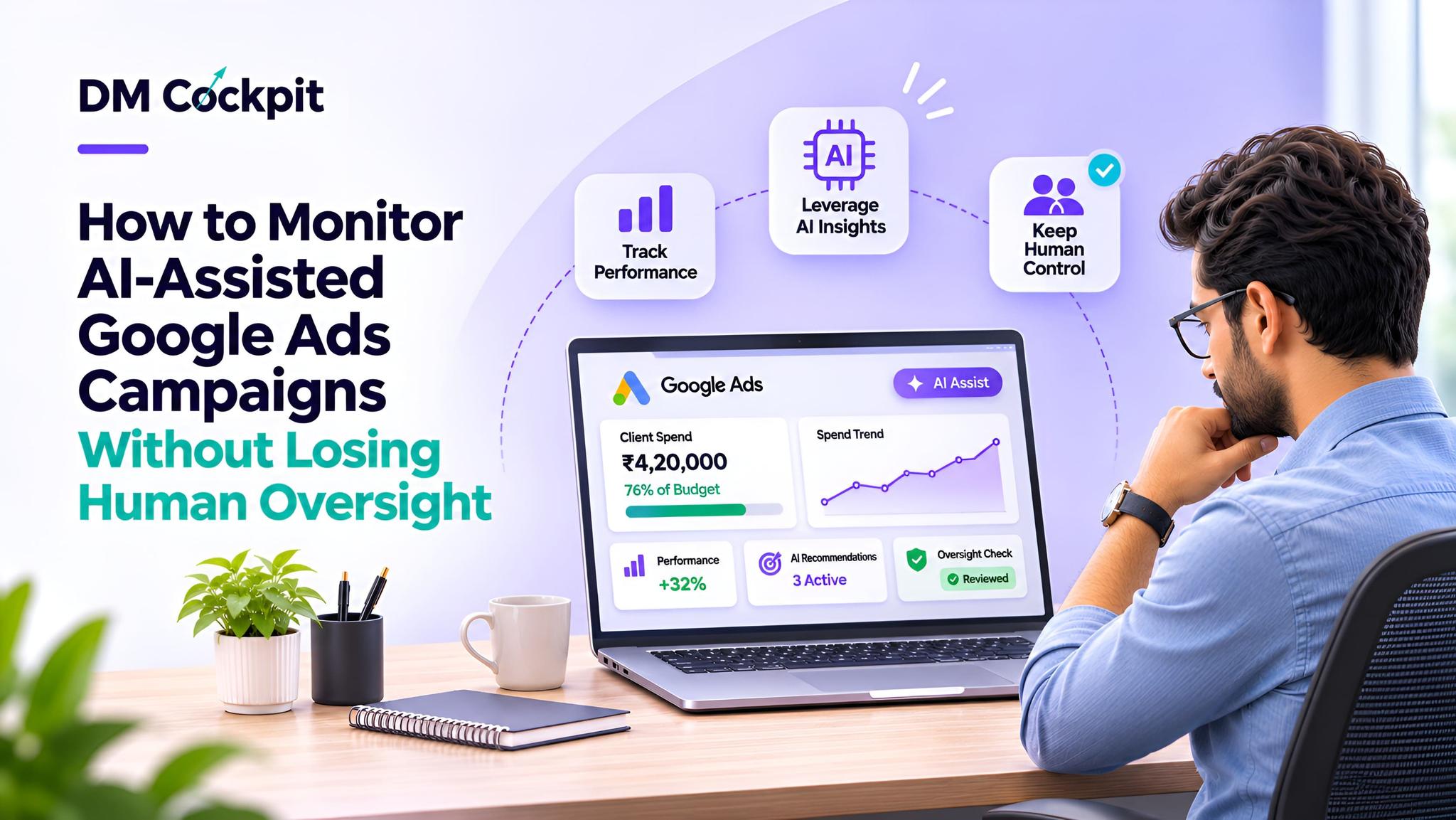
An agency account manager can now make thousands of automated decisions while they are busy checking out other campaigns. Bids are adjusted, ads are optimised, and combinations are decided without having to go through every change in the bids.
Sounds easy, doesn’t it?
But when automated campaigns get clicks and miss the mark on the right customers, there’s an important question: who remains accountable?
For agencies learning to monitor AI Google Ads campaigns, the challenge is balancing automated optimisation with human judgement.
AI can support campaign delivery, but marketers still need to establish objectives, review results and ensure advertising decisions align with client expectations.
Understanding Where AI Operates in Google Ads
Google Ads automates targeting, bidding and optimisation of your creatives, campaign delivery, and so much more. The extent of automation is customised based on the type of campaign and the features enabled.
|
Google Ads feature |
Role of automation |
Agency responsibility |
|
Adjusts bids using auction-time signals |
Review conversion goals and outcomes |
|
|
Optimises delivery across eligible Google channels |
Examine campaign and channel performance |
|
|
AI Max for Search |
Expands search matching and supports creative optimisation |
Review search relevance and campaign controls |
|
Broad Match |
Matches advertisements with a wider range of relevant searches |
Monitor search terms and lead quality |
|
Help generate advertising assets |
Check accuracy and brand consistency |
These properties allow for some manual adjustments to be eliminated. But they don't remove strategic responsibilities.
An automated campaign could potentially lead to an increase in enquiries, but not necessarily customers who are appropriate for the client's line of work.
Human oversight addresses this gap.
Five Decisions Agencies Should Never Leave Entirely to Automation
Agencies shouldn't bother with deciphering all of the automated adjustments as they should concentrate on the ones that have an impact on business results.
1. Define What a Valuable Conversion Means
AI-powered bidding works towards the conversion goals configured within Google Ads.
What if those objectives are not aligned with business priorities, though?
Let's take a real estate company marketing top-tier residential units. Many enquiry forms are generated from the campaign, but sales teams find many prospects are looking for rental accommodation.
The advertising platform may be optimising towards recorded enquiries, even though those enquiries have limited commercial relevance.
Agencies should review:
- Primary conversion actions and their definitions.
- Lead quality reported by sales teams.
- Duplicate or irrelevant enquiries.
- Whether conversion goals match current objectives.
More accurate conversion tracking signals enable agencies to gauge if automation is achieving meaningful results.
2. Keep Campaign Allocation Connected to Business Priorities
Automated bidding can bid on ads but agencies are still responsible for broader budget allocation decisions.
For instance, an education company may market a number of courses at the same time.
One course receives more enquiries and another receives fewer, but better-qualified.
It may be possible to focus further efforts on the campaign that has the most enquiries, but this may not reflect what the client is interested in.
Discuss expenditure patterns, quality and campaign aims prior to making recommendations.
3. Review AI-Generated Advertising Messages
Headlines and descriptions as well as other advertising materials can be created or tailored with the assistance of AI-powered creative capabilities.
But sometimes, messaging created requires correction.
When evaluating advertisements, an agency should check to see if they:
- Accurately describe the product or service.
- Adhere to approved brand guidelines.
- Avoid unsupported claims
- Communicate relevant benefits.
- Direct visitors towards appropriate landing pages.
Some automated features can also influence landing-page selection. Agencies should therefore understand the controls available within their selected campaign types.
When clients have specific message needs, human approval is crucial.
4. Monitor Search Relevance and Audience Quality
An uptick in traffic doesn't necessarily equal better prospects.
Let's say a B2B software company gets students looking into marketing tools rather than businesses looking to buy software.
The campaign may seem to be successful in terms of clicks and enquiries, but it may not be very successful in generating sales opportunities.
Agencies should review the search-term reporting, search-term insights, campaign performance and CRM feedback.
Negative keywords, brand settings and other supported controls can help to improve the relevance of advertising if they are available.
The goal isn't to unduly limit automation. The reason for all of this is to avoid a lack of context for irrelevant activity to be interpreted as commercial progress.
5. Protect Conversion Tracking Accuracy
The quality of the signals Google Ads has to work with is crucial to automated optimisation.
Wrongly set up conversion actions, duplicate events, or missing tracking data can impact reported results and campaign decisions.
For instance, if one enquiry appears several times it could be seen that the performance is greater than the performance in the actual business outcome.
Agencies should periodically check conversions in ads against related website data and business records.
Accurate measurement is crucial for effective automation accountability.
Build a Monitoring Routine Without Constant Interference
It's also essential to understand when to use observation as more effective than taking action as part of knowing how to monitor AI Google Ads campaigns.
A planned review schedule may enable agencies to stay informed without responding to each brief fluctuation in the market.
|
Review frequency |
What to examine |
|
Daily |
Delivery issues, significant alerts and unusual activity |
|
Weekly |
Conversion trends, search relevance and lead quality |
|
Fortnightly |
Creative performance, campaign insights and emerging patterns |
|
Monthly |
Business outcomes, strategic priorities and client feedback |
These intervals are not set schedules but are guidelines.
If you have a campaign where you don't have a lot of conversion data, then it might take a while before you evaluate it, but if you are having a serious tracking or delivery issue, then that should be investigated immediately.
Automated performance can be difficult to interpret if the changes are too frequent and not backed by evidence.
When Should Agencies Intervene?
Before making any changes to the settings of the campaign, ask yourself three questions.
Is the issue persistent?
One bad day is not conclusive. Make meaningful comparisons over a period of time.
Does the issue affect business outcomes?
It is not as important that impressions are lower for a certain period, as it is that the number of irrelevant enquiries is higher.
Is there a clear corrective action?
Correcting inaccurate conversion tracking addresses a measurement problem, unlike repeatedly changing bidding targets in response to daily fluctuations.
Google Ads also offers reporting tools to assist agencies in exploring performance shifts, such as campaign insights, asset reports and explanations.
Use these findings to make decisions, not assume changes.
What Should Clients See in an AI Campaign Report?
Clients don't necessarily require a comprehensive explanation of all automatic bidding decisions.
They should know what the situation is, if the campaign is going to help their goals and what the agency suggests they do next.
A good report will convey:
- Performance: Impactful conversion and campaign performance changes.
- Quality: If the prospect is not relevant to the ad, it's not quality.
- Oversight: Key areas in which the agency has performed checks.
- Next steps: Actions recommended and their intended purpose.
Record key campaign changes and approvals that show where there was input from human judgement.
Keep AI Efficient and Marketing Decisions Accountable
Advertising that's driven by AI makes the most sense when it's part of a company's goals and when marketers still check its results.
A key focus for agencies should be on quality of conversion, relevant audience, accurate measurement and transparency in reporting – not trying to influence every automated adjustment.
At DM Cockpit, we know how difficult it can be to stay on top of advertising performance for multiple client accounts. Agencies will benefit from reporting and campaign monitoring capabilities that are all integrated into one place via our digital marketing platform, keeping them organised and making informed decisions.
We don't feel automation should lead to replacing people making marketing decisions, as it should complement them.
Frequently Asked Questions
1. Can Google Ads AI manage campaigns without human involvement?
Google Ads can automate bidding, targeting and aspects of creative delivery. However, advertisers still need to establish objectives, review conversion quality, monitor campaign performance and ensure advertising messages remain appropriate.
2. What metrics should agencies monitor in AI-assisted Google Ads campaigns?
Important metrics include conversions, conversion rate, conversion value where applicable, spending trends and lead quality. Agencies should also review relevant search-term insights, creative performance and campaign delivery information.
3. How often should agencies review automated Google Ads campaigns?
Daily checks can identify urgent issues, while weekly or fortnightly reviews help agencies evaluate meaningful performance trends. The appropriate frequency depends on campaign activity, conversion volume and business priorities.
4. Does Performance Max provide visibility into automated campaign decisions?
Performance Max provides reporting features such as asset performance, channel performance, search-term information and campaign insights. However, these reports do not expose every individual automated decision.
5. When should agencies override automated campaign settings?
Intervention may be appropriate when conversion tracking is inaccurate, advertising messages are unsuitable, targeting produces irrelevant enquiries or sustained performance issues require correction. Changes should follow evidence rather than isolated fluctuations.
6. Can a marketing dashboard help agencies supervise AI-powered advertising?
Yes. A marketing dashboard can help teams review campaign metrics and identify performance changes across accounts. However, detailed campaign controls and certain diagnostic features remain within Google Ads itself.