
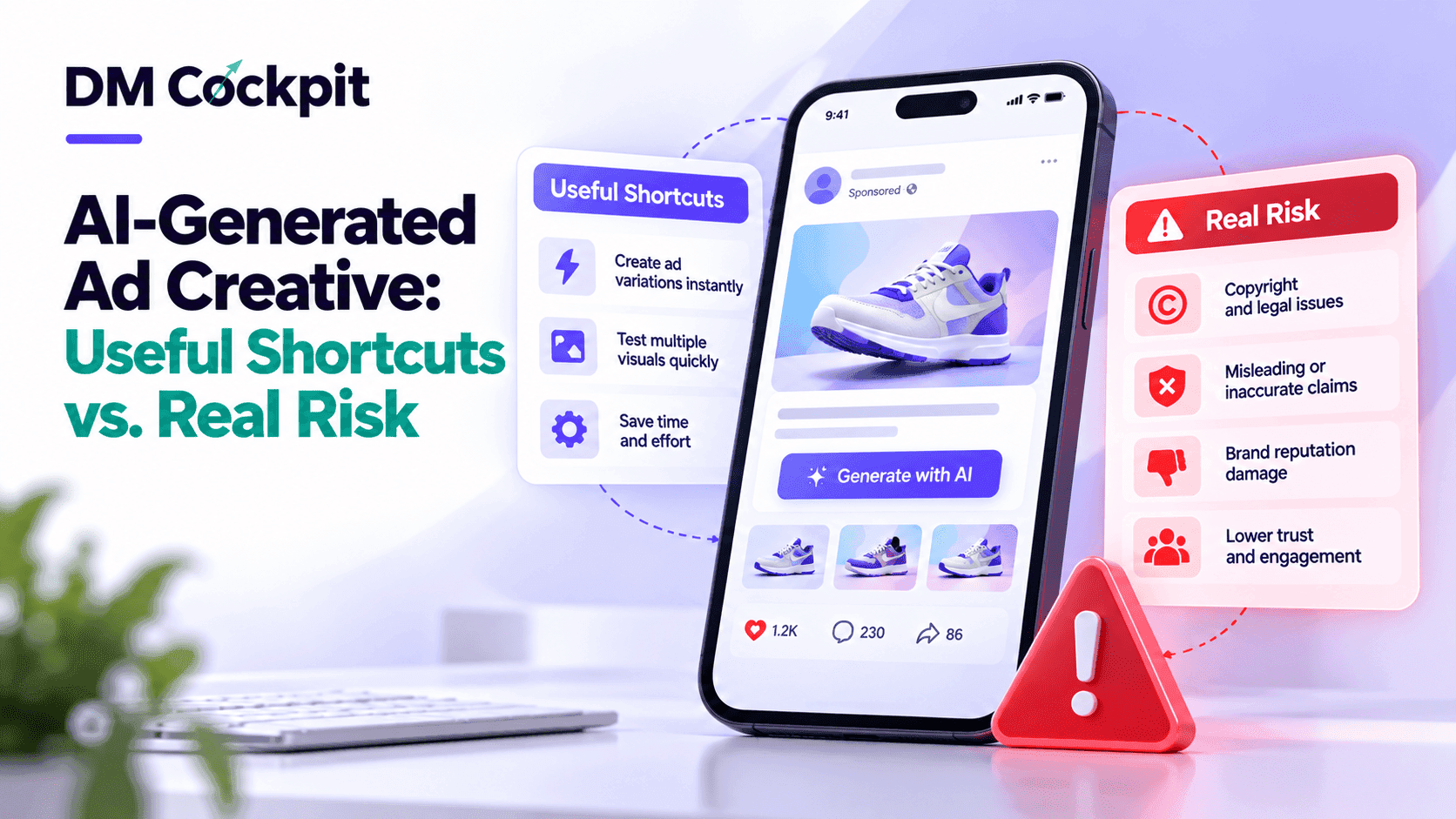
Creating and reviewing ten ad variations once required considerable time. Today, AI can assist a marketing team to create those variations in minutes. With not much effort at all, headlines, image concepts, product descriptions, and various versions of a message can all be produced.
Faster production also does not necessarily equal good advertising.
An AI-generated ad may be polished but not meet the expectations of the audience. Another may perform well initially but become less effective after repeated exposure. These are among the AI generated ad creative risks that agencies should take care of before scaling their advertising campaigns.
However, the real evaluation begins once the ads go live. Agencies must understand which changes to be alert for and which are working and when the creative is becoming ineffective.
Where AI Actually Saves Time in Ad Production
AI is best used when it is able to alleviate tedious tasks without replacing crucial business decisions for marketers.
When working with multiple campaigns it can make it easier for an agency to manage creative development.
Tasks where AI can help
- Headline variations: Create different messages for audiences.
- Ad copy drafts: Prepare preliminary ad copy for evaluation.
- Creative concepts: Investigate visual directions before designers have completed assets.
- Message adaptation: Make the same message fit various contexts and media.
- Testing ideas: Propose other calls to actions or product features that could be tested.
By using these shortcuts, creative teams have more time to review strategy, grasp the audience and develop the best ideas.
However, the “AI-generated” recommendations need to be vetted by a person before they are released.
The Risks Agencies Cannot Afford to Ignore
Not all issues pertaining to AI advertising are obvious right away.
Some problems occur at the creative review. Others only become apparent after campaigns launch.
|
Potential risk |
What it looks like |
Why it matters |
|
Generic messaging |
Different ads sound almost identical |
Audiences have little reason to notice the brand |
|
Inaccurate claims |
Copy includes unsupported promises |
Can damage trust or create compliance concerns |
|
Brand inconsistency |
Visuals or wording conflict with brand guidelines |
Weakens brand recognition |
|
Audience mismatch |
Messaging addresses the wrong needs |
Reduces relevance |
|
Creative repetition |
Multiple ads use nearly identical concepts |
Limits meaningful testing |
|
Creative fatigue |
Previously effective ads gradually lose impact |
Can reduce campaign efficiency |
The mistake is assuming that producing more creative variations will solve these problems.
In reality, additional variations may simply multiply the same weakness.
Creative Fatigue: The Problem That Appears After Launch
Suppose that an ad agency releases 6 different versions of an ad using AI for an online retailer.
One variation performs particularly well during the first week. The team increases its delivery and continues using it.
Over the following weeks, performance begins to change.
- The click-through rate declines.
- The same audience sees the creative repeatedly.
- Cost per desired action increases.
- Engagement becomes weaker despite continued delivery.
The reason for those changes could be creative fatigue, but there can be other variations in audience, competition, seasonality, and delivery conditions that can explain the same.
Creative fatigue happens when an advertisement loses its effectiveness to the same target audience due to repetition.
AI can help produce replacement variations quickly. However, those replacements are not guaranteed to perform better.
Hence, the necessity of creative production and campaign monitoring to go hand in hand.
How to distinguish fatigue from a weak creative concept
If a concept is not working very well, it may be a messaging and/or a relevancy issue.
If the ad that was performing well at first is starting to wane in performance, it may be suffering from ad fatigue.
Before replacing it, examine:
- How performance has been affected for some time or just for a while.
- Whether audience frequency has increased.
- Whether conversion performance has changed alongside engagement.
- Adjustments to targeting, placements or campaign configuration.
- If other creatives in the same campaign follow a similar trend.
These indicators, when combined, give agencies a more solid base to act upon in making changes.
What to Monitor Once AI-Generated Ads Are Live
The creative evaluation should relate to the goal of the campaign.
Click-through isn't the only indicator of whether an ad that drives traffic to a website produces leads. Likewise, a brand awareness campaign may require specific performance indicators which are different from those for a direct-response campaign.
Four useful monitoring signals
|
Metric |
What it reveals |
What agencies should investigate |
|
Click-through rate (CTR) |
How often impressions produce clicks |
Whether the message still attracts attention |
|
Frequency |
Average exposure per reached person |
Whether repeated exposure may be affecting response |
|
Conversion rate |
How effectively visitors complete a desired action |
Whether the creative attracts relevant traffic |
|
Cost per result |
Resources required to achieve the campaign objective |
Whether performance remains efficient |
No single metric proves that a creative has failed.
If the ad is still producing valuable conversions, for instance, despite a drop in CTR, it shouldn't be taken down.
Agencies should interpret these metrics in the context of campaign objectives.
For campaigns running on Meta, the DM Cockpit Meta Ads Monitoring Tool provides a relevant way to explore advertising performance monitoring.
For search and other eligible Google advertising campaigns, the DM Cockpit Google Ads Monitoring Tool is another relevant resource.
The purpose of monitoring is not to collect more numbers. It is important to be aware of the creative decisions that should be attended to.
A Practical Creative Review System for Agencies
It's not necessary for agencies to review all ads manually throughout the day.
They require a process that enables them to identify issues before reporting periods close, and helps them do this consistently.
A basic 3-step system can be used.
Stage 1: Review before publishing
Check whether the AI-generated creative:
- Matches the brand's established voice.
- Uses accurate product information.
- Makes claims the business can support.
- Meets relevant advertising policies.
- Communicates one clear message.
This is the stage that helps to ensure that unnecessary errors don't get to the customers.
Stage 2: Establish a performance baseline
Once launched, gather sufficient information to obtain initial performance understanding.
Where possible, compare creative variations using relevant metrics under similar campaign conditions.
Don't declare a winner if it is based on a small number of impressions or clicks.
Stage 3: Investigate meaningful changes
Look at trends and not daily fluctuations.
If results are low, ask yourself the following: Is the problem in the creative, the audience, the landing page, the campaign setup, or the external environment?
Next, determine if you will rephrase the message, test another concept or continue with the same message in the same campaign.
This allows for creativity generated by artificial intelligence to be easier to manage, without making small performance movements an emergency.
More Creative Variations Do Not Always Mean Better Testing
Suppose an agency creates 30 advertisements.
Twenty versions use nearly identical headlines. Another eight share the same visual concept. Only two introduce a genuinely different message.
The campaign has 30 assets, but might actually provide very little meaningful variation.
A more useful approach is to test different creative hypotheses.
For example:
- One concept emphasizes convenience.
- One is based on a particular customer issue.
- A third shows how the product functions.
- A fourth highlights a verified product benefit.
Each variation should answer a question about audience response.
While AI can speed up the production process, it is up to the marketer to determine what they want to learn.
When Human Judgment Matters Most
AI-generated content can be used to help with execution, but agencies are ultimately accountable for the decisions made in the advertising process.
Human review is especially critical when campaigns are related to sensitive concerns of customers, regulated industries, brand reputation or claims that must be verified.
Agencies should also not assume that more engaging creatives are more convincing.
A clickbait headline may get you clicks but won't necessarily draw in your customers.
Good creative evaluation is thinking in both short and long terms.
It's here where all your account manager, designer, copywriter and performance specialist can share information, not work alone.
The Better Approach: Produce Faster, Learn Continuously
The value of AI-generated advertising is not simply that agencies can publish more ads.
It's a matter of teams spending less time working out the routine variations, and more time figuring out what works.
That means there must be a distinction between creation and assessment.
The first is where AI can help. For the second, reliable campaign data and experienced marketers are still key.
For agencies managing AI generated ad creative risks, the key question isn't simply whether to use AI. It's whether the team has a process to review, measure, and improve its output.
At DM Cockpit, our monitoring tools provide visibility of marketing campaigns, so that marketing teams can monitor the performance of their marketing campaigns. We have a passion for making it easy to look at the facts of the campaign to make decisions on what the next creative step will be.
Frequently Asked Questions
1. What are the biggest risks of AI-generated ad creative?
The main risks include inaccurate claims, generic messaging, inconsistent branding, audience mismatch, and repetitive creative concepts. Agencies also need to monitor performance after launch because an initially successful advertisement can become less effective over time.
2. Can AI-generated advertisements experience creative fatigue?
Yes. AI-generated advertisements can experience creative fatigue just like human-created advertisements. Repeated audience exposure may reduce engagement or response. Agencies should examine frequency, click-through rates, conversions, and performance trends before deciding whether to refresh the creative.
3. How can agencies measure AI-generated ad performance?
Agencies can monitor metrics such as click-through rate, conversion rate, frequency, and cost per result. The most relevant measurements depend on campaign objectives. Comparing meaningful creative variations under similar conditions can also help teams understand which messages perform better.
4. Should agencies replace underperforming AI-generated ads immediately?
Not necessarily. A short-term decline may result from normal performance fluctuations, audience changes, or campaign conditions. Agencies should investigate the cause, review available data, and consider whether the creative has received sufficient exposure before making changes.
5. Is AI-generated ad creative suitable for every business?
AI can assist many businesses with drafting and testing advertising concepts, but its suitability depends on brand requirements, advertising policies, and the accuracy of the generated material. Businesses in sensitive or regulated sectors may require additional review before publishing.
6. How can digital marketing tools help manage AI-generated ads?
Advertising monitoring tools can help agencies organize and review campaign performance information. By tracking relevant metrics and identifying changes over time, marketers can decide when to investigate creative fatigue, test new messaging, or adjust their advertising strategy.