
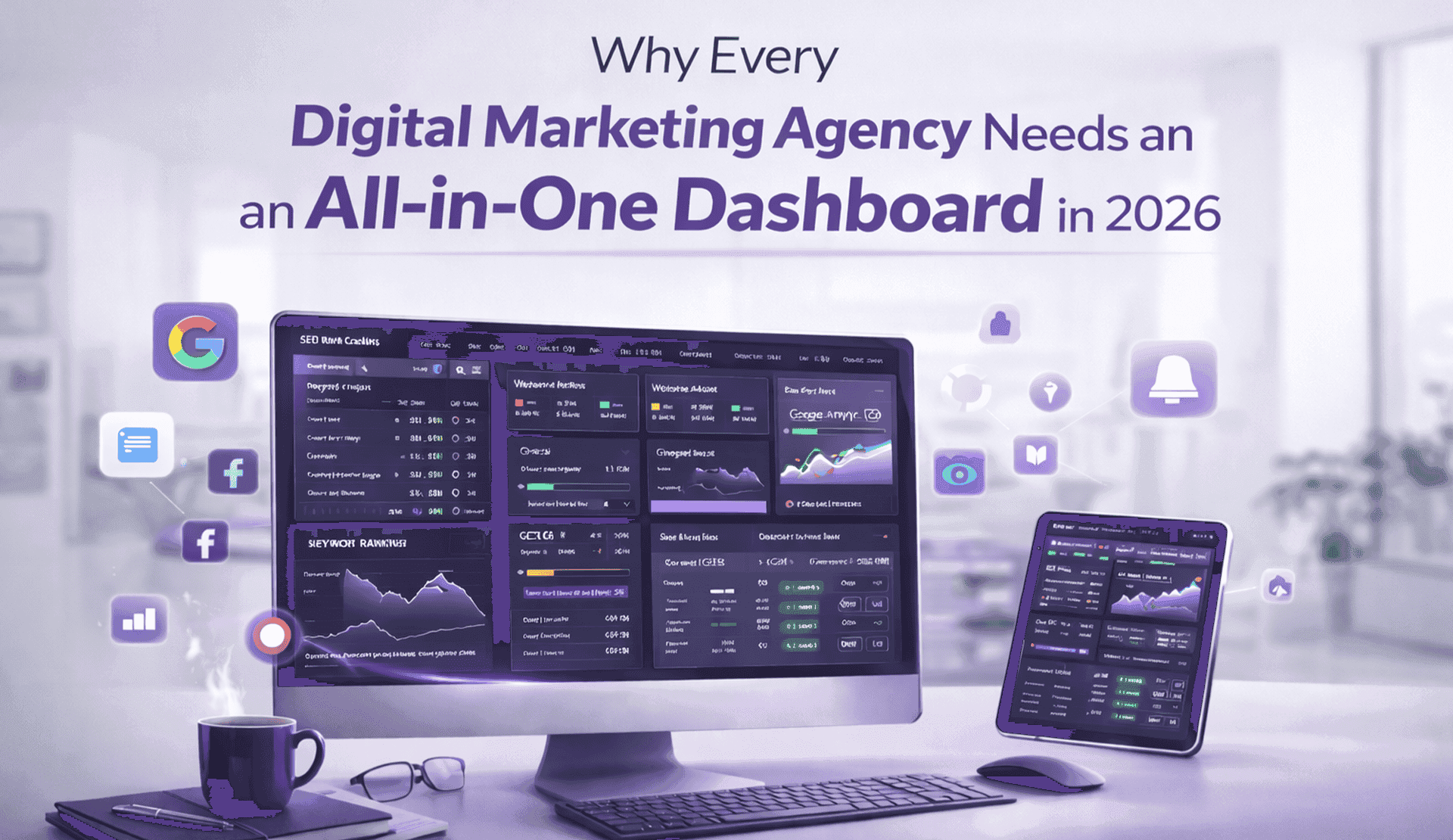
Running a digital marketing agency in 2026 without a centralised marketing dashboard tool is a bit like trying to navigate a city with fifteen different maps, each covering a different neighbourhood, printed in different scales, and updated at different times. You can probably get where you are going eventually. But you will miss turns, waste time, and arrive exhausted.
The agencies that are scaling efficiently right now have solved this problem. And the solution is not more tools. It is the right tool that brings everything together.
The Tool Sprawl Problem Is Worse Than You Think
Let us be honest about the state of agency tooling. Most agencies today run on a patchwork of subscriptions. There is one platform for keyword rank tracking, another for website audit reports, a separate login for Google Analytics, another for Google Ads, a different dashboard for Meta Ads, and yet another for scheduling social media posts. Some teams also maintain spreadsheets stitched together with formulas that only one person fully understands.
This is tool sprawl, and it creates real problems.
Reporting takes forever. Account managers spend hours each week pulling data from five different platforms and assembling it into a coherent client report. That is time that should be spent on strategy and execution, not data wrangling.
Client communication suffers. When a client asks how their campaign is performing, the honest answer is often "let me check a few things and get back to you." That delay erodes confidence.
Errors creep in. Manual data consolidation introduces the very real risk of mistakes, whether that is pulling the wrong date range, mixing up campaign metrics, or simply making a copy-paste error in a client's monthly report.
Team onboarding becomes complicated. Every new hire needs to learn multiple platforms, each with its own interface, terminology, and quirks.
What an All-in-One Marketing Platform Actually Solves
An all-in-one digital marketing dashboard addresses these pain points not by being a mediocre version of many tools, but by being an intelligent hub that connects your data sources, surfaces insights, and makes reporting and monitoring genuinely fast.
Here is what that looks like in practice.
Unified Rank Tracking
Keyword rank tracking is foundational for any SEO-focused agency. A centralised platform lets you monitor your clients' keyword positions across search engines, devices, and locations in real time. No switching tabs, no exporting CSVs, no reconciling data from different sources. When you can see all your client projects in one interface, spotting trends and anomalies becomes much faster.
Website Audit Integration
A good website audit tool embedded within your dashboard means you can detect technical SEO issues, duplicate content problems, broken links, page speed concerns, and crawl errors without leaving your workspace. More importantly, you can track those issues over time within the same environment where you are monitoring rankings and traffic, giving you a much clearer picture of cause and effect.
Google Analytics and Search Console in One View
Most agencies are already heavily invested in Google Analytics and Google Search Console as data sources. The problem is that accessing meaningful cross-channel insights requires jumping between these platforms and manually correlating data. An integrated dashboard that pulls directly from both sources within a single view drastically reduces the time it takes to answer questions like "which pages are driving the most organic conversions" or "where is our click-through rate dropping."
Ads Monitoring Without the Tab-Switching
Google Ads and Meta Ads monitoring is another area where tool consolidation pays dividends. Agencies managing PPC campaigns for multiple clients need to track spend, impressions, clicks, conversions, and ROAS across accounts. Doing this across separate Google Ads Manager and Meta Business Suite interfaces is time-consuming. A unified performance marketing dashboard that aggregates this data saves hours per week and improves the speed at which you can respond to underperforming campaigns.
Social Media Scheduling and Insights
Social media management is another area where fragmentation hurts productivity. Scheduling posts across Instagram, Facebook, and LinkedIn from a single interface, while also tracking post performance and audience engagement metrics in the same place, is a meaningful quality-of-life improvement for agency teams managing multiple client accounts.
The Reporting Advantage
Client reporting is where the ROI on an all-in-one marketing tool becomes most visible. Consider how long it takes your agency to produce a monthly performance report for one client. If the honest answer is more than two hours, you have a consolidation problem.
With a centralised dashboard, custom reports can be generated and shared with clients in a fraction of that time. Data from organic search, paid campaigns, social media, and technical SEO audits are all in one place. Automated report generation means clients receive consistent, professional updates without your team manually building a presentation from scratch each month.
This also changes the nature of your client conversations. When you walk into a monthly review with a clean, comprehensive report that covers every channel in one document, you immediately present as a more strategic and organised partner. That perception has real commercial value in client retention.
Competitor Analysis as a Standard Offering
One of the most valuable capabilities an all-in-one digital marketing platform can add to an agency's offering is integrated competitor analysis. Most agencies understand competitor monitoring intellectually but struggle to make it a consistent part of their delivery because it requires manually checking multiple sources.
When competitor keyword tracking, backlink comparison, and share-of-voice metrics are built into the same platform your team uses daily, competitor analysis becomes something you deliver proactively rather than reactively. That kind of strategic intelligence is something clients genuinely value and will pay more for.
Cost Efficiency Across the Team
There is also a straightforward financial argument for tool consolidation. Running six or seven individual SaaS subscriptions for a team of five account managers adds up quickly. A single all-in-one marketing dashboard with a per-user pricing model often comes in at a lower total cost than the stack it replaces, while reducing the mental overhead of managing multiple vendor relationships.
What to Look For in a Marketing Dashboard
Not all platforms are created equal. When evaluating options, the key capabilities to prioritise include accurate real-time rank tracking, deep website audit functionality, direct integrations with Google Analytics, Search Console, Google Ads, and Meta Ads, social media management features including scheduling and insights, competitor analysis tools, and flexible custom reporting.
Ease of use matters more than most procurement checklists acknowledge. A platform that your whole team actually uses consistently is worth more than a feature-rich platform that only one person understands deeply.
How We Can Help
If your agency is ready to move beyond tool sprawl and build a more efficient, client-impressive reporting and monitoring workflow, we would love to show you what is possible. Our platform brings rank tracking, site audits, Google Analytics integration, ads monitoring, social media insights, and competitor analysis into one clean dashboard. Try it free for 7 days and see how much time your team gets back.
Frequently Asked Questions
1. What is an all-in-one digital marketing dashboard?
It is a platform that consolidates multiple marketing data sources, including SEO, PPC, social media, and analytics, into a single interface for easier monitoring and reporting.
2. Is it really better than using specialised tools for each function?
For most agencies, yes. The time saved on data aggregation and reporting usually outweighs any marginal capability gaps in individual specialised tools.
3. How does a unified dashboard improve client reporting?
It allows automated, multi-channel reports to be generated and shared quickly, improving consistency, reducing manual effort, and presenting a more professional output to clients.
4. Can small agencies benefit from an all-in-one tool, or is it only for large agencies?
Small agencies arguably benefit even more. Fewer team members means less capacity for manual data work, making consolidation a bigger time-saver proportionally.
5. What integrations are most important in a marketing dashboard?
Google Analytics, Google Search Console, Google Ads, and Meta Ads integrations are the most critical. Social media platform integrations are also highly valuable.
6. How important is competitor analysis in an agency dashboard?
Very important. Clients increasingly expect competitor benchmarking as part of their reporting. Built-in competitor analysis makes delivering this consistently much easier.
7. Does using an all-in-one platform reduce the need for a larger team?
It allows a smaller team to manage more client accounts effectively by reducing non-strategic, data-wrangling tasks that consume significant time without adding client value.