
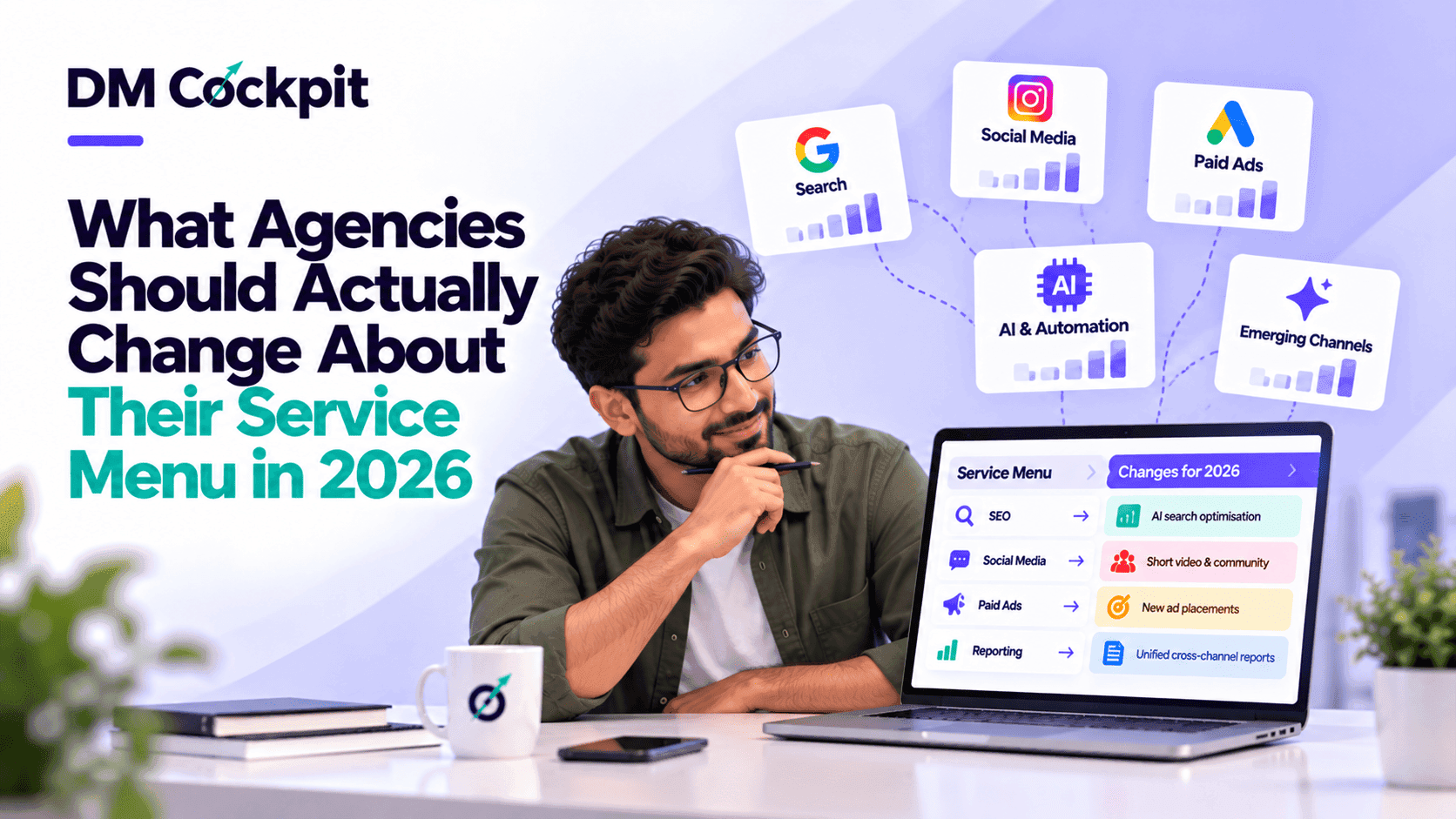
You have a client who wants to be included in ChatGPT's suggestions. Another is looking for AI-generated ads. A third is asking if traditional SEO is still applicable.
These requests have become a common occurrence in the marketing agency world. Understanding these trends is relatively straightforward. Deciding which belong in your official service menu is harder.
An agency service menu in 2026 should mirror the ways in which customers find agencies these days - minus any new marketing fads that turn into false promises. Some services are available for immediate delivery. Others require testing, more accurate measurement or improved client education.
The objective is to create a service that your group can provide reliably, describe accurately, and track effectively.
Start by reviewing what your agency already sells
When launching new services, look at services already offered on your website.
These are some of the common services provided by a standard digital marketing agency: SEO, paid advertising, social media management, content marketing, and analytics. These services aren't gone, but their expectations on how they are delivered have changed.
For example, an SEO client may now wish to inquire about appearance in AI-generated responses. Paid advertising clients may want to see more creative testing since AI tools have made it easier to create variations.
An additional service does not automatically result from either request.
Ask three questions of each of the existing offers:
- Is it the answer to the problem that clients are aware of?
- Can the agency deliver it through a repeatable process?
- What does success mean for the agency?
If it is not clear to the answer for the second or third question, the service must be refined before it can be expanded.
The 2026 service menu: Keep, add, pilot, or defer?
Not all marketing capabilities are equal and some require more effort than others.
Use this decision matrix as a reference for reviewing your offerings.
|
Service |
Recommended action |
Reason |
|
Technical SEO and content optimization |
Keep and improve |
Established processes and measurable outcomes |
|
Google Ads and Meta Ads management |
Keep |
Clear campaign and conversion metrics |
|
AI-search visibility audits |
Add with defined scope |
Combines established SEO checks with available AI-search visibility data and sampled response reviews |
|
Cross-channel reporting |
Formalize |
Helps clients understand combined marketing performance |
|
AI-assisted creative testing |
Pilot |
Useful when supported by human review and performance data |
|
Conversational commerce consulting |
Pilot selectively |
Relevance depends on the client's audience and sales process |
|
Guaranteed AI recommendation placement |
Defer |
Agencies cannot control independent AI-generated answers |
|
Unverified emerging ad-channel management |
Defer |
Limited evidence or measurement may make delivery unreliable |
This way the menu remains focused and there is scope for experimentation.
Services worth formalizing now
1. AI-search visibility audits
As businesses see themselves in buyers' AI-powered search experiences, they are becoming more interested in the answers.
An AI-search visibility audit can help answer questions such as:
- Does the brand appear in relevant AI-generated responses?
- Are important product or service details accurately represented?
- Which competitors appear in similar AI research queries?
- Are the website's pages accessible, easy to navigate, and genuinely useful?
- What are the content gaps that could impact discoverability?
This task is to be completed as a written report containing recommendations with priorities.
As for Google AI search features, the principles of SEO still hold true. Rather than consider AI search as a standalone optimization system, agencies can build this audit around technical accessibility, content usefulness, Search Console visibility data and documented AI-answer observations.
Do not guarantee that making those recommendations will ensure AI answers. Answers are possible to vary by question, system, context, and time.
Ideal for: B2B companies, Software companies, Professional service providers, and Brands whose customers research the product before they buy.
2. Cross-channel performance reporting
Clients don't usually consider their marketing channels one by one.
They ask themselves if they get qualified visitors, inquiries and business opportunities through a campaign.
Agencies can make reporting a structured service that brings together:
- Organic search performance
- Paid advertising results
- Social media engagement
- Website conversions
- Campaign observations and next actions
There's a value in interpretation, not in just putting charts together.
A helpful report outlines changes, the reasons for the change, and the agency's recommendations for the future.
3. Conversion-focused website reviews
A site can get traffic but not do enough to get visitors to take the correct action.
Conversion-focused reviews can review whether your visitors comprehend the offer, can get the facts they're seeking and can take the subsequent step without getting lost.
Agencies can evaluate the clarity of your landing pages, navigation, calls to action, mobile friendliness, and conversion data.
This service can complement SEO and paid advertising, as it covers what happens once they get there.
Services that should remain controlled experiments
There are some new products that have promise but have not yet developed to a state where they are ready to be offered as a standard product to all clients.
AI-generated creative production
AI can help teams develop advertising concepts, alternative headlines, and creative variations.
Producing more ads does not necessarily lead to better performance.
Agencies have to check brand accuracy, factual claims, creative quality, audience response, etc.
A reasonable pilot could be a small range of creative variations to an existing campaign approach, rather than a broad range.
Monitor engagement, conversions, and creative fatigue indicators prior to scaling up the service.
Advertising on emerging channels
New advertising environments can have the potential to get in front of audiences before they can be measured.
But an agency should not add a channel to its service menu simply because competitors are discussing it.
Prior to providing management as an ongoing service, determine if:
- The target audience uses the channel.
- Advertising access is available.
- Campaign results can be measured.
- The team understands the relevant policies.
- Initial tests are helpful indicators.
Instead of full-service management, provide channel feasibility assessments or limited experiments until then.
What agencies should stop selling as standalone promises
If you're changing your agency service menu in 2026, that means you need to eliminate services that you can't provide at your agency.
Guaranteed AI visibility
Nothing guarantees which particular AI assistant will recommend a business for any given question to any of the agencies.
Instead, offer research-based assessments, content improvements, and visibility monitoring.
Bulk AI content without editorial oversight
The quantity of content created is not a worthwhile end in itself.
Clients are looking for content that answers real questions, showcases their expertise, and aligns with their business objectives.
Reporting without recommendations
If an agency only presents monthly figures without recommendations, it is not providing meaningful strategic guidance.
Reporting and advisory services may be combined, but it is important for the client to be aware of the distinction.
Package services around client problems
The traditional agency menu is very clearly defined with SEO, PPC, social media and content.
That is a well known structure; however, clients may have cross-disciplinary problems.
Consider these examples.
|
Client problem |
Suitable service combination |
|
"Customers cannot find us online." |
SEO audit, content optimization, search visibility review |
|
"We get traffic but few inquiries." |
Landing-page review, conversion analysis, campaign optimization |
|
"We don't know which channels work." |
Analytics review, cross-channel reporting, measurement planning |
|
"Competitors appear in AI research." |
AI-search visibility audit, competitor research, content gap analysis |
|
"Our team cannot keep up with campaigns." |
Workflow review, reporting automation, campaign management support |
This organizational structure is useful to account managers in explaining the relationship between deliverables and business needs.
It also helps to avoid selling the same services in an overlapping manner which may create confusion with the agency.
Make delivery readiness part of every service decision
When a service is part of the official menu, it shouldn't be added for the sake of it being known to a team member.
Prior to launch, designate an owner and put in place a delivery process.
Use this checklist:
- Scope: What exactly will the client receive?
- Ownership: Who is responsible for delivery?
- Inputs: What access or information is required?
- Timeline: When will deliverables be provided?
- Measurement: Which indicators will be reviewed?
- Limitations: What outcomes cannot be guaranteed?
In the absence of such details, the offering should be included in an internal pilot page and not a public service page.
It's particularly key for agencies with multiple accounts. Centralized reporting and workflows can contribute to that consistency, as discussed in our article: why agencies are switching to white-label SEO tools in 2026.
Review the menu quarterly, not whenever a trend goes viral
Marketing evolves rapidly, but agencies don't have to revamp their services for every new tool.
Quarterly review offers a necessary level of structure to review new opportunities while keeping client expectations from changing all the time.
During each review, examine:
- Which services clients requested most frequently.
- Which offerings produced useful, measurable outcomes.
- Where delivery teams experienced recurring problems.
- Which experiments deserve further development.
- Which services should be simplified, combined, or retired.
Gather feedback from account managers, not just leadership. They hear the objections the clients have and the needs that are not being met first.
It's better to have a smaller menu of clearly defined deliverables than a long list of loosely associated services.
Build a service menu your team can stand behind
Not all agencies are equal in their services and offerings. This is the one connecting the client's needs and the agency's deliverables.
Maintain existing services. Formalize useful additions such as AI-search visibility audits and cross-channel reporting. Explore new opportunities first and only then commit to it.
We make it easy for agencies to organize marketing activities at DM Cockpit with our SEO monitoring, website audit, advertising insights and client reporting tools. If you want to learn how your team works with delivery in various services, check out our agency plans and capabilities to find out how we can help to make your workflow more connected.
Frequently asked questions
1. What should a digital marketing agency offer in 2026?
A digital marketing agency should focus on services it can deliver and measure reliably. These may include SEO, paid advertising, social media management, content marketing, conversion optimization, and performance reporting. AI-search visibility audits can be a useful addition when the agency has a clear assessment process.
2. Should agencies add AI-search optimization as a separate service?
Yes, selectively. Agencies can offer AI-search visibility audits and related content improvements when they have defined deliverables. However, they should avoid guaranteeing placements or recommendations in AI-generated responses.
3. How often should agencies update their service menu?
A quarterly review is a practical starting point. Agencies should examine client demand, delivery performance, emerging opportunities, and team capacity. Major changes should follow evidence rather than short-lived marketing trends.
4. Is traditional SEO still worth offering in 2026?
Yes. Technical SEO, useful content, website accessibility, and search performance measurement remain important. AI-powered search adds new considerations, but it does not eliminate the need for established SEO practices.
5. Should small agencies offer every new marketing service?
No. Smaller agencies generally benefit from concentrating on services they can deliver consistently. New offerings should begin as controlled experiments or limited assessments until the team develops reliable processes and sufficient expertise.
6. How can agencies introduce new services without confusing existing clients?
Explain the problem each new service solves, how it differs from current offerings, and what the client will receive. Provide clear scope documents, measurable indicators, and realistic expectations. Where possible, connect the new service to an existing client need rather than presenting it as an unrelated add-on.