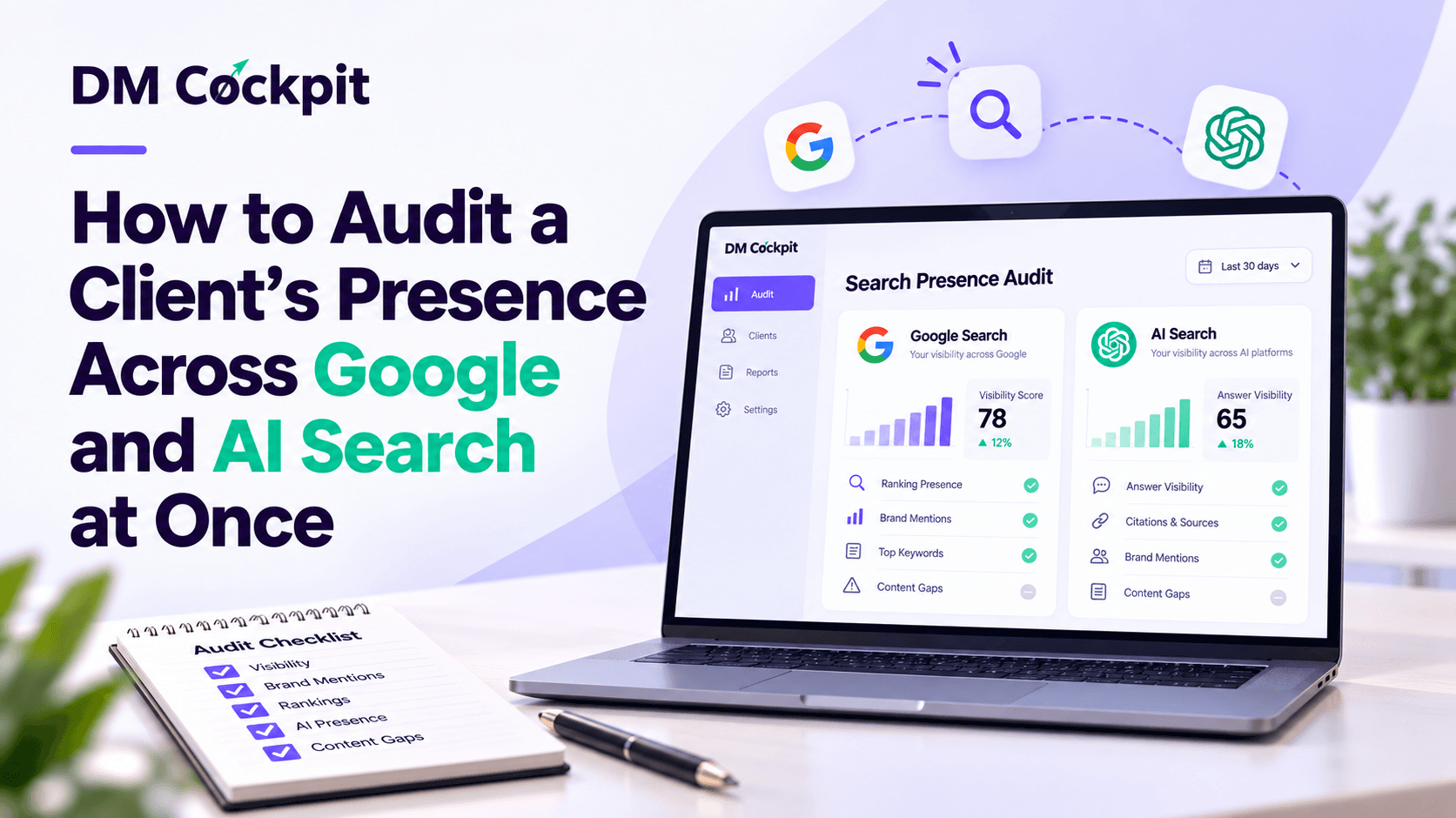
A client searches for one of their most important services on Google and sees their website near the top. Good news. Then they ask the same question through an AI search experience and their brand is nowhere to be found.
That is the visibility problem agencies are beginning to face. A ranking report is no longer enough. The useful multi-surface brand visibility audit should consider how often people see a brand, how it is described, which pages or sources enable that visibility and where the gaps shift between searches.
The aim isn't to conduct two different types of audits, SEO and AI. It is to build one view of discoverability.
Start With Questions, Not Platforms
Opening several dashboards quickly and Google, an artificial intelligence search engine, tends to generate a lot of data and not much structure.
Rather, begin with the questions that are important to the customer's customers.
Create a mini audit sample for various phases of discovery:
- Brand queries: "[Brand name]" or "[Brand name] reviews"
- Service queries: "commercial solar installers"
- Problem queries: "how to reduce office energy use"
- Comparison queries: "solar battery vs grid power for business"
- Recommendation queries: "best options for [specific customer need]"
- Local queries: "[service] near [location]," where relevant
Maintain the same question set or framework across the audit.
That's important because you are comparing surface areas. The last comparison tells you very little if you search on Google with one set of questions and very different questions in AI tools.
Build a Simple Visibility Map
A 40-column spreadsheet isn't necessary to get started.
Write what you can see for each query.
|
Audit Point |
Google Search |
AI Search |
|
Brand appears |
Yes/No |
Yes/No |
|
Owned page appears or is referenced |
Yes/No |
Yes/No |
|
Brand information is accurate |
Yes/No |
Yes/No |
|
Competitors appear |
Which ones? |
Which ones? |
|
Relevant client page |
URL |
URL/source if shown |
|
Message matches client positioning |
Yes/No |
Yes/No |
This immediately exposes differences.
A client may have high traditional rankings but fewer mentions in AI. One could be a company that is referenced often by authoritative third parties, but is not the top page on Google.
Neither result should be reduced to "good" or "bad SEO."
They are different forms of visibility.
Audit Google Visibility First
Google still gives agencies a useful baseline.
Don't just consider the average rank for the client, but what the potential customer sees.
Check the result itself
For priority queries, ask:
- Does the client's page appear?
- Is it the right page?
- Does the title accurately communicate what the page offers?
- What competitors surround it?
- Are directories, videos, forums or other result types taking significant space?
- Does the client's result still make sense for the apparent intent?
This is also where technical health matters.
If search engines can't get to or understand a page, it can't compete effectively. Our Website Audit Tool runs a series of tests for indexability, meta information, internal links, crawl directives and Core Web Vitals.
This audit should then relate symptoms of visibility and potential website problems and not rankings as standalone numbers.
Now Run the Same Themes Through AI Search
This part requires a slightly different mindset.
Do not simply ask, "Did the client rank?"
AI-generated answers may summarize several sources, mention businesses without presenting a conventional ranked list, or change their response when a prompt is worded differently.
Instead, record four things.
1. Presence
Is the client's brand mentioned at all?
2. Prominence
Is it central to the response, one option among many, or merely mentioned in passing?
3. Accuracy
Check factual statements about the business.
Look for incorrect:
- services
- locations
- product descriptions
- company details
- outdated information
- positioning
Being mentioned is not automatically useful if the description is wrong.
4. Source pattern
Where the interface exposes supporting sources or citations, examine them.
Is information coming from the client's website? A publisher? A directory? A review site? A competitor comparison?
This can tell an agency more than the mention itself.
Separate an Absence From an Actual Problem
This is where a multi-surface brand visibility audit can go haywire.
The absence of a brand on one AI prompt is not an indication of an AI visibility issue in the website.
The answers produced by AI may differ, and multiple AI systems might not always give the same answer. Google is also continuing to enhance its AI functionality in the search experience. Its documentation now treats AI features as part of the broader Search appearance landscape.
Look for patterns instead.
When a client is consistently "gone" from a meaningful set of relevant queries, and a similar set of competitors is showing up again and again, this should be looked into.
One missing mention is an observation.
Repeated absence is a pattern.
That distinction keeps client reporting grounded.
Check Whether the Website Supports What the Brand Wants to Be Known For
Then go back to the client's website from the search results.
Let's say a software business wishes to be linked with "enterprise payroll automation" and the term and concept are hardly used beyond a brief product description.
It may just be a lack of evidence at the site to make that association clear.
Review priority pages for:
- clear descriptions of services or products
- specific answers to customer questions
- consistent company and product terminology
- useful supporting content
- logical internal links
- updated facts
- identifiable expertise
- crawlable, indexable pages
You want your business's website to align with what you want it to be about.
That’s a more actionable message than "optimize for AI" to a client.
Keep Schema in Its Proper Place
Then there's structured data which should be audited, but shouldn't be the entire audit.
According to Google, structured data can be used to help Google understand the content on a page and can enable certain pages to appear in richer search results.
But the schema is only one part of a much wider visibility picture.
As you know, there is already a discussion about schema and AI search visibility. If the problems recorded during the technical review are implementation issues, then they would not be repeated here but would be addressed through the wider audit.
Even if the page is well marked up, it still doesn't solve the larger issues if the information is thin, out of date or hard to access.
Turn the Findings Into a Gap Map
Explain the concept with two separate reports: "SEO" and "AI".
Combine the findings.
A useful final view might look like this:
|
Pattern |
What It Suggests |
Next Check |
|
Strong Google + strong AI presence |
Broad visibility |
Protect and monitor |
|
Strong Google + weak AI presence |
Visibility differs by surface |
Review recurring AI source/competitor patterns |
|
Weak Google + AI mentions |
Brand has some external discovery |
Identify sources supporting mentions |
|
Weak across both |
Broader discoverability gap |
Review technical, content and authority issues |
|
Visible but inaccurately described |
Information consistency issue |
Find outdated or conflicting sources |
Look at the table, notice that it does not always give the same fix.
That is intentional.
The audit should be used to establish where to progress to next, rather than to create certainty based on limited observations.
Make the Audit Repeatable
A single snapshot doesn't last long.
Save the query set and repeat the same queries at scheduled times or after significant changes on the website. It's important to note that dates for observations can vary, and search results and AI responses may evolve over time.
Over time, the multi-surface brand visibility audit becomes much more useful because the agency can answer:
- Where has visibility improved?
- Which competitors are appearing more often?
- Which client pages are gaining exposure?
- Are inaccurate descriptions disappearing?
- Are previously invisible topics beginning to surface?
That turns an interesting AI-search exercise into an agency reporting process.
One Search Strategy, More Than One Surface
Clients are not concerned with how the discovery process occurred; it could have been via a blue link, AI-generated discovery, or another search. They are interested in whether or not they can be located by potential customers and whether the information they get is accurate.
That is why agencies need a wider audit without abandoning the SEO fundamentals that still matter.
We bring search performance and website health together at DM Cockpit to help marketers see the site through a different lens. When visibility gaps start to emerge, our website auditing tools can highlight problems like indexability, internal linking, Core Web Vitals, and meta information, providing an actual technical ground for the team to start. The goal is straightforward: take the information you can confirm, recognize the areas you want to address and enrich the next client conversation.
Frequently Asked Questions
1. What is a brand visibility audit?
A brand visibility audit examines whether and how a business appears when potential customers search for relevant topics. A modern audit can compare traditional Google results with AI-generated search experiences rather than relying entirely on keyword positions.
2. Can a brand rank well on Google but have weak AI search visibility?
Yes. The two surfaces do not always display or summarize information in the same way. A brand may perform strongly in conventional results but appear inconsistently in AI-generated answers, which is why agencies should record patterns across multiple relevant queries instead of relying on a single test.
3. How many queries should an agency test?
There is no universal number. Start with a manageable set representing the client's most important brand, service, problem, comparison and recommendation searches. A smaller repeatable query set is generally more useful for ongoing auditing than hundreds of prompts that nobody reviews again.
4. Should agencies report AI mentions like traditional keyword rankings?
Not in exactly the same way. Traditional rankings describe a relatively familiar search position, while AI answers can vary in format and wording. Record presence, prominence, accuracy and visible source patterns instead of forcing AI responses into a conventional ranking report.
5. Does schema guarantee that a brand will appear in AI search?
No. Structured data can help search engines understand page information and support eligible search features, but it should not be treated as a guarantee of inclusion in an AI-generated response. Google documents structured data as one way of providing explicit information about page content.
6. How often should agencies repeat the audit?
Repeat it often enough to identify meaningful changes rather than reacting to every individual response. It is particularly useful after major content updates, technical fixes, site migrations or changes to important service pages. Keeping the original query set makes comparisons much more useful over time.