
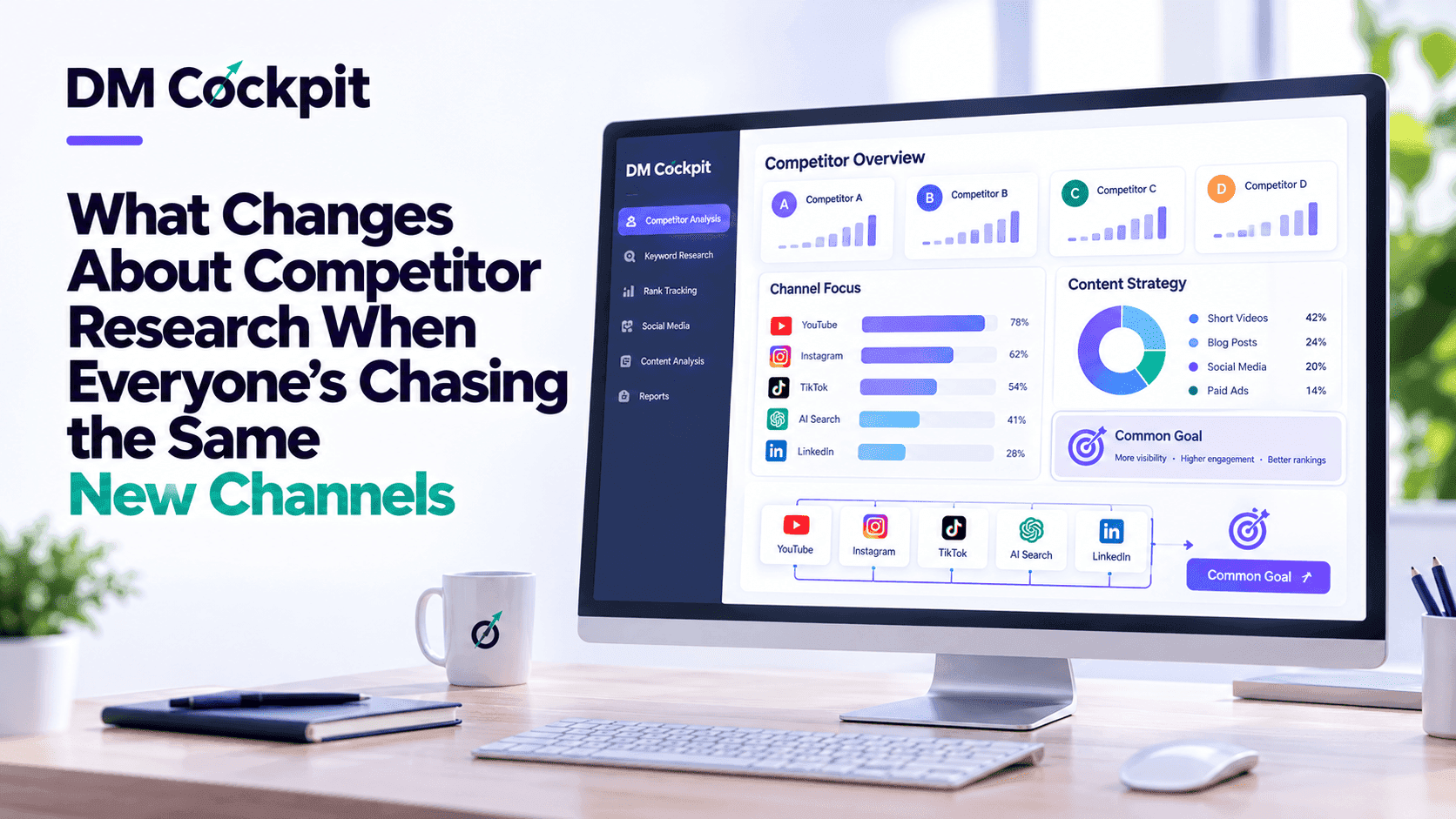
A competitor promotes a product on a new medium. In a matter of days, there are three other brands there. Your client soon asks why their business isn't using the same channel.
This is where competitor research becomes challenging. Being an early adopter of a channel does not guarantee a competitive advantage.
For agencies, competitor research for new ad channels requires a different approach from traditional keyword and advertising analysis. The goal is to get a grasp of what is meaningful to look for in early adopters, distinguish between experiments and established campaigns, and determine which trends are worth investigating.
The First Mistake: Confusing Visibility With Success
As a competitor shows up on a new ad medium, it's easy to think that they have something you don't.
However, public activity only shows a fraction of the picture.
An agency may see a competitor making videos on a different social media site or trying out a new place for ads, such as in a different social setting. That doesn't say anything about the number of qualified leads or profitable sales those campaigns are producing.
Now suppose that there are three competitors in the same channel:
|
Competitor |
Visible activity |
What it might suggest |
|
Brand A |
One sponsored post |
An initial experiment |
|
Brand B |
Several creative variations over multiple weeks |
Ongoing campaign testing |
|
Brand C |
Repeated campaigns with dedicated landing pages |
A more developed channel strategy |
These are interpretations, not proof of performance.
The useful question isn't simply, "Who's advertising here?"
It's, "What evidence suggests this channel is becoming important to our market?"
Where Early-Adopter Signals Usually Appear
Emerging channels rarely come with a clear roadmap for advertisers. Smaller clues need to be recognized by agencies.
1. Repeated advertising messages
A sponsored placement may not be very meaningful. Several messages targeting the same audience may indicate a more deliberate experiment.
Look for changes in:
- Product benefits emphasized in advertisements
- Calls to action and promotional offers
- Creative formats used across campaigns
- Landing pages that correspond to a particular message
There is a place for repetition; there's a place for variation. It might indicate that a competitor is trying to find alternative means of engaging a target audience.
2. Landing pages built for specific channels
An advertisement can't tell you as much as a competitor's website can.
Let's say a software firm develops a landing page that includes messages geared toward a new professional network. The page features a special offer, an audience-centric copy and a dedicated conversion form.
That doesn't confirm successful advertising. But it does require more preparation than sending out a repeat of an existing campaign.
3. Changes in organic content
Paid campaigns aren't the only early indicators.
Observe if competitors start to produce material for a specific platform. If new video formats, repeated video discussion, creator partnerships or channel-specific educational content are created, it could indicate a broader marketing experiment.
If both organic and paid activity grow in tandem, it may warrant further investigation of the channel.
Build a Competitor Activity Log Instead of Collecting Screenshots
Screenshots are useful evidence. They're poor research systems when scattered across folders and conversations.
A simple activity log helps account teams identify patterns without relying on memory.
|
Research field |
What to record |
|
Competitor |
Brand or business name |
|
Channel |
Platform or advertising environment |
|
First observed |
Date activity was discovered |
|
Activity type |
Sponsored content, landing page, partnership |
|
Message |
Main audience problem or offer |
|
Evidence |
Public URL, screenshot, or observation |
|
Confidence |
Low, medium, or high |
|
Next review |
Date to check for further activity |
For example, an agency researching a competitor's activity on an emerging video platform might record two sponsored posts during the first week.
Three weeks later, the same competitor published additional variations and introduced a dedicated landing page.
The agency now has evidence of continued activity, although the campaign's business results remain unknown.
That distinction keeps research credible.
Separate Real Signals From Marketing Noise
Not every observation deserves a client presentation.
A good research process categorizes findings into three groups.
Weak signals: Interesting, but unconfirmed
They range from single ads to sporadic sponsored posts, or a single creator collaboration.
Record them. Don't recommend a channel change based on them alone.
Developing signals: Worth monitoring
These include multiple creative ideas, repeated activity or landing pages that support the activity.
This is a great time for an agency to find out if the channel's audience is what they're looking for.
Stronger signals: Worth discussing
These encompass continued engagement from multiple competitors and a uniform brand message centered on the audience, as well as evidence of the development of supporting content or conversion journeys.
Even good signals don't guarantee profitability.
They indicate that further research may be justified.
The aim is to make better marketing decisions, not make predictions based on public activity.
What Traditional Competitor Research Still Tells You
New advertising channels do not make established research methods irrelevant.
They make the existing competitive picture more important.
Agencies need to know where the competition is getting attention before recommending a new channel.
That includes:
- Organic search visibility
- Keyword overlap
- Competitor content priorities
- Existing audience interests
- Established advertising messages
We have a Competitor Analysis Tool that enables you to conduct studies on other websites, organic keywords, keyword overlap, and search visibility.
These findings can establish a useful baseline before agencies investigate activity on newer advertising surfaces.
To dive more deeply into the topic of competitor research in SEO, check out our Competitor Analysis Playbook for 2026.
The distinction is simple: traditional research shows where competitors are established, while emerging-channel research shows where they may be experimenting.
A Practical Example: Three Brands, One Emerging Channel
Let's say that you're in charge of digital marketing at an agency that's working for a business-to-business software company.
Three competitors begin appearing on a new professional content platform.
The account team investigates their publicly visible activity.
Week 1: One competitor publishes a sponsored educational video. The other two have no visible paid activity.
Week 3: The first competitor publishes additional variations. A second competitor introduces sponsored content aimed at operations managers.
Week 6: Competitors post again. One sets up a landing page that's solving an issue in their specific industry.
The agency now has several useful observations.
One of the first is that the channel might be attracting businesses that are targeting the same type of decision-maker.
Second, it seems that education rather than product is being deployed more frequently.
Third, at least two competitors have demonstrated continued interest.
The agency's biggest mystery is whether either business has made significant conversions.
The next step should be to measure audience relevance and measurement options, rather than making the jump to immediately changing the client's advertising strategy.
Five Questions Before Recommending a New Channel
Use these questions during an account review.
- Does the audience match? Are the platform's users likely to include the client's actual buyers?
- Is competitor activity sustained? Have brands returned with additional campaigns or content?
- Can performance be measured? Can trustworthy measures of meaningful outcomes be found?
- Does the channel offer something different? Does it have the ability to reach an audience or convey a message that can't be done through other means?
- What would justify continued testing? What are some of the results that would indicate for the experiment to be continued?
If an agency can't answer any of these questions, there's a good chance it will need more evidence before it makes a recommendation for action.
How Often Should Agencies Review Emerging Channels?
There's no universal schedule.
Fast-moving consumer markets may require more frequent monitoring. Certainly, specialized B2B businesses may show significant shifts at a later time.
One way to do this is to check the observations of the emerging-channel every month and to review high-level developments with clients every other month.
The research should also have an identifiable owner. Otherwise, teams may retrieve the same data over and over again without using it to provide valuable recommendations.
A simple monthly update could contain:
- One notable new competitor activity
- One emerging pattern worth monitoring
- One finding that challenges an earlier assumption
- One recommended next action
This helps keep reporting focused on meaningful market developments and doesn't become a 'must do' project for each new platform.
Research Before the Market Gets Crowded
The problem that agencies have, when there are several different competitors in the same channel, is reacting too quickly and missing a real chance.
Neither helps the client.
The purpose of competitor research on new ad channels is to identify changes early enough to investigate them carefully. Public advertising activity provides clues, not complete answers.
At DM Cockpit, we'll be able to help your marketing team figure out what the competition is doing by understanding the competition through keyword research, search visibility analysis and performance data. We can help with the existing research baseline and your team can investigate new channels with trusted public research.
Frequently Asked Questions
1. What is competitor research for emerging advertising channels?
It involves examining publicly available evidence to identify where competing businesses may be testing unfamiliar advertising platforms. Agencies review sponsored content, campaign messages, landing pages, and repeated activity to understand possible market developments.
2. How can agencies identify competitors using new advertising platforms?
Agencies can review public advertising libraries where available, examine sponsored posts, monitor competitor websites, and observe channel-specific content. Keeping a dated record helps distinguish isolated activity from repeated experiments.
3. Does competitor advertising activity prove a new channel works?
No. Visible advertising shows that a competitor is active, not that its campaigns are successful. Conversion rates, lead quality, and actual business outcomes are generally unavailable without access to the advertiser's private performance data.
4. Should agencies immediately test every new channel their competitors use?
No. Agencies should first assess audience relevance, measurement options, campaign objectives, and the strength of available evidence. A competitor's activity may justify investigation without requiring immediate investment.
5. What is the difference between traditional competitor analysis and emerging-channel research?
Traditional competitor analysis examines established factors such as search rankings, keywords, content, and existing marketing activity. Emerging-channel research focuses on early adoption signals, unfamiliar advertising environments, and changes in competitor behavior.
6. How can agencies report emerging-channel findings to clients?
A short monthly briefing works well. It should explain what was observed, provide supporting evidence, identify uncertainties, and recommend whether the channel deserves monitoring, further research, or a controlled experiment.