
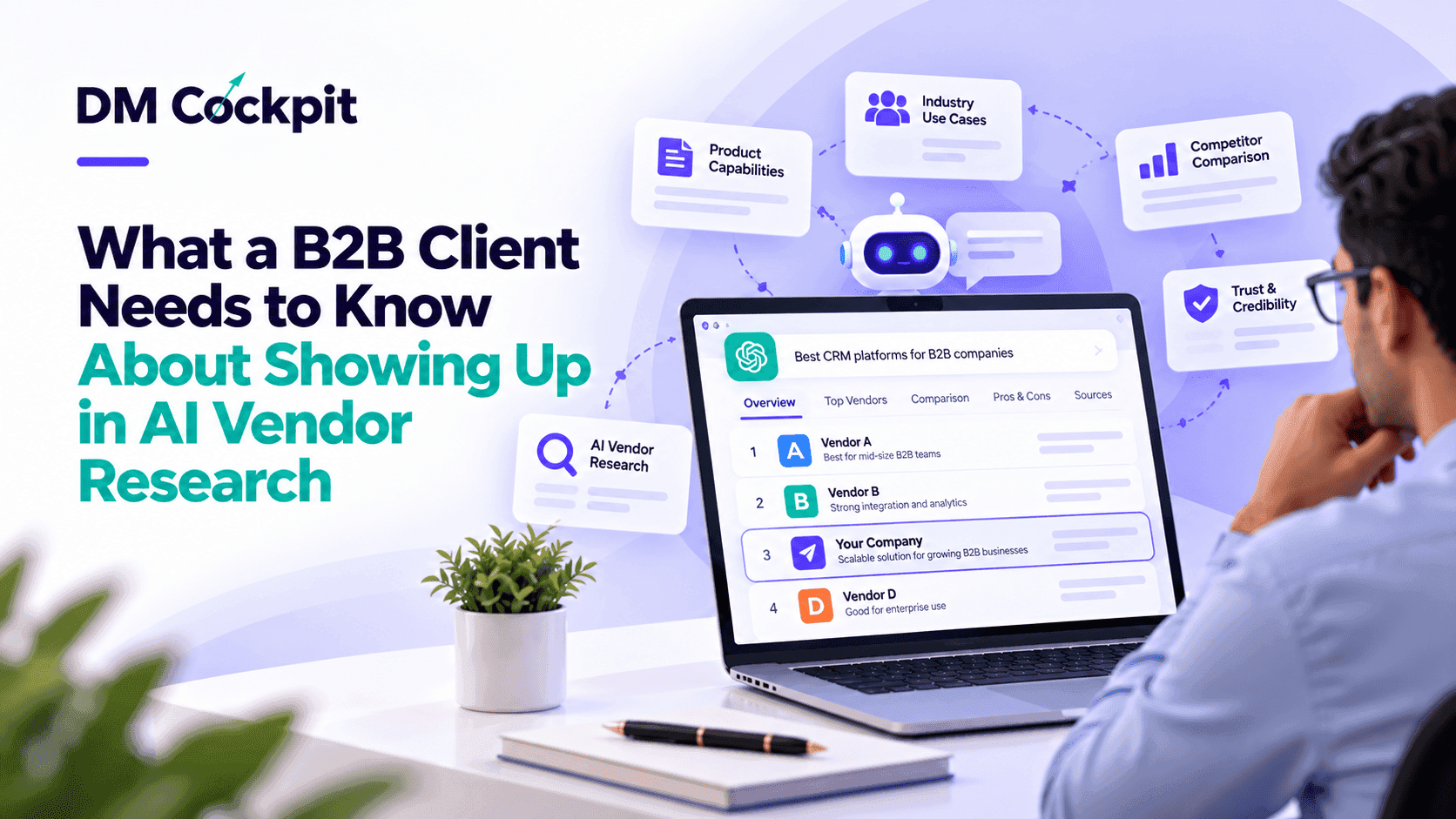
A B2B buyer asks an AI assistant to recommend software vendors that meet specific industry and technical requirements. The assistant produces a shortlist before the buyer visits a single vendor website.
Your client's business might be a strong match. But will it appear in that research?
This is where the B2B AI search visibility for clients becomes a crucial topic for marketers. AI tools are helping buyers to research vendors, decipher services and compile shortlists. During that process, agencies should educate their clients about how they are being portrayed in their businesses.
It's not enough to have a brand in an AI-generated response. It's making accurate and useful information about that business available when potential buyers are considering their options.
AI vendor research is different from a regular Google search
Typical search starts with a brief query, like “enterprise cybersecurity providers.”
This can be a much more specific research question if an AI assisted research question is used:
What cybersecurity vendors have experience with mid-sized financial organizations, provide relevant compliance related documentation, and have cloud expertise?
The second question shows that there are some requirements for purchasing. The researcher would like to have more than a list of company names.
They require information to guide them in their selection of vendors that need to be evaluated further.
In B2B, this means that product capabilities, industry experience, and supporting evidence will be easier to find.
What buyers may ask AI assistants
|
Buyer question |
Information the vendor should provide |
|
Which vendors serve our industry? |
Industry-specific service pages |
|
Can this provider meet our requirements? |
Clear product capabilities and limitations |
|
Has the company handled similar projects? |
Relevant case studies |
|
What makes this vendor different? |
Specific, evidence-backed differentiators |
|
Is the company credible? |
Verifiable company information and third-party references |
|
What should we ask during a demo? |
The documentation and FAQs, and evaluation resources, are all available |
An agency's job is to determine where a client's website is providing answers and where the information is lacking.
Think about the procurement journey, not just rankings
The purpose of a search for B2B is to keep the search process going rather than to make the first sale. Customers have the option to conduct their own research, appeal to their colleagues, request the paperwork, and compare multiple providers before contacting sales.
AI technology can assist with various aspects of this path
Stage 1: Understanding the available options
A buyer can use an AI assistant to get an explanation of a product category or to come up with potential vendors.
Here, it's important to have clear service descriptions and educational resources.
Stage 2: Building a shortlist
The buyer starts to limit his choices.
Questions get more specific, and may include industry appropriateness, integration needs, company size, and service coverage.
A vendor who provides detailed and accurate information can be easier to assess than a vendor who uses general marketing statements.
Stage 3: Checking vendor suitability
The buyer wants to know what they are getting.
Useful becomes case studies, product documentation, implementation information and credible external references.
Stage 4: Preparing for sales conversations
The buyer can let AI guide them in creating questions for a demo or procurement meeting.
Questions can be generated by the information provided by the vendor in a public document, but the buyer needs to check key information directly.
The agency takeaway: Content should help to support the evaluation process, and should not be limited to the initial discovery question.
Five visibility gaps agencies should investigate
The first step in enhancing B2B AI search visibility for clients is to recognize potential information gaps that may leave a customer confused about or uninterested in a vendor.
Here are 5 themes to review.
1. Service pages describe benefits but not capabilities
The terms "flexible solutions for growing businesses" are good but don't convey much information to a procurement manager.
Buyers should be aware of the solution's impact on the business, who it is for, and the problems it is designed to solve when buying.
Better approach: Where the information can be verified add specific capabilities, supported use cases, and relevant limitations.
2. Industry experience is difficult to confirm
The company can be in the healthcare, manufacturing, and finance sectors but refer to just a couple of them.
Carefully crafted industry content can clarify issues of the business and the company's true story.
Do not claim to be an expert in something you don't know.
3. Important answers are hidden in sales conversations
Certain businesses may keep the fundamentals of the product for discovery calls.
This can unnecessarily fuel the conflict when a buyer is considering whether a vendor is on their shortlist.
Agencies can suggest publishing relevant details on what services they offer, their integrations, what they expect during the onboarding process and how they support you.
Confidential or commercial information should be kept confidential.
4. External information is inconsistent
The information on a vendor's website can be different from what's found in the directories or the profiles from the partner sites.
Agencies should check key third-party references and ensure that any discrepancies are addressed if at all possible.
5. Content does not address evaluation questions
Many websites explain why their services are valuable without helping buyers assess suitability.
Useful additions may include:
- Product capability FAQs
- Industry-specific case studies
- Implementation and onboarding overviews
- Integration documentation
- Vendor evaluation checklists
- Clear explanations of service limitations
These resources help with human procurement decisions and AI-assisted research.
A practical AI vendor visibility review for agencies
Agencies cannot guarantee AI recommendations, but a structured visibility review can still provide useful insights.
A structured review may reveal to clients how their businesses present in various research situations.
|
Review step |
What to examine |
Useful output |
|
Identify buyer questions |
Common procurement and vendor-comparison queries |
Research question list |
|
Test AI research tools |
Brand mentions, cited sources, and answer accuracy |
Visibility observations |
|
Review website content |
Missing capabilities, industry information, and evidence |
Content gap inventory |
|
Check external references |
Important directories, publications, and partner pages |
Consistency checklist |
|
Prioritize improvements |
Gaps affecting buyer understanding |
Recommended action plan |
|
Repeat selected tests |
Changes in answers and cited sources over time |
Periodic comparison report |
Record the tool, question, date and answer on each test.
AI answers may be different from one tool to the next and one session to the next. The visibility of a single answer should not be taken as evidence of regular visibility.
Agencies can refer to our detailed guide to Answer Engine Optimization (AEO) for ChatGPT, Gemini, and AI search for a comprehensive overview of how AI assistants search and provide information.
How to explain AI visibility results to a B2B client
Clients are typically interested in knowing if they are getting any business out of marketing.
Do not overload them with new words or a high number of visibility that are not supported.
Instead, expound the outcome in terms of three questions.
Can buyers discover the company?
Indicate whether or not the business was listed in pertinent research tests. Describe the restrictions of the sample.
Can buyers understand what the company offers?
Determine the accuracy of the AI-generated responses with respect to the company's capabilities, industry focus and differentiators.
Can buyers verify the information?
Examine quoted sources and their credibility.
For instance, one report reads:
Your company was mentioned in two of ten responses in our vendor-research tests and a few answers lacked the industry experience section as well. We suggest enhancing the industry page and adding a documented customer example.
This is more specific than just saying that "the client's AI visibility can be enhanced.
What agencies should measure over time
AI search reporting is in the process of maturing. Agencies need to differentiate their results from assumptions.
Google Search Console is now offering separate reporting on visibility in generative AI capabilities like AI Overviews and AI Mode. Agencies may rely on these reports, and can view thoughts from independent AI assistants as independent observations with their own limitations.
Useful indicators include:
- Brand appearance frequency: The number of times the brand is mentioned in a collection of AI research answers as opposed to how much the brand is visible among all users.
- Answer accuracy: Whether AI responses correctly describe the business.
- Source citations: Which websites or documents are referenced.
- Relevant website engagement: Vendor evaluation and industry pages.
- Qualified inquiries: Leads that include information about AI-assisted research, if available.
It's important to note that these are not factors to show as evidence that AI visibility led to a sale.
AI responses can evolve, and referrals won't guarantee all interactions with an AI assistant.
Common promises agencies should avoid
Clients may expect immediate results because AI search is receiving significant attention.
Set realistic expectations.
Do not promise:
- Guaranteed inclusion in ChatGPT or Gemini recommendations.
- A fixed ranking position across AI assistants.
- Immediate leads after publishing new FAQs.
- That adding structured data guarantees an AI citation.
- That every AI-generated brand mentions represents a potential customer.
Agencies can enhance the clarity of content, find new evidence, and enhance discoverability. They don't have control over an independent AI system giving them all the answers.
Make vendor research easier for the next buyer
The most useful question for a B2B client isn't ‘How can we get AI to recommend us?’ It's ‘Can a serious buyer find enough information to decide whether we belong on their shortlist?
This trend helps to maintain the focus on procurement requirements instead of chasing the AI hype.
At DM Cockpit, we can assist marketing teams to coordinate SEO research, track website performance and transform marketing data into more transparent reporting. As agencies develop better vendor visibility strategies for clients, our tools can help the underlying research and reporting process.
Frequently asked questions
1. What is B2B AI search visibility?
B2B AI search visibility refers to how a business is represented or referenced when buyers use AI-powered tools to research products, services, and potential vendors. It includes brand appearances, information accuracy, and the sources used to support generated answers.
2. How is AI vendor research different from traditional SEO?
Traditional SEO focuses heavily on visibility within search engine results. AI vendor research may involve conversational questions, summarized information, and comparisons drawn from multiple sources. Both benefit from accurate, accessible, and relevant website content.
3. Can agencies guarantee that a client will appear in AI recommendations?
No. AI assistants independently generate responses, and their answers can vary. Agencies can improve information quality, content accessibility, and relevant supporting evidence, but they cannot guarantee mentions or recommendations.
4. What content helps B2B vendors become easier to evaluate?
Detailed service pages, industry-specific resources, case studies, product documentation, integration information, and useful FAQs can help buyers understand vendor suitability. Claims should be accurate and supported by evidence.
5. How often should agencies review a client's AI search visibility?
A monthly or quarterly review can be a reasonable starting point, depending on the client's market and resources. Agencies should use a consistent set of research questions and document changes without treating individual responses as definitive trends.
6. How can agencies improve B2B AI search visibility for clients without expensive new tools?
Start by reviewing existing service pages, identifying unanswered buyer questions, checking important external business information, and testing a small set of realistic procurement queries. Prioritize content improvements that also help human buyers make informed decisions.