
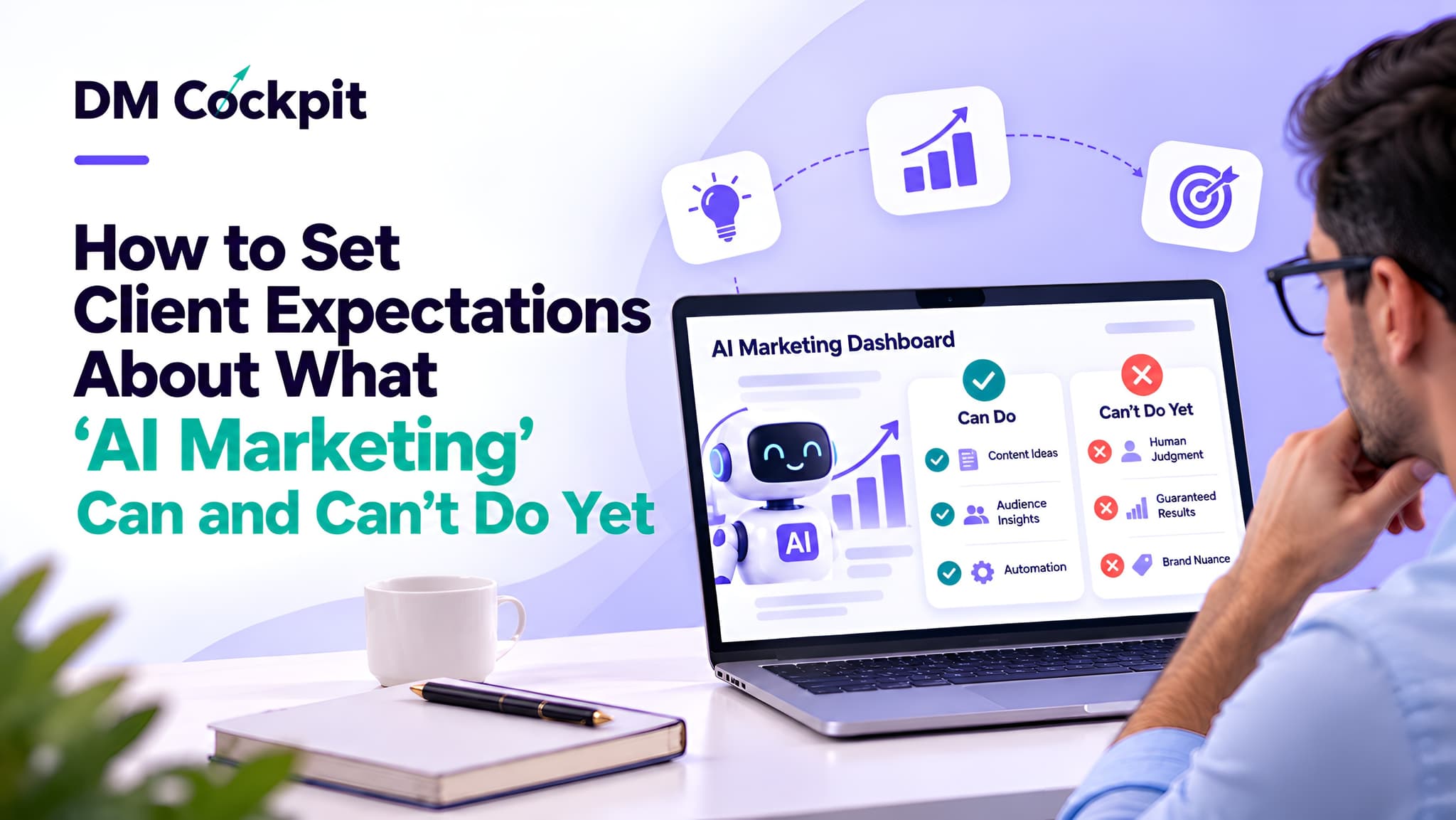
It's Monday and a client is viewing an AI demo on LinkedIn. By Tuesday they're asking if it can write every campaign, predict their best customers and run their ads and double conversions without anyone touching the account.
This is where client expectations AI marketing conversations can get difficult.
It is not the case that clients are not interested in AI. They should be. AI is already proven to be helpful in content, search, advertising, analytics, and day-to-day marketing operations. The trouble is that an impressive demonstration is confused with a reliable business process.
For agencies, the job is no longer to convince clients that AI matters. It is to explain where it genuinely helps, where human judgment still matters and what should be tested before anyone promises a result.
Start by Separating Capability From Outcome
There is a simple distinction that can clear up a surprising amount of confusion:
AI can do a thing. That doesn't imply it can ensure the success of that task.
An AI system can create 20 variations of an ad in a matter of minutes. It's not a guarantee that those 20 ads will outperform the agency-created ads.
It may summarize campaign data. That does not mean its explanation of why performance changed is automatically correct.
It can discover patterns within the client's actions. That isn't to say that it knows what those customers will do next.
That distinction should come early in the client conversation.
Instead of saying:
“AI can automate our advertising.”
A more useful explanation is:
“AI can automate parts of campaign execution and analysis, but we still need to decide what should be automated, check the output and measure whether it improves performance.”
The second version may sound less dramatic. It is also much easier to defend three months later.
What AI Is Already Good At
AI marketing isn't a singular capability. The tools are very different and have significantly different functions, of course, and the utility of each of them depends on the data and workflow that's used.
AI is already viable for an agency in a few areas.
Turning large amounts of data into a starting point
Marketing teams regularly work with more information than anyone can comfortably review line by line.
AI can help organize or summarize:
- campaign performance data
- keyword information
- search trends
- customer questions
- content ideas
- competitor observations
- reporting data
That's good for determining the first place a marketer should start looking.
The important word is first.
A summary can point an account manager toward an unusual change. Someone has to find out if that change is significant, and what has brought it about.
Speeding up repetitive creative work
AI can help teams develop initial ad variations, outlines, social ideas and alternative messaging.
This alters the creative starting point.
A marketer can take 1 hour to take a look at options, discard the bad ones and refine the good ones for testing, rather than developing 10 rough ideas in 1 hour.
People haven't gone away. It has moved.
Making information easier to access
One of AI's more practical uses is helping marketers interact with complicated information more naturally.
Instead of manually working through several reports, teams can increasingly use AI assistance to surface observations and interpret marketing data. We, for example, include DM Captain AI alongside connected agency project data and reporting capabilities.
On top of that, agencies can share our AI Summit 2026 insights with clients instead of explaining every development in a reporting call, to get a broader view on where AI is heading with search, content and digital marketing.
Where the Sales Pitch Usually Runs Ahead of Reality
AI demonstrations are often done in the purest form of a task.
That's not the kind of work it's like in an agency.
A real client might have partial analytics, naming of campaigns that changes over time, several years of legacy content, different offers, multiple decision makers, a sales process that runs some of the way offline, etc.
AI will not solve those issues overnight.
|
The expectation |
The more realistic conversation |
|
“AI will create our strategy.” |
AI can support research and analysis, strategy still requires business context and decisions. |
|
“AI will know what customers want.” |
AI can identify patterns, but customer behavior remains uncertain. |
|
“We can automate all our content.” |
AI can accelerate production, but accuracy, differentiation and brand fit still need review. |
|
“AI will optimize everything automatically.” |
Automation can improve specific tasks when it has suitable data and clear goals. |
|
“AI will tell us exactly what caused a sale.” |
Attribution can remain incomplete, particularly across fragmented customer journeys. |
|
“Using AI means results should improve immediately.” |
Faster execution is not the same thing as better marketing performance. |
This is where a clear client expectations AI marketing framework can come in handy. Agencies aren't dismissing AI. They're setting the precedents for its use.
Use Three Questions Before Making an AI Promise
When a client asks, “Can AI do this?”, avoid answering solely on the basis of whether the technology technically supports the task.
Ask three questions instead.
1. Can it do the task?
This is the capability question.
Is it possible for the system to duplicate, process, and execute the action or recommendation that is being talked about?
Otherwise, the discussion stays on that point.
2. Can we trust it enough for this use?
This is another question.
Ten headline ideas have relatively little impact since an experienced marketer can consider them prior to publishing.
Automatically making an important campaign decision deserves much more scrutiny.
The higher the impact of an error, the stronger the review process should be.
3. Can we measure whether it helped?
This is the most common question that you might overlook in the excitement!
What if an agency implements an AI-driven workflow and productivity increases? Good.
But what happened to quality? Leads? Conversion rate? Engagement? Reporting accuracy? Team review time?
In the absence of an actual baseline, “we're using AI” is an activity, not a result.
Give Clients a Green, Yellow and Red View
Long explanations about machine learning rarely help an account meeting.
A simple traffic-light model often works better.
Green: Use now
Tasks where AI can assist while the team can easily review the result. Think research support, summarization, brainstorming, data interpretation and first drafts.
Yellow: Test with supervision
Tasks that directly influence campaigns, customer experiences or important recommendations. These deserve controlled testing, clear measurement and human review.
Red: Do not promise
Guaranteed outcomes, perfect predictions, completely hands-off marketing and claims that remove uncertainty from advertising.
This gives the client something much more useful than either extreme of “AI will change everything” or “AI isn't ready.”
Do Not Hide the Human Work
There is an odd side effect to AI adoption: agencies can become reluctant to talk about human involvement because automation sounds more advanced.
That is backwards.
Human review is part of a mature AI workflow.
People still provide:
- business context
- positioning
- judgment
- quality control
- brand knowledge
- client knowledge
- ethical oversight
- final accountability
When an AI recommendation doesn't line up with the agency's knowledge of the client's business, somebody must be aware of this.
When a report is automatically generated, if a number is noted but not the business reason for it, you need to provide the context.
It is not an AI, it's an expert. It's determining which is the place where AI may be able to assist with speeding up or enhancing the expertise.
Set Expectations Before the Pilot Starts
Never wait until an AI experiment fails to meet the client's expectations to tell them how it is not meeting their needs.
Before testing anything significant, agree on four points:
- What are we testing?
- What will AI handle?
- What will the agency still review or control?
- How will we decide whether the test worked?
Put those answers into the campaign notes or test brief.
That small step prevents a useful experiment from quietly becoming an unrealistic promise.
It also shifts the focus from "Does AI work?" to an even better question: “Did this specific use of AI increase this specific aspect of our marketing?”
Make AI Useful, Not Magical
The strongest client expectations AI marketing strategy is not about predicting all the things that AI will be able to do. There is no one who can provide a client with a precise blueprint of all of the capabilities that will be available in a year.
Agencies can be a lot more specific on what is usable today.
Explain the task. Define human oversight. Establish criteria for measurement. Test it. After that, determine if it should be bigger.
At DM Cockpit, we feel that technology is best when it provides agencies with greater visibility without the added hype. Our platform integrates all of our client's SEO, advertising, social media, analytics and reporting work in a unified workspace, and for teams that are overwhelmed with data, even AI can help them make sense of their marketing data. The simple objective is to provide people with better information to use but maintain control of the agency.
Frequently Asked Questions
1. How should an agency explain AI marketing to a client?
Start with the business problem rather than the technology. Explain which specific task AI can assist with, what still requires human input and how success will be measured. This is easier for clients to understand than a broad explanation of how artificial intelligence works.
2. Can AI completely automate digital marketing?
AI can automate or assist with parts of marketing, but complete hands-off automation is a much bigger claim. Strategy, business context, quality control, creative judgment and accountability can still require human involvement.
3. What marketing tasks are suitable for AI right now?
Common uses include summarizing information, assisting research, generating initial creative ideas, analyzing marketing data and supporting repetitive workflows. The appropriate level of automation depends on the task, available data and consequences of an incorrect output.
4. Should agencies tell clients when they use AI?
Transparency is particularly useful when AI materially affects client deliverables, campaign decisions or workflows. More importantly, agencies should be clear about how outputs are reviewed and who remains accountable for the work.
5. How can an agency tell whether an AI marketing tool is actually helping?
Establish a baseline before adopting it. Then measure the outcome relevant to the task, such as time saved, output quality, campaign performance or reporting efficiency. Avoid treating the use of AI itself as evidence of improvement.
6. Will AI replace the role of marketing agencies?
AI is changing what agency teams spend time doing, but automation does not remove the need for strategy, client understanding, judgment and accountability. Agencies can use AI to support parts of execution and analysis while keeping people responsible for the decisions that shape the client's marketing.