
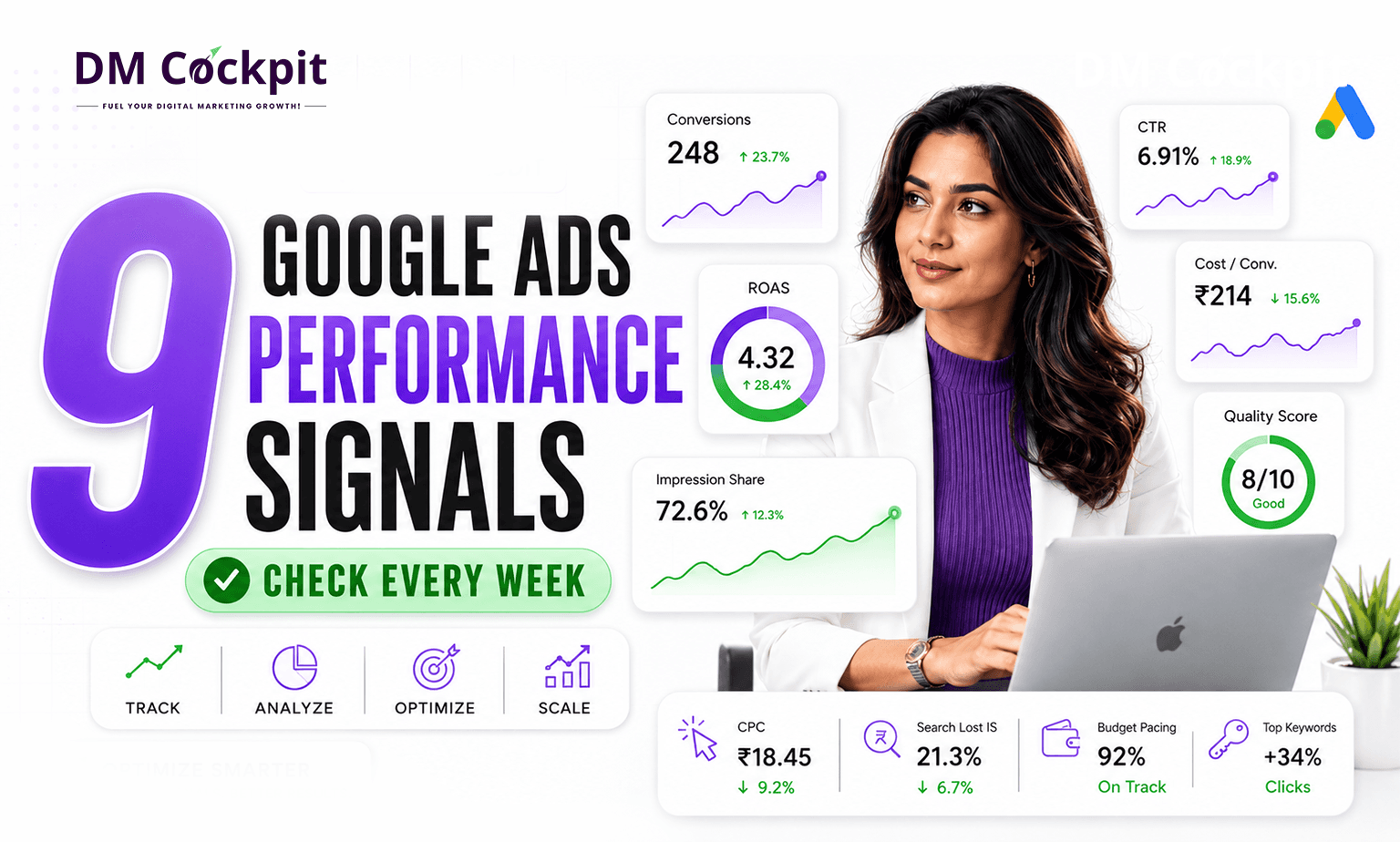
Running Google Ads without weekly monitoring is a fast way to waste budget quietly.
Not dramatically. Quietly.
A campaign can still generate clicks while:
- Conversion quality drops
- CPCs rise
- Search intent weakens
- Wasted spend increases
- Tracking breaks
- Competitors outrank you
- Lead quality declines
And because Google Ads automates so much now, many advertisers assume the platform is handling optimization automatically.
It is not.
Automation helps with bidding and scaling, but performance still depends heavily on human oversight, especially when budgets increase or campaigns become more competitive.
That is why experienced advertisers rely on a consistent Google Ads monitoring checklist.
Not monthly. Weekly.
Weekly monitoring helps catch small performance shifts before they become expensive problems.
Here are nine signals worth reviewing every single week if you care about performance, lead quality, and budget efficiency.
1. Conversion trends, not just conversion volume
A campaign generating conversions does not automatically mean it is healthy.
The first thing worth checking every week is:
- Conversion consistency
- Conversion quality
- Conversion cost trends
- Sudden spikes or drops
Many advertisers focus only on:
- Total leads
- Total sales
- Conversion count
But trends usually reveal problems earlier than totals do.
For example:
- Conversions may stay stable while CPA slowly increases
- Lead quality may decline despite strong volume
- Conversion tracking may inflate numbers accidentally
- Branded traffic may distort performance reporting
Watch for:
- Unusual volatility
- Changes by device
- Campaign-specific drops
- Landing page inconsistencies
- Audience quality shifts
One bad week does not always indicate failure. But repeated trend changes usually point to something worth investigating.
2. Search term quality
This is still one of the most important reports inside Google Ads.
And surprisingly, one of the most ignored.
The search terms report shows what users actually typed before clicking your ad.
That matters because keyword targeting has become broader over time, especially with:
- Broad match expansion
- AI-driven matching
- Automated targeting
- Performance Max campaigns
You may think you are targeting high-intent buyers while Google quietly matches ads to irrelevant searches.
Review:
- Irrelevant queries
- Low-intent searches
- Informational traffic
- Competitor searches
- Geographic mismatches
- Poor commercial intent
Adding negative keywords weekly helps protect budget efficiency.
This is especially important in industries where CPCs are already expensive. A few irrelevant clicks every day compounds quickly across campaigns.
3. Cost per conversion trends
CPA changes rarely happen overnight.
More often, performance slowly drifts.
That gradual drift is dangerous because advertisers adjust too late after significant budget leakage already occurred.
Weekly CPA reviews help identify:
- Bidding inefficiencies
- Audience fatigue
- Landing page issues
- Seasonal demand shifts
- Increased competition
- Conversion tracking problems
Compare:
- Week-over-week CPA
- Campaign-level CPA
- Device-level CPA
- Audience-specific CPA
And avoid judging CPA in isolation.
Sometimes higher CPA is acceptable if:
- Lead quality improves
- Deal size increases
- Customer lifetime value rises
The context matters as much as the metric itself.
4. Impression share loss
Many advertisers focus only on clicks and conversions while ignoring visibility.
Impression share reveals how often your ads are actually appearing when eligible.
Low impression share can indicate:
- Insufficient budget
- Weak ad rank
- Bidding limitations
- Growing competition
- Declining Quality Score
Two specific metrics deserve attention:
- Search Lost IS (Budget)
- Search Lost IS (Rank)
If campaigns lose impression share due to budget, scaling opportunities may exist.
If campaigns lose impression share due to rank, ad quality, relevance, or bidding strategy may need adjustment.
This becomes especially important in competitive industries where visibility shifts quickly week to week.
5. Click-through rate changes
CTR alone does not determine campaign success, but sudden changes often signal deeper issues.
A declining CTR may indicate:
- Weaker ad relevance
- Audience fatigue
- Stronger competitor ads
- Search intent mismatch
- Poor messaging alignment
An unusually high CTR can also be misleading if traffic quality drops.
Weekly CTR monitoring helps identify:
- Ad copy fatigue
- Creative performance shifts
- Keyword relevance problems
- SERP competition changes
Review CTR by:
- Campaign
- Ad group
- Keyword category
- Device
- Audience segment
And remember, CTR benchmarks vary heavily by industry. Comparing campaigns against generic averages usually creates bad decisions.
6. Quality Score and landing page experience
Google rewards relevance more than many advertisers realize.
Poor Quality Scores increase CPCs and reduce visibility even when budgets are strong.
Every week, review:
- Expected CTR
- Ad relevance
- Landing page experience
- Keyword alignment
Landing pages deserve extra attention.
A campaign can fail even with strong targeting if:
- Load times are slow
- Mobile UX is weak
- Forms are confusing
- Messaging feels disconnected from the ad
- Trust signals are missing
Sometimes advertisers spend weeks adjusting bids when the real problem sits on the landing page itself.
Google increasingly measures user experience signals alongside traditional ad metrics.
7. Device-level performance
Desktop and mobile users often behave differently.
So do tablet users, although many advertisers barely review them anymore.
Weekly device analysis helps uncover:
- Mobile conversion gaps
- Form usability problems
- Slow-loading experiences
- Audience behavior differences
- Hidden budget inefficiencies
Common patterns include:
- Strong mobile CTR but weak conversions
- Higher desktop lead quality
- Mobile bounce rate spikes
- Device-specific CPA inflation
Ignoring device segmentation can hide meaningful performance problems inside otherwise healthy campaigns.
8. Budget pacing and spend anomalies
Campaign budgets rarely fail all at once.
Usually the warning signs appear gradually:
- Unexpected spend spikes
- Underdelivery
- Pacing inconsistencies
- Traffic volatility
- Sudden CPC inflation
Weekly budget reviews help prevent:
- Overspending
- Campaign throttling
- Missed impression opportunities
- Inefficient allocation
This becomes even more important with automated bidding strategies because spend behavior can fluctuate aggressively during algorithm adjustments.
Some campaigns burn budget faster after entering new auctions or broader audience pools.
Without regular monitoring, those changes often go unnoticed until monthly reporting arrives too late.
9. Competitor movement inside search results
Google Ads performance is never static because competitors constantly adjust:
- Bids
- Creatives
- Landing pages
- Targeting
- Promotions
- Offers
Auction Insights reports help reveal:
- Impression share changes
- Overlap rates
- Outranking trends
- Competitor aggression
- Emerging advertisers
If CPCs suddenly rise or CTR declines unexpectedly, competitors may be reshaping the auction environment.
This context matters.
Sometimes campaigns underperform not because your setup deteriorated, but because competitor activity intensified.
Understanding those shifts helps advertisers react strategically instead of making unnecessary changes based on incomplete data.
Why weekly monitoring matters more in 2026
Google Ads automation has improved significantly.
But automation also creates a false sense of security.
Campaigns now adapt dynamically across:
- Audiences
- Placements
- Bidding strategies
- Search intent signals
- AI-driven matching systems
That flexibility increases scale potential. It also increases complexity.
Small inefficiencies can spread faster through automated systems than they used to.
Weekly monitoring creates control points.
Instead of waiting for monthly reporting, advertisers catch:
- Tracking issues
- Budget leaks
- Audience drift
- Declining lead quality
- Auction volatility
- Conversion inconsistencies
before performance damage compounds.
The biggest mistake advertisers still make
Many advertisers monitor metrics individually instead of interpreting relationships between them.
For example:
- High CTR with poor conversions
- Stable CPA with declining lead quality
- Rising impressions with falling engagement
- Increased spend with stagnant revenue
No metric exists in isolation.
Good campaign management comes from understanding how signals interact together.
That is why experienced PPC teams rely on structured monitoring systems instead of reacting emotionally to single data points.
A strong Google Ads monitoring process prevents expensive surprises
Most Google Ads problems give warning signs before campaigns collapse completely.
The challenge is noticing those signals early enough.
A weekly Google Ads monitoring checklist helps advertisers:
- Protect budget efficiency
- Improve lead quality
- Catch performance drift
- Optimize faster
- Scale campaigns more confidently
Over time, disciplined monitoring creates more stable campaigns and better long-term ROI than constant reactive changes.
At DM Cockpit, we help agencies and marketing teams monitor campaign performance through centralized dashboards, automated reporting, AI-powered insights, and cross-channel visibility tools designed to simplify ongoing ad management. As Google Ads becomes increasingly automated, having a clearer view of performance signals every week becomes even more important.
FAQs
1. How often should Google Ads campaigns be monitored?
Most active campaigns should be reviewed weekly at minimum. Higher-budget or fast-scaling campaigns may require daily monitoring, especially during launches, seasonal periods, or aggressive optimization phases.
2. What is the most important Google Ads metric to track weekly?
There is no single metric that tells the full story. Conversion trends, CPA, search term quality, CTR, impression share, and lead quality should all be reviewed together to understand actual campaign health.
3. Why is the search terms report important?
The search terms report reveals the real queries triggering your ads. It helps identify wasted spend, irrelevant traffic, poor-intent searches, and opportunities for negative keyword optimization.
4. Does automation remove the need for Google Ads monitoring?
No. Automation improves bidding and targeting efficiency, but campaigns still require human oversight. Budget pacing, conversion quality, search intent alignment, and competitor activity still need regular analysis.
5. What causes Google Ads performance to suddenly decline?
Common causes include:
- increased competition
- tracking issues
- landing page problems
- audience fatigue
- rising CPCs
- irrelevant search traffic
- algorithmic bidding adjustments
- seasonal demand changes
Weekly monitoring helps identify these issues before they significantly affect ROI.