If Meta can generate more of the ad, help optimize the campaign, and increasingly decide which creative is most relevant to an individual user, what exactly is the agency being paid to do?
It is an uncomfortable question, but dismissing it would be a mistake.
Some execution work is becoming easier to automate. Meta says it is using AI to make campaign setup and improvement easier, while its advertising systems increasingly use AI for creative generation, optimization support, ad ranking, and performance recommendations. In Q4 2025, Meta also began testing an AI business assistant with advertisers for optimization and account support.
For agencies, therefore, the useful question is not whether AI will affect advertising workflows. It already is. The more important question is which parts of agency work lose value, which change, and where human judgment becomes more important.
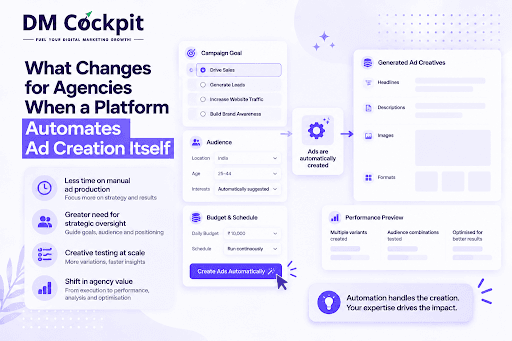
The AI automated ad creation agency impact discussion is therefore less about agencies disappearing and more about how their responsibilities change as platforms automate more execution work.
What Meta Is Actually Trying to Automate
AI in Meta advertising is broader than simply writing several versions of a headline.
Meta's advertising systems already use automation to help advertisers find audiences and manage delivery, while its newer generative AI capabilities can assist with ad creative. Meta has also introduced transparency measures for ads created or significantly edited using generative AI features.
Behind the scenes, automation extends further. Meta says its advertising models are becoming more sophisticated at deciding which ads are likely to resonate with different users. Its Generative Ads Recommendation Model (GEM), for example, is part of its continuing investment in AI-driven ad ranking.
This matters because automation is entering several stages that agencies historically handled themselves:
- Creative variation
- Audience and delivery decisions
- Campaign optimization
- Performance recommendations
- Attribution and measurement support
- Account assistance
That does not mean every one of these functions has become fully autonomous. It means agencies should expect the boundary between platform work and strategic work to keep moving.
Break the Agency Workflow Into Pieces
Talking about AI "replacing agencies" is too broad to be useful. An agency is not one task.
A better approach is to separate the workflow.
|
Agency activity |
Automation pressure |
Human/agency role |
|
Asset variation |
Higher |
Brand inputs and creative judgment |
|
Campaign setup |
Changing |
Strategy and governance |
|
Optimization |
Changing |
Business interpretation |
|
Reporting |
Assisted |
Explanation and accountability |
|
Client strategy |
Lower direct replacement |
Decision-making |
The pressure is greatest where work is repetitive, platform-specific, and based on signals the advertising platform can already observe.
The harder work sits elsewhere: understanding what the client is trying to achieve, determining whether the campaign supports that objective, maintaining brand consistency, connecting advertising results with wider business information, and deciding what should happen next.
Execution Is No Longer the Safest Place to Build Agency Value
For years, agencies could demonstrate expertise partly through their ability to operate complicated advertising platforms.
That advantage becomes less defensible when the platform itself simplifies setup, recommends actions, generates variations, and automates more optimization.
Consider an agency whose value proposition is largely:
- We build the campaigns.
- We make several ad variations.
- We adjust settings.
- We send a performance report.
Every part of that workflow now faces some degree of automation pressure.
The response should not be to compete with AI on the volume of manual tasks completed. Agencies need to move closer to decisions that require business context.
A platform can identify patterns within its data. It does not automatically know that a client's priority has changed, that a particular product should not be promoted heavily this month, or that a technically strong creative direction conflicts with the wider brand.
That context remains important.
Creative Volume and Creative Strategy Are Not the Same Thing
Generative AI can make producing variations dramatically easier. But generating more assets does not automatically answer the harder creative questions.
What should the campaign communicate?
Which customer problem matters?
What makes the brand different from its competitors?
Which claims should be avoided?
What does the client want customers to remember after seeing the campaign?
These are strategic inputs.
There is also a governance issue. Meta now provides disclosures for certain ads that use generative AI creative features, including cases involving significantly AI-edited imagery or photorealistic humans. Agencies therefore have reasons beyond performance to maintain oversight of how automated creative tools are being used.
The agency role can shift from producing every variation manually to establishing the creative system within which variations should be produced.
More Automation Can Make Measurement More Important
There is a strange effect when platforms automate more decisions: marketers may perform fewer individual actions while needing a clearer understanding of what the system is doing.
If an automated system selects audiences, tests creative combinations, changes delivery, and makes recommendations, simply reporting that a campaign was "optimized" tells a client very little.
Agencies still need to ask:
- Which campaigns are producing meaningful outcomes?
- Which creative themes consistently perform well?
- Are clicks translating into valuable actions?
- Are short-term platform results aligned with the client's actual objectives?
- Is performance improving because of better advertising, external demand, or another factor?
Meta itself continues to invest in measurement alongside automation, including incremental attribution designed to estimate conversions caused by advertising rather than simply associated with it.
For agencies, this makes interpretation a bigger part of the job.
The Client Conversation Changes Too
Historically, a client might ask:
"What did you change in the campaign?"
Increasingly, the more revealing question could become:
"What decisions are you making that the platform cannot make from its own data?"
That changes account management.
An agency should be able to explain why a certain campaign objective matters, why one message deserves greater emphasis, how paid social fits alongside other channels, and when the platform's recommendation does not match the client's broader situation.
This is where the AI automated ad creation agency impact discussion becomes an operational issue rather than merely an advertising technology story.
The agency is moving from being the person who knows which buttons to press toward being the team responsible for deciding what the advertising system should be trying to accomplish.
What Agencies May Need to Repackage
Instead of protecting old workflows, agencies can reconsider what they actually sell.
Looking at the AI automated ad creation agency impact this way makes the shift clearer: repetitive execution may lose some value while strategy, governance, interpretation, and accountability become more important.
Manual production: Creative direction
Rather than measuring output by how many variations people manually produce, agencies can define messaging, guardrails, concepts, and testing hypotheses.
Platform operation: Governance
The job moves from operating every control toward supervising how automation is being used and whether it remains aligned with campaign objectives.
Reporting: Interpretation
Sending metrics is less valuable when platforms can generate summaries themselves. Explaining what those metrics mean and what should happen next is harder to automate.
Campaign management: Business decision support
Agencies can connect platform performance to the client's commercial priorities rather than treating advertising metrics as an isolated scorecard.
None of these shifts guarantees that agency work becomes more valuable. Agencies still have to demonstrate that their judgment improves decisions. Automation simply makes manual activity a weaker proxy for expertise.
Amazon's AI Development Shows This Isn't Isolated
Meta is not the only advertising ecosystem moving in this direction.
Amazon has also introduced generative AI capabilities intended to simplify campaign and creative development. Rather than repeating that development here, our earlier article on Amazon's new AI assistant and the future of advertising provides additional context.
The broader lesson for agencies is more important: automation is becoming a platform-level direction rather than a feature belonging to one advertising company.
Agency Social Work Extends Beyond Generating Ads
Paid creative is also only one part of a client's social presence.
Agencies still coordinate organic publishing, campaign calendars, audience engagement, cross-platform messaging, performance analysis, approvals, and reporting. Those responsibilities become harder to manage when every platform introduces its own automation layer.
A centralized social media management tool can help bring scheduling, insights, performance monitoring, and social workflows into a more consistent environment. DM Cockpit, for example, supports centralized management and analytics across multiple social platforms.
The operational advantage increasingly comes from seeing the whole picture rather than manually controlling every individual action.
Automation Changes the Work, Not the Need to Understand It
Agencies should not assume that automation automatically protects or destroys their role. It does something more practical: it changes which activities clients are likely to consider valuable. Routine execution faces greater pressure, while strategy, governance, interpretation, creative direction, and accountability become more important.
At DM Cockpit, we see visibility as an important part of that transition. As advertising and social platforms automate more activity, agencies still need an organized way to monitor performance, understand what is happening across channels, and turn data into decisions. Bringing social insights, advertising information, reporting, and wider digital marketing activity together can make that oversight easier.
The agencies that adapt will not need to prove their value by showing how many buttons they pressed. They will need to show that they understand which decisions matter and why.
Frequently Asked Questions
1. Will AI-powered ad creation replace advertising agencies?
AI can reduce the manual work involved in activities such as creating variations, campaign setup, and optimization. However, agencies also handle strategy, brand judgment, governance, client communication, cross-channel planning, and interpretation. The effect therefore depends heavily on what services an agency provides.
2. What advertising activities is Meta automating with AI?
Meta uses AI across areas including ad ranking, audience and delivery optimization, creative tools, performance recommendations, and measurement. It has also tested an AI business assistant designed to help advertisers with optimization and account support.
3. Does automated creative make human creative strategy unnecessary?
No. Producing an asset and deciding what a brand should communicate are different tasks. Human teams still need to establish messaging, positioning, campaign objectives, brand standards, and creative guardrails.
4. How should agencies prepare for greater advertising automation?
Agencies can review how much of their value currently depends on repetitive platform execution. Strengthening strategic planning, measurement, creative direction, governance, and business-level interpretation can make the service less dependent on tasks that platforms increasingly automate.
5. Why does reporting become more important when campaigns are automated?
Automation can reduce the number of manual campaign decisions while increasing the need to understand results. Clients still need to know what changed, what produced meaningful outcomes, whether performance supports their objectives, and what action should come next.
6. What should agencies focus on if platforms handle more campaign execution?
The focus can shift toward setting objectives, supplying strong creative inputs, maintaining brand standards, interpreting results, challenging inappropriate automated recommendations, connecting channels, and helping clients make better marketing decisions.