
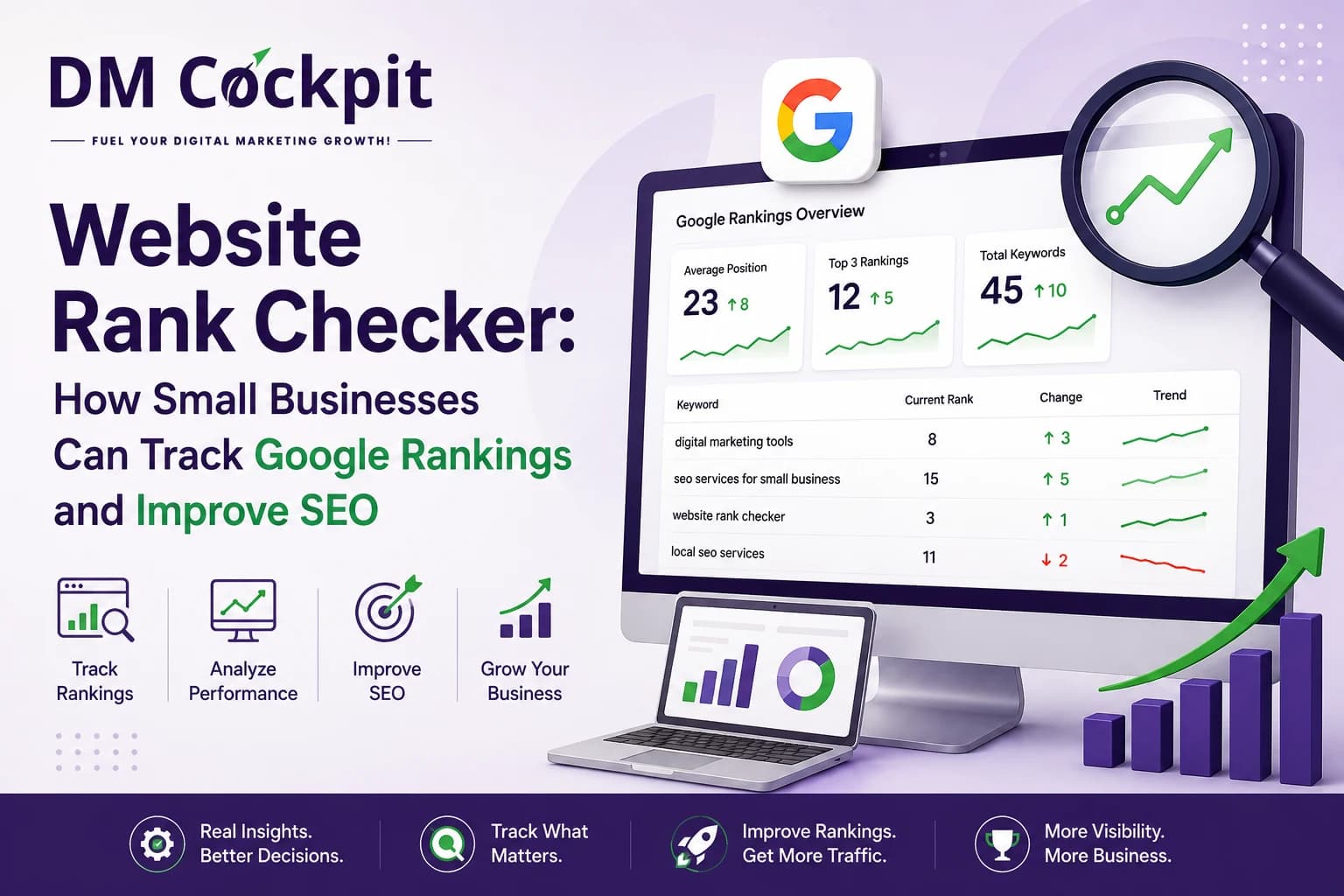
If you're running a small business, your website is one of your biggest marketing assets. But simply having a website isn't enough. The real question is: Can people find it on Google?
That's where a rank checker for a website becomes valuable. It helps you understand where your pages appear in search results, which keywords are performing well, and where you have opportunities to improve.
Many business owners publish content, optimize their pages, and then wait for results without knowing what's actually happening behind the scenes. Tracking your rankings gives you the insights you need to make smarter SEO decisions instead of relying on guesswork.
In this guide, we'll explain how website rank tracking works, why it matters for small businesses, and how combining it with a website audit tool can strengthen your overall SEO strategy.
What Is a Website Rank Checker?
A website rank checker is an application that monitors the ranking of your website for a particular keyword on search engines.
If you have a local bakery and you wish to appear on page one of the search engine results for “birthday cakes near me”, a rank checker will tell you if your site is on page one, page three or anywhere else.
The tool doesn't require you to manually search Google each day, instead, it automatically monitors keyword rankings as time goes on, allowing you to see trends and track SEO improvements.
Most modern rank checkers also provide insights such as:
- Daily or weekly ranking updates
- Keyword performance trends
- Landing pages ranking for each keyword
- Search visibility
- Competitor comparisons
Why Tracking Rankings Matters
Many small businesses focus only on website traffic. While traffic is important, rankings tell you why traffic is increasing or decreasing.
Here are some benefits of using a rank checker for websites regularly.
Measure SEO Progress
SEO is an ongoing process.
You may see this taking a couple of weeks if you have optimized content published last month. Tracking keyword positions enables you to observe the progress of your work.
Find New Opportunities
You may find that there are a few key words that are already in the top 11-20 search results.
These keywords are near the first page and frequently can be improved slightly to climb.
Detect Ranking Drops Early
Search rankings change frequently.
By monitoring them, you can become aware of any sudden drops before they start to impact your site traffic.
Prioritize SEO Work
You don't need to make changes to all pages on your website, since you might choose to work on the ones that have the biggest potential for being higher ranked.
What Should a Good Website Rank Checker Include?
Not every tool offers the same capabilities.
Here are some features worth looking for.
|
Feature |
Why It Matters |
|
Keyword tracking |
Monitor rankings for target keywords |
|
Historical data |
Compare performance over time |
|
Competitor monitoring |
Understand how competitors rank |
|
Location tracking |
View rankings by geographic region |
|
Search visibility reports |
Measure overall SEO growth |
|
Website audit tool integration |
Identify technical SEO issues affecting rankings |
How a Keyword Position Checker Helps Your SEO Strategy
A Keyword position checker provides more than just ranking numbers.
It helps answer questions like:
- Which keywords are improving?
- Which pages have stopped growing?
- Which topics deserve more content?
- Which pages should be updated?
For example:
|
Keyword |
Current Position |
Action |
|
Email marketing software |
8 |
Continue optimizing |
|
SEO reporting dashboard |
15 |
Update content |
|
Marketing analytics platform |
27 |
Build supporting content |
|
Website audit software |
42 |
Improve page authority |
Rather than making random updates to your SEO, you can focus your efforts on specific updates that will lead to better results based on the real data.
Why Rankings Alone Are Not Enough
Rankings are important but they do not provide an explanation as to why a page does well or poorly.
Therefore, businesses need to use a website audit tool with the ranking data.
A website audit can identify issues such as:
- Missing meta descriptions
- Duplicate page titles
- Broken internal links
- Slow page speed
- Mobile usability problems
- Missing image optimization
- Crawl errors
When ranking data and website audits work together, you gain a much clearer picture of your website's overall SEO health.
Using a URL Rank Checker for Individual Pages
Sometimes you don't need to evaluate your entire website.
A URL Rank Checker allows you to analyze the performance of a specific page.
This is useful when:
- Launching a new landing page
- Publishing a blog post
- Updating an existing article
- Optimizing service pages
- Measuring campaign performance
You don't have to look at your whole website, you can focus on the pages that are directly related to your business objectives.
Common Ranking Mistakes Small Businesses Make
There are websites that are incapable of getting better rankings because of common mistakes that they make on their websites.
The following are some of the more frequent ones:
Tracking Too Few Keywords
A single or two keywords aren't enough to get the big picture.
Monitor keywords in various products, services and informational themes.
Ignoring Search Intent
It's important to know what users want to know when addressing them well.
Having a page unmatched with search intent will not perform consistently.
Never Updating Existing Content
Over time, older pages tend to lose rankings.
Statistics can be refreshed, new data added and it can be made easier to read, so maintaining visibility.
Skipping Technical SEO
Content isn't the only thing.
Search engines may not be able to crawl and index your website due to technical problems.
Choosing the Best Rank Checker for Website Monitoring
The best rank checker for website monitoring should make your SEO job easier, not harder.
Consider these factors:
- Easy-to-read dashboards
- Automated keyword tracking
- Website audit capabilities
- Competitor analysis
- Multiple project management
- Search performance reporting
- Integration with Google Search Console and Google Analytics
Several search engine optimization (SEO) tools all built onto a single platform can save time for a growing business.
Benefits of Using a Rank Checker for Website Online
Cloud-based SEO platforms make tracking rankings much easier.
A rank checker for website online offers advantages such as:
- Access from anywhere
- Automatic ranking updates
- Centralized reporting
- Collaboration with team members
- No manual spreadsheet management
- Faster reporting for clients or stakeholders
This is especially useful for agencies, freelancers, and businesses managing multiple websites.
Simple SEO Workflow for Small Businesses
A consistent workflow makes SEO easier to manage.
|
Step |
Activity |
|
1 |
Identify target keywords |
|
2 |
Publish optimized content |
|
3 |
Track rankings regularly |
|
4 |
Run a website audit tool |
|
5 |
Fix technical issues |
|
6 |
Update content where needed |
|
7 |
Monitor improvements over time |
Following this process helps build steady SEO growth without relying on guesswork.
Make Ranking Data Work for Your Business
Google rankings don't remain static. They evolve as new content is released by the competition, algorithms get updated, and user behavior changes.
The companies which continuously make improvements to their search engine visibility are the ones which track their performance, discover opportunities and take informed decisions that influence the search engine optimization of their website.
A reliable rank checker for website, combined with a Keyword position checker, URL rank checker, and a comprehensive website audit tool, gives small businesses the visibility they need to improve their online presence with confidence.
At DM Cockpit, we believe SEO should be easier to understand and manage. That's why we've combined web tracking, website audits, performance reporting, analytics and marketing insights in one platform. From managing your own business website to several client projects, we can help you make better decisions with meaningful data.
Frequently Asked Questions
1. What is a rank checker for a website?
A rank checker for websites is a tool that monitors where your web pages appear in search engine results for specific keywords and tracks ranking changes over time.
2. How often should I check my website rankings?
For most small businesses, reviewing rankings weekly is sufficient. Daily monitoring may be useful for competitive industries or active SEO campaigns.
3. What is the difference between a Keyword position checker and a URL Rank Checker?
A Keyword position checker tracks the rankings of specific search terms, while a URL Rank Checker focuses on how an individual webpage performs in search results.
4. Why should I use a website audit tool along with rank tracking?
Rank tracking tells you where your pages rank, while a website audit tool identifies technical and on-page issues that may be limiting your SEO performance.
5. Can a rank checker improve my Google rankings automatically?
No. A rank checker doesn't directly improve rankings. It provides the data needed to make informed SEO improvements that can lead to better search visibility over time.
6. What should I look for in the best rank checker for website monitoring?
Look for features such as keyword tracking, historical ranking data, competitor analysis, website audits, reporting capabilities, and integrations with platforms like Google Search Console and Google Analytics.