
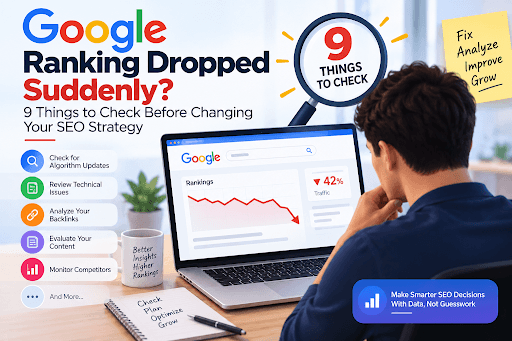
A Google ranking dropped without warning can make you question everything. Should you rewrite the page? Build more backlinks? Change your keywords? Start publishing more content?
Not so fast.
A ranking decline does not automatically mean your SEO strategy has failed. Rankings move for many reasons, including algorithm changes, technical problems, competitor activity and changes in search behaviour. Before making major changes, you need to find out what actually changed.
Here are nine things to check when your Google ranking dropped suddenly, along with a practical way to decide what deserves your attention first.
1. Check whether the drop is real
Before changing anything, confirm that you are looking at a genuine SEO ranking drop rather than normal fluctuation.
One keyword moving from position 4 to 7 is not necessarily a problem. A group of important keywords falling sharply over the same period is much more significant.
Look at:
- The number of keywords affected
- How far the rankings moved
- Whether the affected keywords relate to the same pages
- Whether organic clicks and impressions also declined
- Whether the change happened suddenly or gradually
A useful rule is simple: look for patterns, not isolated movements.
Our [Website Rank Checker] can help you monitor keyword positions over time, including ranking trends and changes across your tracked keywords.
2. Find the exact date your rankings changed
The date of the decline can tell you more than the size of it.
Open Google Search Console and compare your performance before and after the drop. Identify when impressions, clicks or average positions started changing.
Then ask what happened around that date.
Did your team:
- Publish or remove pages?
- Change internal links?
- Redesign the website?
- Update page templates?
- Change titles or content?
- Modify robots.txt or indexing settings?
- Move the website?
- Change redirects?
This is where SEO investigation becomes more useful than guesswork.
If you can connect the Google ranking decrease to a specific website change, you have a much stronger starting point for diagnosis.
3. Check Google algorithm updates
A broad ranking change across several pages may coincide with a Google algorithm update.
That does not necessarily mean your website has received a penalty. Google's ranking systems are continually reassessing search results, and broad updates can cause some websites to gain visibility while others lose it.
If your rankings dropped around an update, resist the temptation to rewrite your entire site overnight.
Instead, compare:
- Which pages lost visibility
- Which queries declined
- Which competitors gained positions
- Whether the affected content genuinely satisfies the search intent
- Whether the decline continues after the update settles
The timing is useful evidence, but it is not proof of causation.
4. Check whether a page disappeared from Google's index
Sometimes the problem is not ranking at all. The page may no longer be indexed.
Check the affected URL in Google Search Console and confirm that Google can access and index it.
Look for issues involving:
- Noindex directives
- Incorrect canonical tags
- Robots.txt restrictions
- Redirects
- Server errors
- Accidental page deletion
- Major URL changes
This matters because trying to improve content will not fix an indexing problem.
If several pages disappeared at once, investigate technical changes across the website before making content or keyword decisions.
5. Compare the affected page with the pages now ranking above it
This is one of the most useful checks when a keyword ranking dropped.
Search the query and study the pages that replaced yours.
Do not just compare word count.
Look at:
- Search intent
- Content depth
- Original information
- Page structure
- Topical coverage
- Freshness
- Internal linking
- Expertise and evidence
- How directly the page answers the query
Imagine a guide that previously ranked for "best CRM for small businesses". If the results now favour comparison pages with clearer product information, adding another 1,000 words to your existing guide may not solve the problem.
The better question is: what does the current search result satisfy that my page no longer does?
6. Check whether competitors improved
SEO is relative.
Your website can remain exactly the same while another website becomes more useful, more authoritative or more relevant.
That can produce a Google ranking dropped suddenly scenario even when you made no changes yourself.
Compare your affected page with the new competitors and identify what changed in the SERP.
You may discover that competitors have:
- Created more relevant supporting content
- Improved their page experience
- Added original research or examples
- Built stronger internal linking
- Earned relevant backlinks
- Better matched the search intent
This is where competitor research becomes more valuable than simply checking your own page.
We provide competitor analysis and keyword research capabilities within DMCockpit, including the ability to research keywords by domain and identify terms competitors are ranking for.
7. Investigate backlinks and lost authority
A sudden ranking decline can sometimes follow the loss of important backlinks.
That does not mean you should immediately launch a large link building campaign.
First, investigate whether meaningful links disappeared and whether the affected pages relied on them.
Pay particular attention to:
- Links pointing directly to affected pages
- Important referring domains that disappeared
- Large numbers of lost links around the same date
- Changes involving redirects or removed pages
The context matters. Losing one low quality backlink is very different from losing several relevant links that previously supported an important page.
Our [SEO Backlink Checker] can be used as part of that investigation when you need to examine your site's backlink profile.
8. Check traffic before assuming rankings are the problem
Sometimes marketers see fewer leads or visitors and immediately blame rankings.
But rankings are only one part of the picture.
A page can maintain its position while receiving fewer clicks because the search results page has changed. New SERP features, different layouts, ads or changing search behaviour can all affect how users interact with organic results.
Look at:
|
Metric |
What it can tell you |
|
Impressions |
Whether visibility in search has changed |
|
Average position |
Whether rankings have moved |
|
Clicks |
Whether organic visits have changed |
|
CTR |
Whether users are clicking at the same rate |
|
Conversions |
Whether traffic is producing business results |
At DMCockpit, we bring ranking information together with other marketing data, including Google Analytics insights, so performance can be assessed from more than one angle.
That broader view matters. A ranking decline is worth investigating, but the business impact should determine how urgently you respond.
9. Do not change your SEO strategy until you know the cause
This is the step most people skip.
When rankings dropped, the instinct is often to do something immediately. Rewrite every title. Add keywords. Publish ten new blogs. Remove old content. Buy backlinks.
That creates another problem: you may fix something that was never broken.
Instead, create a simple diagnosis:
Ranking change → affected pages → affected queries → timing → possible cause → evidence → action
For example:
Several commercial keywords declined → same landing page → competitor pages gained visibility → no technical issues → decline began during an algorithm update → content no longer matches current intent closely enough → improve the page based on the SERP.
That is a much stronger strategy than making five unrelated changes at once.
A practical checklist before you make changes
When your Google ranking dropped, check these in order:
- Confirm the decline across multiple keywords.
- Identify the exact date it started.
- Check Google Search Console for impressions, clicks and position changes.
- Check indexing and technical accessibility.
- Look for relevant Google algorithm updates.
- Compare the affected pages with current competitors.
- Investigate significant backlink losses.
- Check whether CTR or search behaviour changed.
- Make changes only after identifying the strongest explanation.
What should you do if the rankings do not recover?
Do not judge your response after a single day.
SEO changes need time to produce measurable results, and rankings naturally fluctuate. Continue monitoring the affected keywords and pages so you can see whether the trend is improving, staying flat or getting worse.
DMCockpit can make this monitoring process easier by tracking keyword positions and ranking trends over time. Our rank tracking also supports daily updates and comparisons across different periods, giving you a clearer view of whether a movement is temporary or part of a longer trend.
The goal is not to react to every position change. It is to spot meaningful patterns early enough to investigate them properly.
Do not fix what you have not diagnosed
A Google ranking dropped alert should trigger investigation, not panic.
The most useful SEO response is rarely the fastest one. Check the timing, confirm the scale of the decline, investigate technical health, compare competitors and look at the wider performance data. Only then decide whether your content, links or SEO strategy actually needs to change.
At DMCockpit, we use ranking data, keyword research, competitor insights and broader marketing reporting to give teams a clearer picture of what is happening. If rankings move, the objective is not simply to notice the change. It is to understand it well enough to make a sensible next decision.
Frequently Asked Questions
1. Why did my Google ranking drop suddenly?
Common causes include algorithm changes, technical problems, indexing issues, competitor improvements, lost backlinks and changes in search behaviour. The timing and pattern of the decline usually provide the first clues.
2. Should I change my SEO strategy after a ranking drop?
Not immediately. Diagnose the cause first. Changing several SEO variables at once makes it harder to understand what actually affected performance.
3. Can a Google update cause rankings to drop?
Yes. Broad algorithm updates can change how Google evaluates and orders search results. A decline during an update does not automatically mean your site has received a penalty.
4. Why did one keyword ranking drop while others stayed stable?
The affected query may have become more competitive, its search intent may have changed, or competitors may have improved their pages. A single keyword decline should be analysed separately from a sitewide drop.
5. How can I track keyword ranking changes?
Use a rank tracking system that records keyword positions over time. Historical data makes it easier to distinguish normal fluctuations from sustained ranking changes.
6. Can lost backlinks cause an SEO ranking drop?
They can contribute, particularly when important or relevant links are lost. However, backlink loss should be considered alongside content, technical and competitive factors rather than treated as the automatic cause.
7. How long should I wait before reacting to a ranking drop?
There is no universal waiting period. First determine whether the change is isolated, technical, algorithm related or part of a broader trend. Then monitor the affected queries and pages while addressing the evidence based issue.