
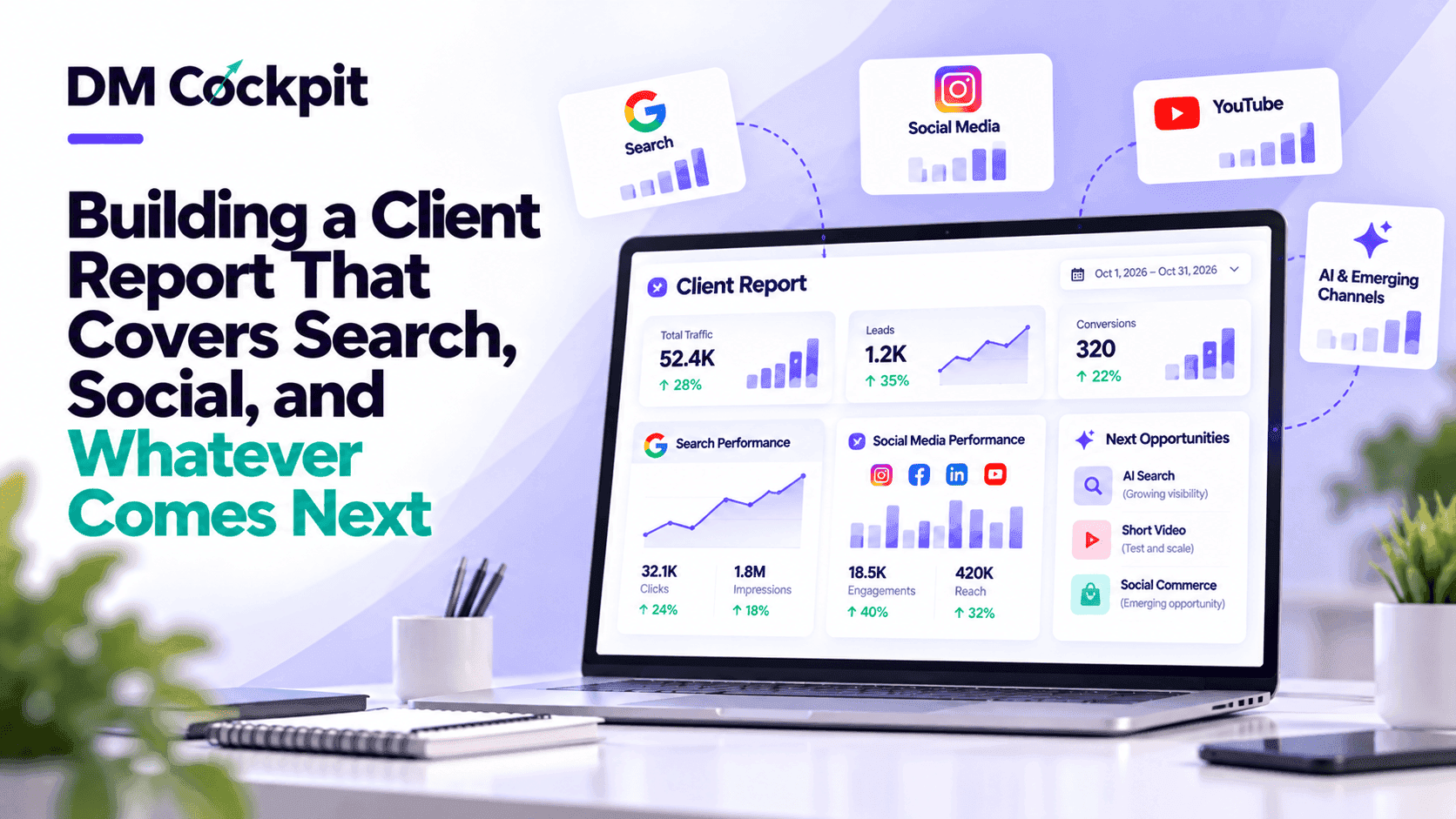
Individual marketing platforms are prone to change, and a client report based on them can quickly become obsolete. An agency is reporting on Google Search, Instagram and LinkedIn. Next, the client wants to know about a new advertising channel or traffic from a new social network, or about AI search visibility.
An additional dashboard shot may be the answer to the present request. However, after several months, the report becomes more difficult to read, more time consuming to prepare and less valuable to make decisions.
Future proof client reporting works best when reports are organized around business objectives rather than individual platforms.
This means that agencies can test new channels without having to have a new reporting system every time the marketing environment evolves.
Start With the Questions Clients Actually Want Answered
Clients usually don't require all of the metrics in their marketing accounts. They are interested in knowing if their investment is having an impact.
A useful report should answer five questions:
- Are we reaching the right audience?
- Are people engaging with our marketing?
- Are those interactions generating leads or sales?
- Which activities are contributing to progress?
- What should we change next?
Whether the agency is tasked with SEO, paid advertising, social media or channels that are not yet widely used, these questions remain relevant.
Imagine you're a B2B software firm that is actively using Google, LinkedIn, and organic search marketing. The marketing team may be recording hundreds of metrics for individual pieces. Its leadership needs to know, however, is the growth of qualified leads and rate of conversion, as well as which channels are helping to build the pipeline.
The difference should shape the structure of the report.
Build the Report Around Four Permanent Sections
Rather than having each of the marketing platforms report separately, agencies can establish a framework that will continue to be relevant regardless of the changes in marketing channels.
|
Reporting section |
What it should explain |
Example metrics |
|
Audience reach |
How potential customers discover the business |
Impressions, visibility, reach |
|
Engagement |
How people respond to marketing activity |
Clicks, engagement rate, engaged sessions |
|
Conversions |
Whether marketing contributes to business goals |
Leads, purchases, qualified inquiries |
|
Business impact |
What results mean for future decisions |
Conversion trends, attributed revenue, lead quality |
These sections are the basic elements of a flexible reporting system.
Audience reach: Show where visibility is growing
Search rankings, social media impressions and advertising reach are all different measures. But they all play a role in determining the visibility of a company to prospective customers.
Have the numbers by the channels available, and discuss them as a group.
If the volume of clicks from organic search decreases and the number of clicks from social traffic increases, the audience discovery behavior has shifted, for instance. That does not necessarily mean one channel has replaced the other.
Engagement: Look beyond surface-level activity
Not all high impressions are reflective of high audience interest.
When visitors are finding a brand, an agency should review their intent to take any meaningful actions.
This could be the activity of:
- Website visits from campaigns
- Engaged sessions
- Content interactions
- Landing page performance
- Returning visitors
The aim is to share what engagement means, not all available numbers.
Conversions: Connect activity to meaningful actions
The reporting of conversions should be centered around what is important to the client's business.
That could be completed purchases for an e-commerce company. In the case of a service business, it might be inquiries or booked consultations that are qualifying.
The agencies should also discuss the limitations of attribution. A customer can find a business via social media and then access them via Google and finally via the click of an e-mail and then convert.
No report should make an assumption that a certain channel is the channel of information for which data is lacking.
Business impact: Explain what happens next
That's where reporting is helpful in the decision making process.
Don't conclude with the performance numbers, but discuss what the numbers tell you about the next steps.
The report could suggest refining a landing page, reviewing a campaign that isn't doing as well, or sticking with a channel experiment before scaling it up.
Recommendations must always be related to evidence.
Separate Core Metrics From Channel-Specific Details
A frequent reporting error is to report on all metrics equally.
An improved system employs two types of information.
Level 1: Core performance summary
This includes the metrics that remain consistent across reporting periods, such as total qualified leads, website conversions, and overall campaign performance.
Level 2: Channel-specific supporting details
This contains the information needed to understand individual channels.
For example:
|
Channel |
Supporting metrics |
|
Organic search |
Rankings, clicks, impressions, organic conversions |
|
Paid search |
Click-through rate, conversions, campaign performance |
|
Social media |
Reach, engagement, referral traffic |
|
Email marketing |
Opens, clicks, attributed conversions |
|
Verified referrals, observed brand mentions, supported visibility indicators |
Not all metrics are directly comparable. An impression on Instagram is not a Google Search impression.
The intent of this structure is to provide a consistent and stable main report and to facilitate detailed analysis if desired.
Make New Channels Easy to Add
Suppose that a client starts playing around with a new advertising medium.
The agency could use a traditional reporting system to develop a whole new report section, add screenshots and redesign the monthly report presentation.
A modular report is a different kind of a report.
Step 1: Identify the channel's role
Determine whether the new channel is primarily intended to generate awareness, engagement, leads, or sales.
Step 2: Select meaningful measurements
Select measures that will serve that purpose.
Engaging with the audience and reach could be helpful for an awareness campaign. Qualified inquiries and conversions might be more important for lead generation.
Step 3: Check measurement reliability
Check to ensure the platform is consistent in its data prior to adding figures to the main report.
Ask if conversions can be measured, if definitions of reporting are known and if numbers can be compared over time.
Step 4: Add the channel to an existing reporting section
Put its performance under the right business objective.
The primary organization of the report remains the same.
That's the practical benefit of future-proof client reporting. Agencies can increase their reporting without having to repeat the client's interpretation of performance.
Give Emerging Channels a Separate Testing Status
Not all new marketing channels are suitable for displaying in the primary performance overview.
The data or the reporting style, or the attribution of the experiments is not consistent in early experiments.
A separate testing section helps to avoid false comparisons.
|
Test detail |
What to record |
|
Channel |
Where the experiment is running |
|
Objective |
What the agency wants to learn |
|
Measurement |
Which indicators are available |
|
Limitations |
What the data cannot confirm |
|
Next decision |
Continue, adjust, expand, or stop |
This can make it easier for clients to identify successful marketing activities from the ones that are still in the testing phase.
It also helps to stop agencies hyping their initial results.
Positive engagement after two weeks may be encouraging, but it does not establish long-term business value.
Use a Monthly Reporting Structure That Clients Can Follow
A consistent report should be easy for clients to scan without interpreting dozens of charts.
This is a real-life example of a monthly structure.
Page 1: Executive performance summary
Add reporting period, key business outcomes, major changes and the most important recommendation.
Page 2: Progress against business goals
Demonstrate if the marketing program is progressing towards agreed goals.
Give a reason for the difference between targets and actuals.
Page 3: Channel contribution
Provide a general overview of how search, social, paid campaigns and other active channels helped to perform.
Page 4: Key findings and limitations
Explain the significant trends, unusual findings, and any data quality issues.
Page 5: Next month's priorities
List the actions recommended by the agency, the owner of the action, and what will be reviewed next.
Detailed channel reports can appear in an appendix or linked dashboard.
This creates a narrative that clients can follow and then includes the supporting information.
Keep Historical Comparisons Meaningful
When new channels are added, there will be another reporting challenge: historical comparisons.
What if an agency starts counting a new advertising source towards total traffic? Very large visitor numbers could be reported in the next month.
If no context is provided, the client may think that they must have suddenly got better in their campaigns.
Agencies should be conscious about the coverage changes and when it happens.
Useful practices include:
- Recording when new channels enter the report
- Keeping metric definitions consistent
- Separating comparable historical figures from newly added data
- Explaining changes in attribution or tracking
- Avoid combining metrics that use different definitions or measurement methods.
These details might not be significant, but they help maintain the report's credibility.
Turn Performance Data Into Decisions
A report should not just be a description of what has happened. It should be used to assist in the client's next steps.
For instance, organic traffic may increase while qualified inquiries remain unchanged.
The report should discuss what might have happened. Are your visitors arriving at information pages without definite paths to conversion? Are there any changes in the audience? Are there any tracking problems with recorded leads?
One good step that can be taken next would be to check landing page performance instead of suggesting that they just pump more out there.
A structured approach to content marketing ROI and SEO performance can help connect marketing activities with business results.
If there are technical website problems that are identified during a report, a website audit tool can help support any recommendations made with regards to crawlability, page performance, SEO, or any other issues.
What's important is that for each recommendation there is a clear reason.
Make Reporting Easier to Maintain
A good reporting system can be challenging to manage if all changes have to be made manually.
The way that reports are put together and evaluated should be recorded by agencies.
This is a brief checklist for reporting that can cover:
- Data sources and reporting periods
- Metric definitions
- Tracking changes
- Quality checks
- Client-specific objectives
- Recommendations requiring follow-up
While repetitive data gathering can be lessened with automation, human review is still necessary.
Someone still needs to explain why performance changed, whether the data is accurate, and what the client should do as a next course of action.
A Reporting System That Can Grow With Your Clients
Marketing channels will continue changing. Client expectations will change with them.
Agencies aren't required to anticipate all of the new platforms that will come down the road. They require reporting frameworks that pull out business results from channel-specific reporting.
At DM Cockpit we can help you move your performance data into a more structured environment, and make it easier for your marketing team to review marketing activity and areas for improvement.
We're focused on helping agencies spend the least amount of time searching out disjointed information and the most amount of time knowing what information their clients need.
Frequently Asked Questions
1. What is future proof client reporting?
Future proof client reporting is an approach that organizes marketing performance around consistent business objectives instead of individual platforms. It allows agencies to add new channels while maintaining a familiar reporting structure.
2. How can agencies report on multiple marketing channels?
Agencies can group metrics into categories such as reach, engagement, conversions, and business impact. Channel-specific details can then support the main summary without overwhelming clients with unrelated measurements.
3. Should every new marketing channel appear in client reports?
Not immediately. Experimental channels can be included in a separate testing section until their data becomes reliable enough for regular performance comparisons. This helps clients understand early results without confusing them with established campaign outcomes.
4. What metrics should a digital marketing client report include?
The right metrics depend on the client's objectives. Common examples include qualified leads, conversions, website traffic, engagement, and campaign performance. Agencies should prioritize measurements that support decisions rather than reporting every available statistic.
5. How often should agencies update client reports?
Monthly reporting works for many ongoing marketing programs, while active advertising campaigns may require more frequent monitoring. The reporting schedule should reflect campaign activity, client expectations, and how quickly decisions need to be made.
6. How can agencies make marketing reports easier to understand?
Use a short executive summary, consistent metric definitions, clear comparisons, and specific recommendations. Keep detailed technical information available separately so clients can understand the main findings without reviewing every data point.