
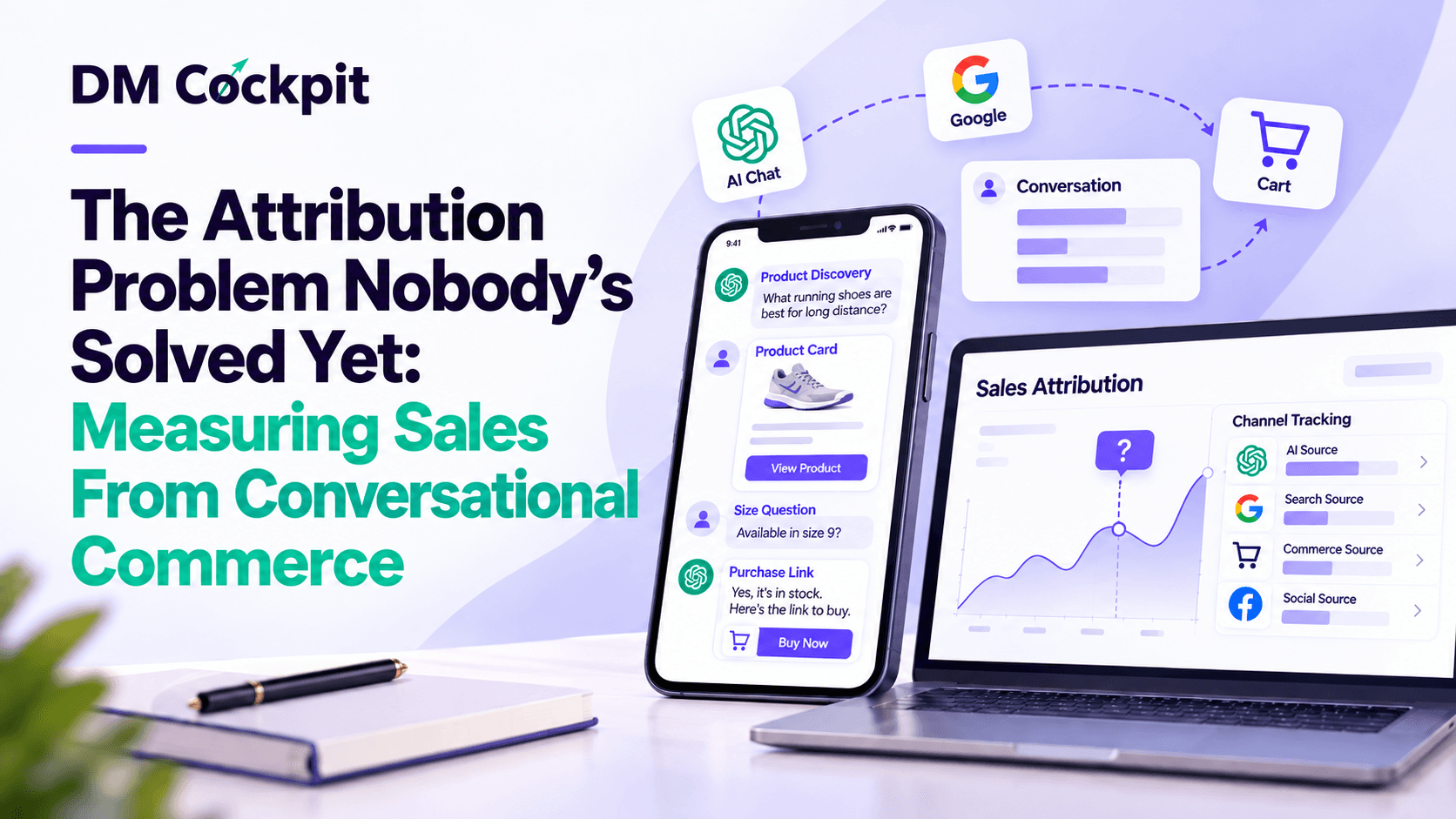
A customer discovers a product through search. After a couple of days, they consult an AI assistant for alternatives. They keep the conversation going, they compare features, they get a recommendation and then they end up on the brand's web page to make the purchase.
In analytics, the sale will be displayed. But what should be credited for it?
The fundamental question in conversational commerce attribution is what happens when a customer interacts with your brand through a conversation. A key measurement challenge for agencies is an uncomfortable one: The customer journey can affect a sale, but it can do so without being fully tracked through the traditional reporting chain.
The solution is not to create certainty when it doesn't actually exist. Agencies need to separate what can be measured from what can only be inferred.
Follow One Customer and Watch the Trail Disappear
Consider a simplified buying journey:
- Maya searches Google for a product category.
- She visits a retailer but leaves without buying.
- Two days later, she asks an AI assistant to compare several options.
- The conversation helps her narrow the choice.
- She later returns to the retailer.
- She completes the purchase.
Some aspects of this process can be tracked via traditional analytics. The website visit, landing page, the behavior of the session and the purchase can all be visible.
The difficult part is step four.
How much influence did that conversation have?
Did it introduce the product? Reinforce an existing preference? Remove an objection? Simply repeat information Maya already knew?
A conversion event alone cannot answer those questions.
That is where the attribution chain becomes incomplete.
The Dark Funnel Is Getting Darker
The phenomenon of hidden influence has been a problem for marketers for years.
Influence can come through colleagues, podcasts, private messages, offline conversations, communities and other sources that aren't always generating a clean digital referral.
Conversational interfaces take it another step.
A user might have a conversation with an AI system for several minutes before going to a company's website to make a purchase. That transition, and the referral information that is passed, can mean that analytics won't show the entire back-and-forth or its impact.
As per Google's explanation, when there is no clear referral source, GA4 can be used to identify traffic as (direct) / (none). Missing campaign information, copied links, offline documents, redirects, and other situations can contribute to lost source information.
So “direct” should not automatically be interpreted as “this person independently remembered the URL and typed it.”
Sometimes, the trail simply became incomplete.
What GA4 Can Tell You: and What It Cannot
The distinction matters when reporting results to clients.
GA4 remains valuable because it can show measurable activity once users reach properties where tracking is implemented. Traffic-source dimensions can identify sources, mediums, campaigns, source platforms, and channel groups when the necessary information is available.
For an agency, that means you can still examine:
- sessions and users
- landing-page activity
- traffic sources
- engagement
- key events
- purchases or leads
- campaign-tagged traffic
- changes in direct and referral traffic
Don't make up a full story from evidence that is not complete.
GA4 cannot recreate the information from a detailed product conversation carried out elsewhere and subsequently no longer available.
That distinction should appear in client reporting.
Think in Three Evidence Levels
A simple reporting model helps.
|
Evidence level |
What you have |
How to report it |
|
Observed |
Tracked visit, source, campaign or conversion |
State it directly |
|
Associated |
Traffic/conversion pattern changes alongside an activity |
Describe the relationship |
|
Inferred |
Evidence suggests influence, but the path is incomplete |
Label it as a hypothesis |
The third row is where agencies need discipline.
Correlation is useful. It's not the same as attribution, though.
Partial Attribution Is Better Than False Precision
Suppose a client begins appearing more frequently in AI-generated recommendations.
Over the next month, the agency sees:
- more branded searches
- increased direct traffic
- stronger visits to product pages
- more returning users
- additional conversions
Those movements are worth investigating.
But saying, “AI conversations generated 27% of this month's sales” would require evidence capable of supporting that number.
A better report would state that the change occurred over the same time and describe the signals that changed.
This approach makes conversational commerce attribution less impressive on a slide, but is much more justifiable in the client meeting.
Build a Measurement Layer Around What You Control
Not all external platforms can give agencies the perfect referral and conversation-level data.
They can enhance the measurement at their own destinations.
1. Keep campaign tagging disciplined
If possible, use the same UTM conventions for destination links.
For marketing links, Google suggests proper tagging to avoid any traffic being lost due to missing out on some parameters.
Avoid letting each team member invent a new naming convention.
2. Get landing-page conversion tracking right
Downstream behavior is even more important when the source is imperfect.
Monitor activities that show show evidence of progress, such as:
- Lead submissions
- Account registrations
- Demo requests
- Purchases
- Other confirmed business conversions
The exact events should match the client's actual objectives.
3. Watch direct traffic instead of dismissing it
A rise in direct traffic is not proof of AI influence.
It is a signal worth examining alongside other evidence.
Look at landing pages, geography, timing, new versus returning users, branded search activity, and conversion behavior before forming a hypothesis.
4. Compare periods around known changes
Create a baseline of the brand before a new conversation or discovery surface is added.
Then compare what happens.
You still may not establish causation, but you have a much stronger reference point than memory or anecdotal impressions.
Your Attribution Report Needs an “Unknown” Category
This may be the hardest adjustment for agencies.
Clients naturally want every conversion assigned somewhere.
Search generated this much. Paid social generated that much. Email generated the rest.
Modern customer journeys do not always cooperate.
GA4 itself can display values such as Direct, Unassigned, (not set), or Unattributable when the information needed for a dimension or attribution path is unavailable or cannot be assigned as expected.
Avoid uncertainty, rather explain it.
Simply report:
“Some conversions have no reliable identifiable upstream source. These are included in total conversions but are not assigned to a conversational channel without supporting evidence.”
The sentence helps to keep the report intact.
Don't Turn Every Direct Visit Into an AI Conversion
As conversational commerce attribution becomes a bigger discussion, there is a temptation to create new rules that make reporting appear more complete.
For example:
“Direct traffic increased after our AI initiative, therefore the additional direct sales came from AI.”
That is not a safe assumption.
Direct traffic can have multiple causes. Google specifically notes several situations in which referral information may be absent.
The agency is not responsible for removing uncertainty, just reducing it.
That could involve utilizing analytics and client CRM data, post purchase questions, campaign tagging, platform reporting, branded search movement and, when relevant, controlled tests.
It is not always possible to find the entire answer in one place.
Better Reporting Starts With Better Boundaries
Attribution can be helpful since it allows the agency to determine where to invest attention and resources.
An attribution model can be dangerous, however, when the tidiness of the dashboard is confused for certainty of human actions.
That is a weakness that's easier to see in conversational commerce.
We help agencies view Google Analytics reporting in a new light at DM Cockpit, such as sessions, channels, traffic sources, landing pages and conversion data. Our Google Analytics Reporting Tool can simplify tracking and reporting the measurable part of the customer journey. It will not create a referral chain that doesn't exist and a good agency report should not try to fool the user.
The aim is not to achieve an "attribution-free" situation. It's the awareness of where the evidence stops, and where your interpretation starts.
Frequently Asked Questions
1. What is conversational commerce attribution?
It is the process of trying to understand how conversations through AI assistants, chat interfaces, messaging environments, or similar experiences contribute to customer actions and sales. The difficulty is that these interactions may not always pass enough information into a company's analytics system to establish a complete journey.
2. Can GA4 track sales influenced by AI conversations?
GA4 can track activity that reaches a properly measured website or app and can identify traffic sources when suitable referral or campaign information is available. It cannot automatically reconstruct every external conversation that may have influenced a person before the visit.
3. Does direct traffic mean the customer typed the website address?
Not necessarily. Direct traffic indicates that Analytics does not have a clear referral source for the session. Typed URLs and bookmarks can create direct visits, but missing campaign information and some other referral situations can also result in direct traffic.
4. How can agencies improve attribution for emerging channels?
Start with the parts of measurement you control. Maintain consistent UTM tagging, configure meaningful conversion events, establish performance baselines, review landing-page behavior, and combine analytics data with other verified client information.
5. Should agencies attribute an increase in direct sales to AI exposure?
Not without supporting evidence. A simultaneous increase can justify investigation, but it does not establish causation. Agencies should present it as an association or hypothesis unless they have stronger attribution evidence.
6. Will conversational commerce ever have perfect attribution?
Measurement is likely to improve as platforms and analytics systems evolve, but “perfect” attribution is a difficult standard because customer decisions can involve private, offline, cross-device, and untracked interactions. A more practical goal is stronger evidence, clearer tracking, and transparent reporting about what remains unknown.