
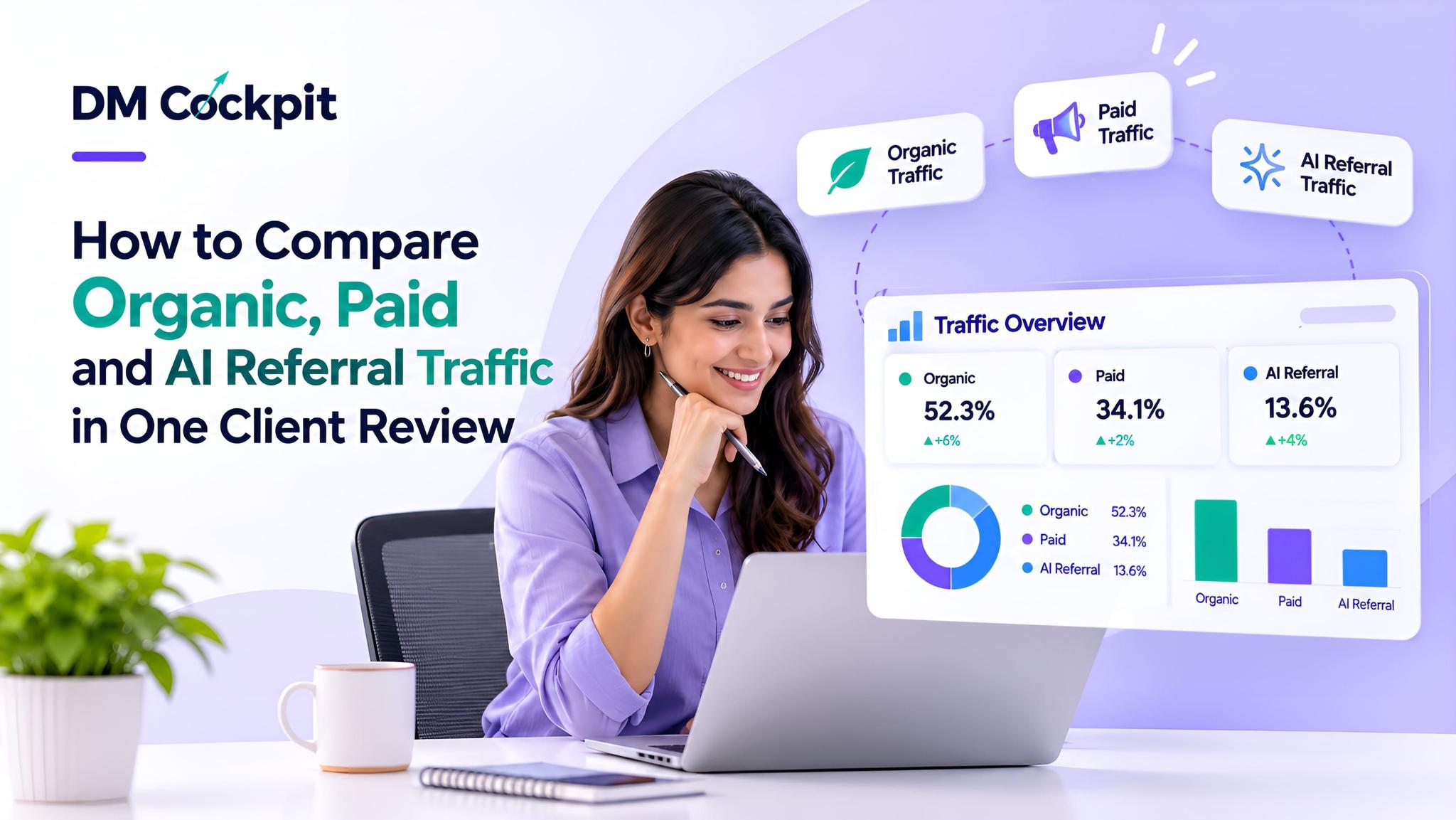
A marketing agency launches its monthly dashboard. There have been some decreases in organic traffic, some increases in paid traffic and an increase in sessions from ChatGPT and other AI platforms.
The client asks, ‘Is our digital marketing improving?
The answer involves more than identifying which channel was the one that brought the most visitors.
To determine the impact of each traffic source on website engagement and business outcomes, agencies must compare organic paid and AI traffic.
However, these channels are used for different things. A user that has searched in Google could be looking for information or a person that is paying for the advertising can be looking for a comparison.
An effective client review will provide this clarity but not confuse stakeholders with a lot of disconnected reporting.
Three Traffic Sources, Three Different Roles
Agencies need to be familiar with each acquisition source first before making comparisons.
|
Traffic source |
How visitors arrive |
What agencies should examine |
|
Organic search |
Unpaid search engine results |
Sessions, engagement and key events |
|
Paid traffic |
Advertisements across search, social and other platforms |
Campaign sessions, conversions and lead quality |
|
AI referrals |
Identifiable links from AI-powered platforms |
Referral sources, engagement and key events |
Organic search is a way of discovery using search engines. Paid campaigns can be used to target audiences of interest, and AI assistants can also be used as a way for people to find websites.
But, there are also AI-powered experiences that fit into the traditional search engines.
Google Analytics 4 (GA4) now has an AI Assistant default channel for popular sources like ChatGPT and Copilot. This classification does not include AI Overviews and AI Mode from Google.
Agencies need to differentiate identifiable AI Assistant traffic from general AI-driven discovery.
A Client Review That Changed the Conversation
Imagine you are working with a fictional agency for a business software company for their digital marketing.
The following website sessions are reported in its monthly report.
|
Channel |
Previous month |
Current month |
Change |
|
Organic search |
12,000 |
11,400 |
-5% |
|
Paid traffic |
6,000 |
7,200 |
+20% |
|
Identifiable AI traffic |
200 |
450 |
+125% |
|
Total |
18,200 |
19,050 |
+4.7% |
Illustrative figures for these three selected channel categories only.
The first impression is positive. Combined sessions grew and so did the amount of traffic that was AI-related, more than doubling in amount.
Does that mean that the business got better-quality queries?
Not necessarily.
Before it draws the conclusion that the engagement, conversion activity, and incoming leads quality are all signs of commercial progress, the agency needs to investigate them.
The 125% increase needs context given the relatively low traffic levels.
Establish a Consistent Reporting Foundation
Various platforms have different measures.
Google Ads captures advertising interactions and performance of conversions, and GA4 does website and app analytics.
Adding figures together without knowing what they represent can lead to misinterpretation of the data.
Agencies should have the following rules in place before creating a client review:
- Reporting period: Include comparable website metrics, using the same date range.
- Primary metric: Determine which is the best metric to use for reporting, sessions or users or key events.
- Channel classification: Record the identification of the source of each channel.
- Conversion definitions: When comparing outcomes use consistent business actions.
- Attribution: Explain the difference in the ways platforms award conversion credit.
- Data limitations: Recognise the lack of data, delays in data reporting and consent restrictions.
The Traffic acquisition report in GA4 is a great place to start comparing traffic acquisition sources at the session level.
Google Ads and other campaign platforms can offer more context when analysing the ads themselves.
The aim is consistency, not uniformity of the figures on all platforms.
Look Beyond Traffic Volume to Understand Visitor Quality
An increase in traffic doesn't mean an increase in sales.
There are three other areas to review that make for a meaningful review.
1. Engagement: Are Visitors Interacting?
When a visitor is engaged in the session, and their engagement rate, the agencies can get an understanding of how the visitors interact with the website.
An AI Assistant session could report high engagement levels while recording comparatively low levels of sessions, for instance.
But not all engagements result in a purchase intent or high-quality leads.
2. Key Events: Are Visitors Taking Action?
Relevant actions to review are completed enquiry forms, registrations or demo requests.
Even if the overall traffic is low, a smaller acquisition channel could be providing valuable business outcomes.
For lead generation businesses, CRM records and sales feedback can provide additional evidence of enquiry quality.
3. Landing Pages: Where Does Interest Begin?
Visitors to your site may come from various sources and be directed to various pages.
It might be possible to attract organic search traffic to educational articles, and paid search traffic to dedicated landing pages.
AI referrals may lead to guides, product pages or detailed resources.
These patterns can be seen when analysing channel performance, which can help agencies understand what is going on.
Present All Three Channels in One Report
A single reporting table may help make performance differences more understandable.
Consider this second illustrative view of the same fictional business.
|
Metric |
Organic |
Paid |
AI |
|
Sessions |
11,400 |
7,200 |
450 |
|
Engagement rate |
62% |
55% |
71% |
|
Key events |
180 |
145 |
22 |
|
Key events per 100 sessions |
1.58 |
2.01 |
4.89 |
Illustrative figures only. The final row assumes one consistently configured key event is being compared.
The AI channel shows the highest engagement rate and the most key events relative to its session volume.
However, organic search still generates substantially more total key events.
This is why agencies should compare organic paid and AI traffic using both absolute figures and appropriate rates.
Even then, key events do not necessarily represent unique customers or qualified leads.
The report should describe what the measurements are telling, rather than saying that one channel is the best.
Five Reporting Mistakes That Can Mislead Clients
There are plenty of ways that even seasoned marketers can misinterpret when comparing sources of acquisition.
- Treating all AI-influenced visits as identifiable AI traffic
Some AI interactions do not result in an identifiable acquisition source. Some visits may be attributed to other channels.
- Comparing advertising clicks directly with GA4 sessions
Click and website sessions are two different metrics. Do not substitute their totals for each other.
- Assuming engagement proves lead quality
Engagement shows website interaction. Qualified leads require additional business evidence.
- Overreacting to small traffic samples
The percentage jump could be the result of relatively few more visits.
- Ignoring changes outside the dashboard
The performance reports can be affected by seasonality, campaign changes, changes to the website and tracking.
This awareness of the limitations can give credibility to the client when discussing matters.
Turn the Dashboard Into a Meaningful Client Discussion
It's unusual for the client to have to understand each one of these metrics individually.
They would like to know about three things:
- What changed? Identify important movements across acquisition channels.
- Why does it matter? Relate those changes to engagement, key events and business goals.
- What happens next? Make appropriate investigations or marketing suggestions.
For instance, an agency could state that organic search is still the biggest acquisition channel, paid search is driving more sessions, and identifiable AI traffic is becoming a smaller channel that needs to be tracked.
The next review may be on whether those visitors then turn into a qualified enquiry.
This makes reporting the business performance and not just a list of isolated numbers.
Bring Your Marketing Reports Together
It's even more difficult to compare acquisition channels when agencies have multiple clients and frequently move from one reporting platform to another.
At DM Cockpit, we help marketing teams organise important SEO, advertising and analytics information through a centralised digital marketing dashboard. Our reporting tools aid in providing better performance reviews and enable agencies to report with greater confidence.
We believe useful reporting should remain simple, not more complex.
Frequently Asked Questions
1. What is the difference between organic search and AI referral traffic?
Organic search generally includes visits from unpaid search engine results. Identifiable AI referral traffic comes through links associated with AI-powered platforms. GA4 also recognises an AI Assistant channel, while Google's AI Overviews and AI Mode are excluded from that classification.
2. Can GA4 identify visitors coming from AI platforms?
Yes, GA4 can recognise certain AI-related sources when suitable acquisition information is available. Its AI Assistant channel helps classify identifiable visits, but it cannot measure every interaction or recommendation involving AI platforms.
3. Why do Google Ads clicks and GA4 sessions show different numbers?
Google Ads clicks measure advertising interactions, while GA4 sessions measure website activity. Tracking limitations, consent preferences, session attribution and reporting differences can contribute to discrepancies between the platforms.
4. Which traffic source is best for generating conversions?
There is no universally best source. Performance depends on the business, audience, campaign objectives and visitor intent. Agencies should compare relevant key events, qualified enquiries and actual business outcomes rather than traffic volume alone.
5. How often should agencies review AI-related website traffic?
Monthly reviews are a practical starting point for many agencies. Websites receiving substantial identifiable AI traffic may benefit from more frequent analysis, while smaller samples should be interpreted cautiously.
6. What should a combined marketing traffic report include?
A useful report should include channel-level sessions, engagement rates, relevant key events, landing pages, period-on-period changes and important measurement limitations. It should also explain the main findings and recommend practical next steps.