
A client comes to the marketing review meeting and asks, “Should we begin advertising on AI platforms?”
This may seem like a straightforward question. But first, a successful account manager is on a mission to understand the client's definition of AI ads.
Do they want information on ad creatives produced by AI? Automated campaign optimization? Or advertising experiences in the context of AI-driven search and conversational experiences?
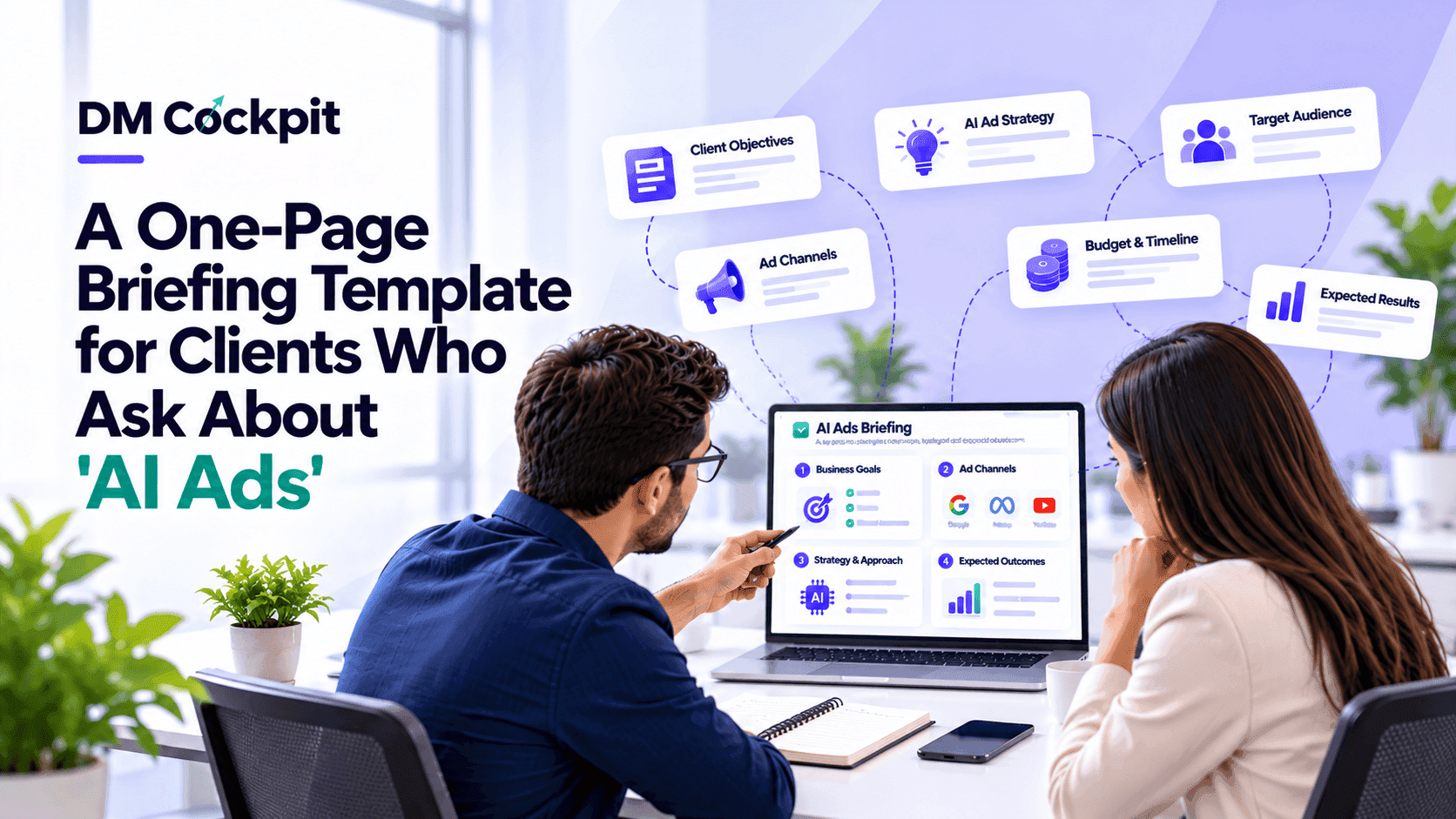
A client briefing template for AI ads can help agencies understand the distinction and also discuss chances and suggest future steps, while keeping their clients from getting lost in technical language.
The following is a one page briefing structure you can copy, customize and share once the question is raised by the client.
First, clarify what the client means by AI ads
AI ads can encompass a variety of advertising strategies.
|
Type of AI advertising |
What it means for clients |
|
Using AI to help produce advertising images, copy, or variations |
|
|
AI-assisted campaign optimization |
Using automated systems to support targeting, bidding, and delivery |
|
Advertising in AI-powered experiences |
Exploring promotional placements within supported AI search or conversational products |
|
Using AI to interpret campaign results and identify patterns |
These categories should not be shown as alternatives.
A business that has an active Google Ads campaign, for instance, could be leveraging the AI capabilities of Google Ads campaigns without advertising within a conversational AI product.
The initial task that the agency has to do is determine which opportunity the client wishes to investigate.
The one-page AI advertising client briefing template
Copy the following five-section briefing into a single-page client document. Keep each response concise.
1. Business context
Client: [Business name]
Prepared by: [Agency or account manager]
Date: [Insert date]
Current marketing channels: [Google Ads, Meta Ads, SEO, email, etc.]
Primary business objective: [Lead generation, brand awareness, customer acquisition, etc.]
Client's question: [What advertisement opportunity would we like to consider?]
Briefing summary:
We are exploring advertising opportunities with Artificial Intelligence (AI) that can complement your current marketing goals. The recommendations we make will be based on the relevance of the audience, the variety of advertising options, and the extent of reliability in measuring results.
2. What is changing?
AI is transforming business campaign creation, optimizing ads, and targeting new customer audiences.
Machine learning is already being harnessed in advertising, with some platforms already using it extensively. Other AI-powered experiences are introducing or testing new promotional formats.
But availability, targeting controls, reporting capabilities, and availability to the ads vary depending on provider and market.
The bottom line for your business: AI advertising is worth a look, but you don't have to implement all the new features right away.
3. Potential business opportunities
|
Opportunity |
Possible business value |
|
Faster creative testing |
Explore more messaging ideas |
|
Automated campaign optimization |
Support ongoing campaign adjustments |
|
Emerging advertising placements |
Reach audiences through additional discovery experiences |
|
Improved reporting workflows |
Identify performance changes more efficiently |
The following are potential benefits; they are not promises.
Recommendations should be made based on the client's audience, past campaign performance and the ability of the advertising product being recommended.
4. Risks and limitations
Before approving a new advertising test, consider:
- Audience uncertainty: Does the intended customer actually use the channel?
- Limited measurement: Can the business identify meaningful results?
- Creative accuracy: Could AI-generated messaging contain misleading claims?
- Brand consistency: Will the advertising match the company's established voice?
- Platform maturity: Are the necessary advertising controls available?
A promising new channel is not automatically a suitable channel.
5. Recommended next steps
Our recommendation: [Explore now / Monitor developments / Continue existing approach]
Reason: [Explain the business case in two or three sentences]
Proposed action: [Review platform availability, assess audience fit, or prepare a controlled campaign test]
Success indicators: [Qualified leads, conversions, engagement quality, or other relevant metrics]
Next review: [Insert review date or decision milestone]
Client approval: [Approved / More information required / Deferred]
Note for account manager: Ensure that the briefing is no longer than one page and only includes the most relevant information for the business context, opportunity, risks and recommendation.
How account managers should customize the briefing
Only a template that is based on the client's business situation will be useful.
AI advertising, for instance, could be beneficial for a variety of different reasons for an ecommerce brand, whereas for a B2B software company, the motives might differ entirely.
Look at the following two examples.
Example A: An ecommerce client
The client would like to leverage advertisements that have been created via AI for products to be used in their current social media marketing efforts.
The agency could focus its briefing on:
- Product information accuracy
- Creative consistency
- Testing different messages
- Monitoring engagement and conversion performance
The suggestion could be a small creative project in a set, already established marketing account.
Example B: A B2B software client
The client would like to know if the people interested in purchasing will be able to find its software using conversational AI.
With this, the question that may arise does not always center around paid advertising.
The agency needs to differentiate between ads and organic visibility in its AI answers.
For a bit of background: The Guide to Answer Engine Optimization (AEO) and visibility in ChatGPT and Gemini provides information on how it's better for businesses to approach discovery with AI rather than a conventional search engine.
The difference is intended to keep clients from being misled that AI search visibility is the same thing as paid advertising opportunities.
Five questions to answer before recommending an AI advertising test
The recommendation could be a small creative test within an existing advertising account.
Utilize these questions during the client discussion.
- Is the opportunity currently available?
Ensure that the advertising product is appropriate for the client's market, business category and intended campaign format.
- Does it reach the right audience?
If the target customers don't see it, it is of limited value to the business.
- Can results be measured?
Determine what can be reported and if there are meaningful outcomes that can be linked to the activity.
- Is the existing campaign performing well?
If campaigns already running have performance issues, it might be more complicated to expand into another channel.
- What would justify continuing?
Decide what evidence must be gathered in order to continue, change or terminate the experiment.
These questions help agencies move from speculation to a structured decision-making process.
Common mistakes that weaken AI advertising briefings
It can get more complicated than necessary even for experienced account managers.
|
Common mistake |
Better approach |
|
Calling every automated feature an AI advertising channel |
Explain the specific technology or placement |
|
Promising improved campaign performance |
Describe expected benefits as hypotheses |
|
Recommending a new channel without audience research |
Establish audience relevance first |
|
Presenting AI search mentions as paid advertising results |
Separate organic visibility from advertising |
|
Using technical terminology throughout |
Explain what changes for the client's business |
|
Ending without a recommendation |
Provide a clear next action and review point |
The objective is not to make the briefing sound high tech. It's to ease the client's decision.
Make the briefing part of your regular client workflow
A useful client briefing template for AI ads should not be created from scratch every time a client asks about a new technology.
Agencies can have a general document, and only change the portions that might alter.
For example:
- Keep the business context and approval sections consistent.
- Update platform information when new advertising features become available.
- Add client-specific audience and campaign observations.
- Record recommendations and agreed next steps.
- Review the original assumptions after any approved test.
The other benefit of the method is that a good history of the agency's recommendations and reasons is maintained.
The account manager can come back to the topic after a few months, and suggest referring the client to the first briefing, without the need to repeat it.
Give Clients Clarity Before Asking Them to Experiment
Clients don't have to have an account manager who advises them on all the latest advertising trends. They want someone to fill them in on what is important, what is not, and what has to be studied further.
That conversation will be facilitated with a briefing. It's also useful for agencies to have realistic expectations when launching new advertising opportunities.
At DM Cockpit, we help marketing teams keep a clearer view of their digital marketing activities through centralized monitoring and reporting tools. We think more visibility means more informed conversations, particularly as agencies consider new advertising opportunities in addition to existing ones.
Frequently asked questions
1. What should an AI advertising client briefing include?
It should explain the client's business objective, the specific AI advertising opportunity, potential benefits, limitations, measurement options, and recommended next steps. Keep the language simple enough for a nontechnical decision-maker to understand.
2. How is AI advertising different from traditional digital advertising?
AI advertising often involves automated optimization, AI-assisted creative production, or placements within AI-powered experiences. Traditional digital advertising can also use automation, so the distinction depends on the specific product and feature being discussed.
3. Should agencies recommend AI ads to every client?
No. Recommendations should depend on audience behavior, campaign objectives, platform availability, and measurement capabilities. Some businesses may benefit more from improving existing advertising activities before exploring emerging opportunities.
4. Can AI advertising guarantee better campaign performance?
No. AI-related features may support creative development or campaign optimization, but results depend on many factors, including audience relevance, messaging, competition, and campaign execution.
5. How often should agencies update an AI advertising briefing?
Update it when relevant platform capabilities, advertising policies, audience information, or client objectives change. Agencies should also revisit the briefing after completing a campaign experiment or reaching an agreed review milestone.
6. Can one briefing template work for different industries?
Yes, provided the business context, risks, and recommendations are customized. The same structure can support ecommerce, professional services, B2B technology, and other industries without assuming their advertising needs are identical.