
For years, WhatsApp has occupied a different place in the digital marketing mix. Facebook and Instagram were where brands advertised; WhatsApp was often where conversations continued. A customer might discover a business elsewhere, tap a button, and then move into WhatsApp to ask a question, request details, or follow up.
That boundary is changing.
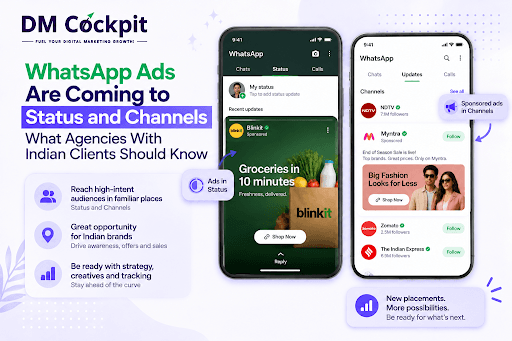
WhatsApp has introduced commercial opportunities within its Updates tab, including ads in Status and promoted Channels. For agencies working with Indian clients, this creates another Meta surface to understand, plan for, and potentially incorporate into campaigns.
There is one distinction worth making immediately: these ads are not being inserted into people's personal chats. Meta has placed these commercial experiences in the Updates tab, which houses Status and Channels, separately from private conversations.
The topic of WhatsApp Status ads agencies is becoming more relevant for teams supporting Indian clients, making that distinction important before introducing the new inventory into campaign discussions.
First, Separate the Three WhatsApp Environments
Talking broadly about "ads on WhatsApp" can give clients the wrong impression. There are different environments inside the app, and they do not serve the same purpose.
|
WhatsApp Area |
Main Role |
Advertising Implication |
|
Personal chats |
Private conversations |
Ads are not being inserted into personal conversations |
|
Status |
Temporary photos, videos, text, and other updates |
Businesses can appear through Status ads |
|
Channels |
One-way updates from organizations, creators, and businesses |
Promoted Channels can improve discovery |
This distinction matters because privacy concerns are likely to be among the first questions agencies receive.
Meta says personal messages, calls, and Status content remain end-to-end encrypted. Personal messages, calls, and groups are not used to determine the ads a person sees. Instead, Meta says signals for relevant commercial experiences can include limited information such as location at the country or city level, language, Channels followed, and interactions with ads. People who have added WhatsApp to Meta's Accounts Center may also have information from their Meta accounts used for ad personalization.
What Meta Is Actually Rolling Out
Meta originally announced three commercial additions to the WhatsApp Updates tab: ads in Status, promoted Channels, and Channel subscriptions.
For advertisers, Status is particularly important. Ads can appear between the organic Status updates that people are already viewing. WhatsApp currently describes the format as a way for businesses to extend Meta campaigns to Status and direct interested people toward a WhatsApp conversation, a website, and eventually additional destinations.
Promoted Channels solve a different problem. Rather than being conventional Status advertising, they help Channel admins gain visibility when people are discovering Channels.
This distinction should remain clear in agency planning:
- Status ads create paid brand exposure within Status.
- Promoted Channels support Channel discovery.
- Channel subscriptions are a monetization feature for eligible Channel owners rather than a standard advertising placement.
Meta has also been bringing WhatsApp more closely into its wider advertising infrastructure. In India, businesses can manage marketing activity across WhatsApp, Facebook, and Instagram through Ads Manager, giving agencies a more connected environment for planning campaigns across Meta properties.
Why This Matters More for Agencies With Indian Clients
For Indian agencies, the significance is not simply that "WhatsApp is popular."
The more important change is that an app already deeply embedded in everyday communication is gaining a more formal discovery and advertising layer.
That can alter campaign planning. Previously, an agency might use Facebook or Instagram advertising to generate awareness and then use WhatsApp as the destination for an inquiry. Status advertising introduces the possibility of paid discovery happening within WhatsApp itself.
Meta has already highlighted Indian brands including Maruti Suzuki, Air India, and Flipkart in connection with Status ads, while promoted Channels have also begun being used in India.
For WhatsApp Status ads agencies planning campaigns for Indian clients, this means WhatsApp should no longer automatically be treated only as the final messaging step. Depending on campaign objectives and placement availability, it can also become part of the discovery layer.
That does not mean every client suddenly needs WhatsApp Status advertising. Agencies still need to consider audience behavior, campaign objectives, creative suitability, available placements, and the role WhatsApp is expected to play in the wider customer journey.
Don't Sell It to Clients as "Ads Inside Their Chats"
This is probably the easiest way to explain the change incorrectly.
Wrong: WhatsApp is putting advertisements into people's private conversations.
More accurate: Meta is introducing advertising and promotional opportunities within WhatsApp's Updates environment, away from personal chats.
The difference is more than wording.
A client hearing "WhatsApp ads" may immediately imagine sponsored messages appearing between conversations with family, colleagues, or friends. That is not how Meta has positioned the Status-ad experience.
Agencies should make this distinction early because it prevents a campaign discussion from becoming an unnecessary privacy debate based on the wrong understanding of the product.
It also creates better expectations about user behavior. Someone viewing Status is already consuming temporary visual content. That context is different from someone opening WhatsApp specifically to reply to a private message.
Where WhatsApp Could Sit in the Existing Meta Mix
WhatsApp does not need to replace Facebook or Instagram to become useful advertising inventory.
It can instead add another surface to a broader Meta strategy:
- Facebook can continue supporting reach, discovery, community, and performance campaigns.
- Instagram remains highly relevant for visual discovery, creators, Reels, Stories, and product-led experiences.
- WhatsApp Status adds another vertical, temporary-content environment within the Updates tab.
- WhatsApp Channels can provide a broadcast relationship between organizations and followers.
- Cross-platform planning allows agencies to think about where discovery starts and where the customer goes next.
That wider view also makes measurement important. Adding another placement is useful only if the agency can still understand what is happening across campaigns.
Our Meta Ads Monitoring Tool gives agencies a centralized way to monitor Meta advertising performance rather than treating every campaign view as an isolated piece of information.
What Agencies Should Prepare Before Clients Ask
There is no need to build an elaborate WhatsApp advertising strategy for every account immediately. Agencies can start by getting five fundamentals right.
For WhatsApp Status ads agencies, the immediate priority is to understand the inventory, identify suitable clients, plan appropriate creative, and establish how performance will be measured.
1. Understand the Inventory
Make sure account teams know the difference between Status ads, promoted Channels, organic Status, Channels, and private chats.
2. Identify Suitable Clients
Ask whether WhatsApp already plays a meaningful role in the client's customer journey. A new placement should solve a marketing problem, not simply be adopted because it is new.
3. Think About Creative Context
Creative built for another Meta placement should not automatically be assumed to suit Status. Consider how users consume vertical, temporary content and what action should logically follow the ad.
4. Decide What Happens After Attention
Should an interested user start a WhatsApp conversation or visit the client's website? The destination should reflect the campaign objective and the client's ability to handle the resulting demand.
5. Prepare the Reporting Conversation
Clients will want to know whether the new inventory is producing useful business outcomes. Agencies should decide what they will monitor and how WhatsApp activity fits into broader Meta reporting before adding another placement to the mix.
Keep WhatsApp Advertising Separate From WhatsApp AI
Another potential source of confusion is the growing number of AI features associated with WhatsApp.
WhatsApp advertising and AI-assisted business communication are related to the broader evolution of the platform, but they are not the same product discussion.
Status ads concern paid discovery and advertising inventory. Business AI and other assistants concern how businesses may automate or improve interactions and support.
We have explored that separate issue in our article on what Meta AI can't do on WhatsApp that DM Captain will do for you. Keeping the two conversations separate makes it easier for agencies to explain exactly what is changing and why it matters.
New Inventory Still Needs Clear Oversight
WhatsApp's evolution gives agencies another potential way to connect paid discovery with a platform customers already use for communication. The opportunity, however, should be evaluated like any other media opportunity: against the client's audience, objective, creative approach, customer journey, and measurable results.
At DM Cockpit, we focus on helping agencies keep marketing performance visible as the channel mix becomes more complicated. As Meta expands the places where businesses can reach customers, our role is to help teams monitor their advertising activity without losing sight of the bigger performance picture.
The arrival of another advertising surface should not mean another disconnected reporting process. For agencies, the stronger position is to understand what the new inventory does, explain it accurately to clients, and decide where it genuinely belongs in the wider strategy.
Frequently Asked Questions
1. Are WhatsApp ads shown inside personal chats?
No. Meta says ads in Status and other commercial features are placed within the Updates tab, away from personal chats. Personal messages and calls remain end-to-end encrypted, and Meta says private messages, calls, and groups are not used to determine the ads people see.
2. What are WhatsApp Status ads?
They are paid advertisements that appear between organic Status content in WhatsApp. Businesses can use the placement to reach people while they are viewing updates and direct interested users toward destinations such as a WhatsApp conversation or website.
3. Are WhatsApp Status ads relevant to Indian businesses?
They can be relevant where the audience, campaign objective, creative format, and customer journey make WhatsApp a useful discovery or response channel. Meta has already highlighted Indian brands using the Status-ad format, but agencies should evaluate suitability client by client rather than treating it as mandatory inventory.
4. Are promoted WhatsApp Channels the same as Status ads?
No. Status ads are advertising placements shown around Status content. Promoted Channels are designed to improve a Channel's visibility and help people discover it. They should be treated as separate commercial opportunities.
5. Can agencies manage WhatsApp alongside Facebook and Instagram campaigns?
Meta has been centralizing marketing across WhatsApp, Facebook, and Instagram through Ads Manager. For Indian businesses, Meta has specifically announced the ability to manage marketing activity across these properties from the same environment.
6. What should agencies do before recommending WhatsApp advertising?
Start by confirming current placement availability, understanding the client's audience and objective, determining the appropriate creative approach and destination, and deciding how results will be measured. The fact that a new advertising surface exists is not, by itself, a reason to recommend it.