
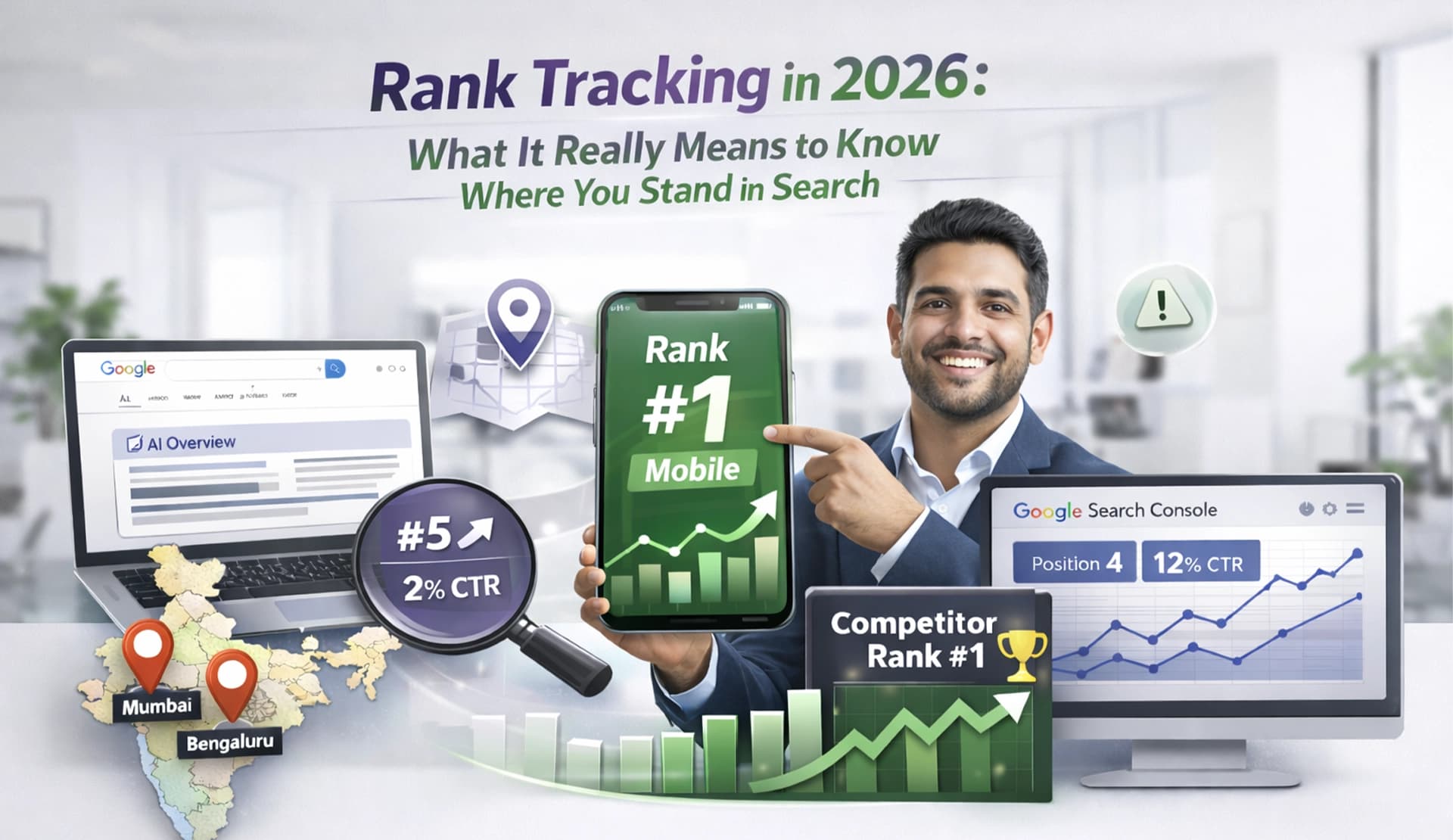
Knowing your keyword rankings is easy. Understanding what those rankings actually mean for your business that is the harder part.
Rank tracking has been a core part of SEO since the beginning. But in 2026, with AI Overviews appearing at the top of results, zero-click searches at record highs, and search results personalised by location and device, a keyword ranking number tells a significantly incomplete story if you do not know how to read it properly.
This blog is for marketers, agency professionals, and business owners who want to go beyond the surface and understand what keyword position tracking actually means in the current search environment — and how to use that data to make smarter decisions.
What Keyword Rankings Actually Measure (And What They Do Not)
A keyword ranking tells you where your website appears in a search engine's results page for a specific query at a specific moment. That is it.
What it does not tell you:
- How many people actually search that query each month
- Whether searchers see an AI Overview above your result that satisfies their intent without them clicking
- Whether the search was performed on desktop or mobile (rankings often differ)
- Whether the searcher was in Mumbai or Bengaluru (rankings can differ by location)
- Whether your listing attracts clicks — or whether a higher-ranked competitor with a better title tag is stealing them
In isolation, a ranking number is information. In context, with these additional layers understood, it becomes intelligence.
Why Rankings Fluctuate — And When to Worry

Rankings fluctuate. This is normal. What matters is whether the fluctuation is within expected variance or signals something more significant.
Normal causes of ranking fluctuation:
- Algorithm updates — Google pushes hundreds of updates annually, with several major core updates each year
- Competitor content changes — a competitor publishes a stronger page for the same keyword
- Seasonal variation — some queries naturally rise and fall based on time of year
- Index freshness — Google re-crawls and re-evaluates pages on its own schedule
Causes worth investigating:
- Sudden drops across multiple pages simultaneously — often indicates a technical issue like a crawl error, accidental noindex tag, or a manual penalty
- Gradual decline over weeks — usually a content quality signal, meaning competing pages have become more authoritative or more useful to searchers
- Position 1 losing clicks despite stable ranking — often means an AI Overview or featured snippet is now satisfying intent above your result
Understanding the difference between noise and signal in ranking data is a core competency for anyone doing serious SEO work in 2026.
Tracking Rankings the Right Way

Most brands track too few keywords. Or they track the wrong ones. Here is how a proper keyword ranking strategy should be set up.
Separate Branded from Non-Branded
Branded keywords — searches that include your company name — behave differently. You almost always rank first for your own brand name, so that data tells you little about competitive SEO performance. Track branded and non-branded keyword groups separately.
Segment by Location
If your business serves multiple cities or regions, your rankings in Delhi versus Pune versus Bengaluru can be meaningfully different. Local SEO tracking requires location-specific rank data, not a national average.
For businesses with physical locations or regional service areas, city-level tracking is non-negotiable for accurate performance understanding.
Separate Desktop and Mobile Rankings
Google's search index is mobile-first. But many businesses primarily review rankings from desktop. Mobile rankings for the same keyword can be different — sometimes significantly — and mobile is where the majority of Indian search traffic comes from.
A rank tracker that separates these gives you a much clearer picture of the actual search experience your audience is having.
Track Your Competitors' Rankings Too
Your keyword position is relative. If you move from rank 4 to rank 3, that sounds good. But if your primary competitor moved from rank 2 to rank 1 in the same period, the competitive dynamic actually shifted in their favour.
Competitive rank tracking — monitoring where your main competitors stand for your shared target keywords — gives you the context to properly evaluate your own performance and identify gaps worth targeting.
The Click-Through Rate Disconnect

Here is something important that most rank trackers do not show you by default.
Ranking at position 1 used to reliably mean the most clicks. That relationship has broken down. AI Overviews, featured snippets, People Also Ask boxes, Google Maps results, shopping ads — all of these elements now appear above or alongside traditional organic results. Position 1 in the organic results may actually be below the fold for many queries.
The result is that two pages can have very similar ranking positions, but dramatically different click-through rates based on what appears around them on the SERP.
Connecting your rank tracking data with Click-Through Rate (CTR) data from Google Search Console gives you a much more honest view of which rankings are actually driving traffic. A page ranking at position 4 with a 12% CTR might be delivering more value than a page at position 2 with a 3% CTR.
Optimise for clicks, not just positions.
Turning Rank Data Into Actual Decisions

Data without action is just noise. Here is a practical framework for using rank tracking intelligently:
When a page drops significantly in ranking:
- Check Google Search Console for any manual actions or crawl issues
- Compare the page against the current top-ranking pages for the same keyword — is the content still competitive?
- Check backlink profile — did you lose relevant backlinks?
- Review if a recent Google update may have devalued the content category
When a page ranks well but drives little traffic:
- Check CTR in GSC — is the meta title and description compelling?
- Check if AI Overviews or featured snippets are consuming the intent above your result
- Consider whether the keyword volume justifies the attention, or if resources are better deployed elsewhere
When a keyword is in position 8-15: This is the "near miss" zone — just off the first page or at the bottom of it. Pages in this range often represent the best ROI opportunity for optimisation effort. A targeted update — improving content depth, adding internal links, earning relevant backlinks — can push these pages into genuine visibility relatively quickly.
What Good Rank Tracking Software Should Do

Not all rank trackers are created equal. In 2026, a useful keyword tracking tool should:
- Track across locations — city, region, or country level depending on your needs
- Separate desktop and mobile results
- Show ranking history over time — not just current position
- Allow competitor domain tracking for the same keyword sets
- Connect or integrate with Google Search Console for CTR context
- Update frequently — daily or near-daily for high-priority keywords
- Alert you when significant movements occur so you do not have to check manually
At DM Cockpit, accurate and contextual rank tracking is one of the core capabilities we have built our platform around. Our tool tracks keyword positions by location and device, compares your rankings against competitors, and integrates with Google Search Console data so you are never looking at rankings in isolation. If you are making SEO decisions based on incomplete ranking data, we would love to show you what full-picture visibility actually looks like.
Frequently Asked Questions
1. How often do keyword rankings change?
Rankings can fluctuate daily due to algorithm refreshes, competitor changes, and content updates — significant changes are worth investigating, minor day-to-day shifts are usually normal.
2. Should I track hundreds of keywords or focus on a smaller set?
Focus on a core set of twenty to fifty high-intent target keywords deeply, rather than loosely tracking hundreds with no clear priority.
3. Why does my ranking look different when I search manually versus my tracking tool?
Manual searches are personalised by your location, search history, and device — a rank tracker removes this personalisation for consistent, comparable data.
4. What is a good keyword ranking to aim for?
Positions one to three receive the majority of clicks for most queries — targeting top-three positions for high-priority keywords is a practical goal.
5. How does AI Overview affect my rankings?
AI Overviews appear above traditional organic results for many queries, meaning even a first-position ranking may receive fewer clicks than it did previously.
6. Can I track local keyword rankings for different cities?
Yes — a proper rank tracking tool allows you to set specific city or region targets so you see how your site performs in each relevant market.
7. What should I do if my rankings suddenly drop?
First check Google Search Console for errors or manual actions, then compare your content against top competitors, and review whether a major algorithm update may have occurred recently.