
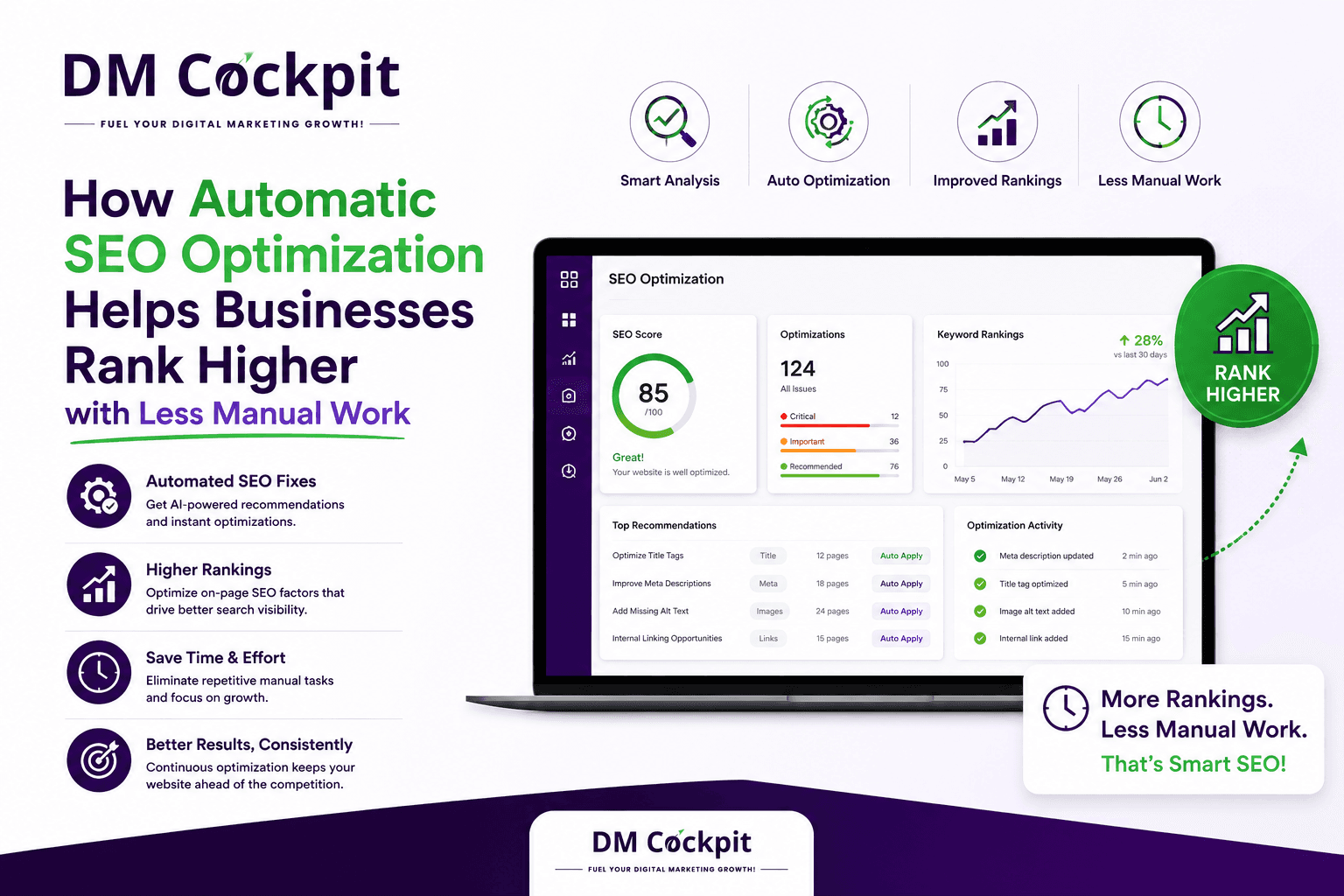
As websites grow, SEO becomes less about knowing what to do and more about finding enough time to do it. Monitoring rankings, checking technical issues, reviewing reports, and tracking competitors can quickly become repetitive. That's why businesses are increasingly turning to automatic SEO optimization to reduce manual work and focus on strategy.
The challenge today is rarely a lack of SEO knowledge. More often, it's the growing amount of manual work required to keep campaigns running efficiently. Monitoring keyword positions, reviewing crawl issues, identifying indexing problems, and preparing performance reports all consume valuable hours that could otherwise be spent improving strategy and creating better content.
That's where automatic SEO optimization is changing the search game for businesses. Automation isn't designed to replace marketers. Its purpose is to reduce repetitive work so SEO teams can spend more time on strategy, optimisation, and business growth.
Why SEO Has Become More Operational Than Ever
Optimized pages and waiting for the results are not the sole methods of modern SEO. It is now an ongoing operational process that needs to be continually monitored, analysed and improved.
A typical SEO campaign now involves:
- Monitoring keyword rankings across multiple locations.
- Running regular technical website audits.
- Checking crawl errors and indexing status.
- Watching competitor activity.
- Identifying new content opportunities.
- Reviewing website performance reports.
Each task is important on its own, but together they create a workload that grows alongside every website.
As businesses expand their digital presence, they add new service pages, publish more content, target additional keywords, and compete across multiple markets. What once required a few hours every month can quickly become a daily responsibility.
At DM Cockpit, we understand that SEO teams should spend less time collecting data and more time acting on meaningful insights. That's why we've built automation into everyday SEO workflows.
A Day Inside an SEO Team Before Automation
Before automation became part of everyday SEO, much of the working day revolved around gathering data from different platforms.
|
Time |
Typical SEO Activity |
|
Morning |
Review keyword ranking changes across priority pages |
|
Mid-Morning |
Export Google Analytics and Search Console reports |
|
Afternoon |
Run technical website audits and review crawl issues |
|
Late Afternoon |
Monitor competitor rankings and recent content updates |
|
End of Day |
Prepare reports, document findings, and share updates with stakeholders |
While every task contributes to campaign performance, notice how much of the day is dedicated to checking, exporting, organizing, and documenting information.
Only after these activities are complete can the team begin making meaningful optimization decisions.
What Automatic SEO Optimization Helps With
We designed our platform to automate repetitive SEO tasks while leaving strategic decisions in the hands of marketers.
Continuous Website Monitoring
Instead of manually reviewing website health, automated systems continuously monitor technical performance and highlight issues that require attention.
Keyword Position Tracking
Rather than searching individual keywords one by one, automated tracking provides updated ranking information across target keyword groups, making it easier to identify positive or negative movement.
Technical Issue Detection
Broken pages, crawl errors, duplicate content, missing metadata, and indexing concerns can be detected automatically, allowing teams to prioritize fixes before they affect visibility.
Performance Reporting
Generating reports manually every week or month often requires combining data from several platforms. Automation streamlines this process and keeps stakeholders informed with consistent reporting.
Competitor Monitoring
SEO isn't done on its own. Automated competitor monitoring can enable businesses to gain insights into the altering nature of search visibility in their market sector, without having to be hands-on constantly.
AI-Powered Recommendations
Today, AI helps businesses identify patterns, surface optimisation opportunities, and turn large volumes of SEO data into practical insights for faster decision-making.
Tasks That Benefit Most From Automation
Some SEO responsibilities deliver significantly greater value when handled automatically.
Rank Checking
Automated tracking keeps keyword performance updated consistently, reducing the need for manual searches.
Crawl Monitoring
A website can be crawled continuously, which means that any technical issues will be detected as they happen rather than when they are scheduled for an audit.
Broken Link Detection
Finding broken internal and external links manually becomes increasingly difficult as websites grow. Automation helps maintain a healthier website structure.
Site Health Monitoring
Technical indicators such as page errors, indexing status, and performance changes can be monitored continuously instead of through occasional reviews.
Metadata Reviews
Automation highlights missing or duplicate titles and descriptions, allowing SEO teams to improve on-page optimization more efficiently.
Report Generation
Recurring reports become faster, more consistent, and easier to share across marketing teams, leadership, or clients.
Competitor Alerts
Rather than manually reviewing competitor websites, automated alerts notify teams when significant ranking or visibility changes occur.
What Automation Can Do And What Still Needs Human Expertise
We've always believed automation should support marketers rather than replace them. That's why our platform focuses on simplifying repetitive tasks while leaving strategy, creativity, and decision-making to SEO professionals.
|
Automation Handles |
SEO Professionals Handle |
|
Collecting SEO data |
Building long-term SEO strategies |
|
Monitoring rankings and technical changes |
Creating valuable content |
|
Generating recurring reports |
Understanding customer intent |
|
Detecting technical issues |
Prioritizing business goals |
|
Identifying performance trends |
Developing creative campaigns |
SEO is still a strategic practice that revolves around understanding the audience, addressing the problem, and delivering valuable experience.
Automation simply reduces repetitive work, giving SEO professionals more time to focus on strategic decisions.
Business Benefits Beyond SEO
The value of automation extends beyond improving search rankings.
When repetitive processes become more efficient, businesses gain operational advantages across their marketing activities.
Faster decision-making
We've seen that faster access to reliable SEO data helps marketing teams respond more confidently to ranking changes and technical issues.
Reduced manual errors
Automated workflows reduce inconsistencies that often appear when information is collected from multiple sources.
Improved collaboration
Marketing specialists, content writers, managers and stakeholders can use the same data, rather than separate reports.
Simplified reporting
Recurring updates become easier to produce, improving communication with internal teams and clients.
Scalable marketing operations
As websites grow, automation helps businesses maintain consistent SEO processes without increasing manual workload at the same pace.
Higher productivity
Less time spent collecting information means more time available for optimization, content development, and business growth initiatives.
Signs Your Business Has Outgrown Manual SEO
Your current workflow may be limiting growth if several of these situations sound familiar.
- Keyword rankings are still checked manually every week.
- Preparing reports requires several hours each month.
- Multiple SEO platforms remain open throughout the day.
- Technical issues are discovered after rankings decline.
- Important keyword movements are frequently missed.
- Multiple websites or client campaigns require simultaneous monitoring.
- Team members duplicate the same reporting tasks.
- There is a delay in gathering information to engage in strategic discussions.
When these challenges become routine, automation is no longer a convenience. It becomes an essential part of running SEO efficiently at scale.
Final Thoughts
Successful SEO has always been about informed decisions, continuous optimisation, and long-term strategy. Those principles haven't changed. What has changed is the amount of work required to support them. With automatic SEO optimization, businesses can reduce repetitive tasks and give their teams more time to focus on improving content, technical performance, and long-term growth.
At DM Cockpit, we believe marketing teams should spend less time exporting reports and more time improving SEO performance. That's why we've brought keyword tracking, website audits, competitor monitoring, analytics, automated reporting, and AI-powered insights together on one platform, helping businesses make faster, more informed SEO decisions.
Frequently Asked Questions
1. What is automatic SEO optimization?
Automatic SEO optimization uses software and AI to automate repetitive SEO tasks such as keyword tracking, technical website monitoring, reporting, and issue detection. It helps marketing teams manage SEO more efficiently while allowing them to focus on strategy and content improvements.
2. Can automatic SEO optimization improve search rankings?
Automation itself does not improve rankings directly. It helps businesses identify technical issues, monitor keyword performance, and respond to changes more quickly, creating a more consistent and efficient SEO process that supports better long-term results.
3. Does SEO automation replace SEO professionals?
No. Automation handles repetitive tasks such as monitoring and reporting, while SEO professionals continue to make strategic decisions about content, user experience, technical improvements, and overall marketing priorities.
4. Which SEO tasks are best suited for automation?
Tasks such as keyword rank tracking, website audits, crawl error monitoring, broken link detection, competitor tracking, metadata reviews, and performance reporting are commonly automated because they require regular monitoring.
5. Is automatic SEO optimization suitable for small businesses?
Yes. Even smaller businesses can benefit from automation by reducing manual work, improving reporting accuracy, and identifying SEO issues before they begin affecting website performance.
6. How often should SEO performance be monitored?
SEO performance should be monitored continuously rather than only during monthly reviews. Regular monitoring allows businesses to identify ranking changes, technical issues, and optimization opportunities much earlier.