
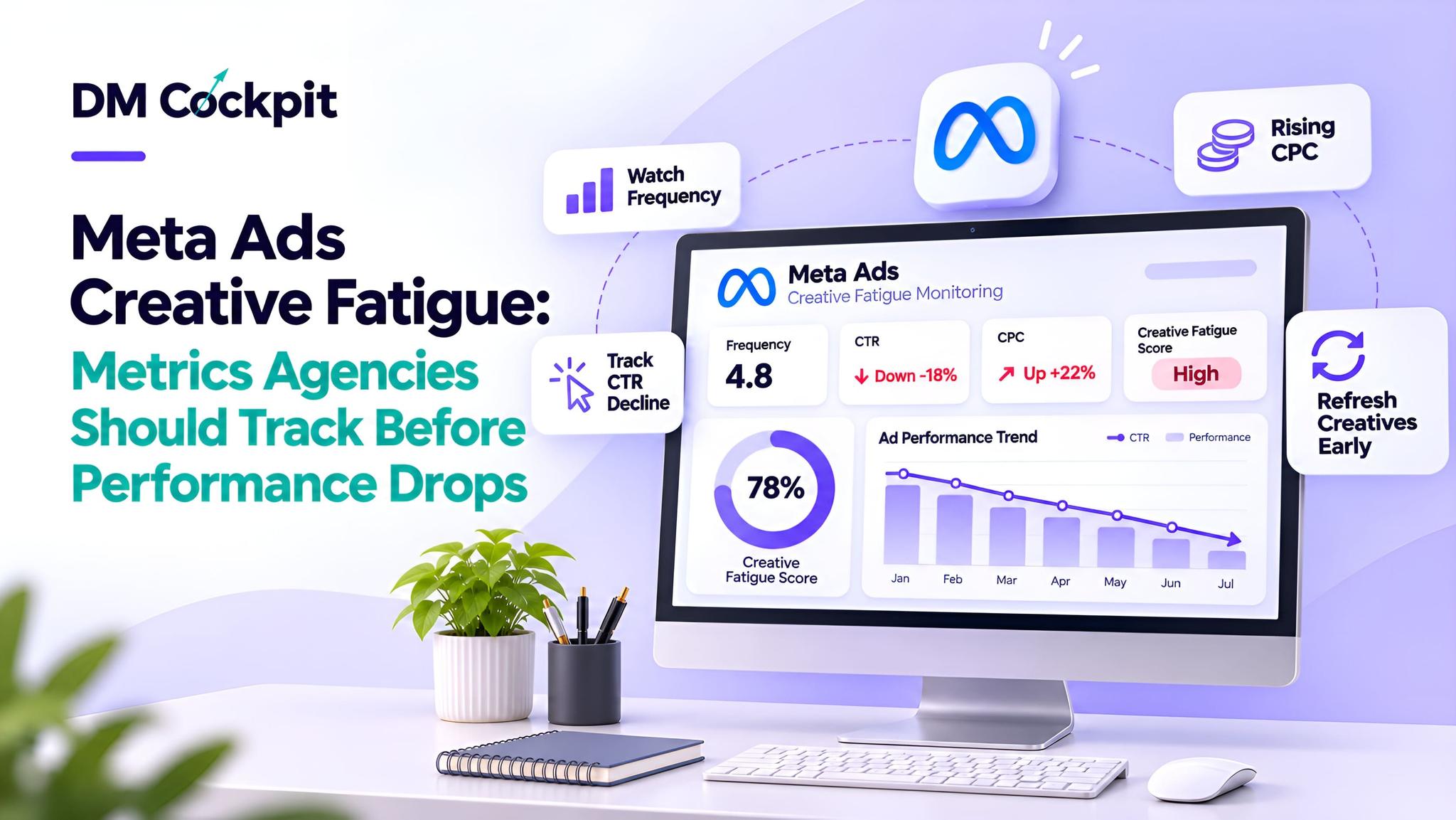
A Facebook or Instagram ad may perform well for weeks before it starts to shift. People who previously clicked, watched or enquired in the past may slowly stop responding, despite the fact that the setting for the creative and the campaign are the same.
This is a question that is important to ask for a marketing agency: has the audience lost interest or are there other performance inhibitors?
It's likely that there's an issue with Meta ads creative fatigue, meaning that after exposure to the same ads creative, it loses effectiveness.
But failing results do not necessarily warrant an ad change. Agencies need to look at a number of performance metrics before they can even begin to determine the issue.
Understanding these can help marketing teams make creative decisions and give their customers explanations for performance variations.
Why Do Meta Ad Creatives Lose Their Impact?
Imagine scrolling through Instagram and a video ad plays over and over again. First of all, it attracts attention. With repeated exposure, it is possible you'll begin to tune it out.
This is a good example of how creative fatigue can set in.
These are some of the common causes:
- Exposure to the same visual or messages repeatedly.
- Limited variation across advertisements.
- Audiences becoming familiar with the offer.
- Smaller audience groups receiving repeated impressions.
- Advertising messages losing their initial appeal.
But don't mistake creative fatigue for audience saturation.
Creative fatigue is an issue of decreasing responses to repeated creative elements. Audience saturation means that there is limited opportunity to reach a more relevant audience.
There can be some redundancy between these problems, but changing a picture does not necessarily resolve both problems.
Seven Metrics Agencies Should Monitor
The reality is that agencies should look at performance of ads over time, rather than waiting for it to drop.
1. Frequency: How Often Is the Audience Seeing the Advertisement?
Frequency is the average number of times an ad was viewed per account that it was shown to, over a given reporting period.
This is determined by dividing impressions by reach.
For example, 30,000 impressions across 10,000 accounts produced an average frequency of three.
If the frequency rises, it may be a sign of re-exposure to the audience, especially if growth slows.
But there's no universal rule for determining what frequency means they've had enough of being creative.
Agencies should benchmark frequency against results and click through, as well as campaign goals.
2. Link CTR: Is the Creative Still Attracting Clicks?
Click through rate (CTR) is the percentage of impressions to the number of links that are clicked.
If your campaigns are intended to send website traffic, then link CTR might be a better metric of your response than CTR on all clicks.
Let's take this example as a demonstration:
|
Reporting period |
Link CTR |
Frequency |
|
Week 1 |
2.8% |
1.6 |
|
Week 2 |
2.4% |
2.3 |
|
Week 3 |
1.9% |
3.1 |
|
Week 4 |
1.4% |
4.0 |
Not industry benchmarks, illustrative figures.
The drop in link CTR and rise in frequency indicates that there is a need to investigate the creative.
The pattern, however, may also be due to changes in the audience or in targeting or placements.
3. Cost Per Result: Is Campaign Efficiency Weakening?
Cost per result is the average cost of a campaign per result.
This can be a lead, a purchase or another type of result that is relevant to the campaign goal.
If cost per result is increasing and engagement is decreasing, agencies can ask themselves if repeated exposure to the creatives is playing a factor.
But, increased cost per result may also be related to competition changes, delivery or conversion performance changes.
Agencies should make comparisons with similar campaigns and reporting periods before making any conclusions.
4. Engagement: Are People Responding Less Often?
Changes in audience response can be detected through comments, shares, reactions and more.
While a product's initial ad can get a lot of clicks, it can also gain less attention over time.
However, the importance of engagement metrics depends on campaign goals.
Even if a lead generation ad gets few likes or comments, it can generate valuable leads.
As such, agencies should focus on the quality of the business results, rather than the number of engagements.
5. Reach and Impressions: Is Exposure Becoming Repetitive?
Reach is the number of accounts a visible ad has been viewed in at least one session and impressions is the number of times the ad is displayed on screen.
With higher impressions and slower growth, it could be that existing audiences are being exposed to the same content over and over again.
This is a pattern that should be investigated in campaigns for smaller groups.
Compare periods of time for the same reporting periods and determine if there is any change in the campaign or in specific ads.
6. Conversion Rate: Are Visitors Still Taking Action?
An advertisement can still create clicks, without creating great enquiries or purchases.
This is because conversion is an element of creative evaluation.
For instance, one campaign could maintain a stable CPC, but experience fewer form conversions.
Rather than pointing fingers at the creative, agencies should delve into landing page experience, tracking accuracy and visitor relevance.
If an issue arises after the click, you'll have to go with another solution.
7. Video Performance: Are Viewers Losing Interest?
In the case of video ads, there are metrics that can be used to gauge attention.
Useful indicators include:
- Three-second video plays.
- Average video play time.
- Video plays at selected completion percentages.
- Changes in viewing behaviour across comparable creatives.
If the number of early views is down, there could be a problem with the opening message or visuals.
But agencies should make comparisons of videos of similar format, length and placement.
Check Meta's Creative Fatigue Indicators
Meta Ads Manager can offer you clues that an ad may be limited or fatigued in its creative performance, depending on the campaign settings and reporting capabilities. Agencies should check indicators they have available in their account and compare them with campaign metrics.
These signals take into account previous advertising performance and changes in cost per result.
They will be available, though, based on campaign and creative setup.
Just because there isn't a warning, doesn't mean it's performing well.
Agencies should not use these indicators as substitutes for their own performance analysis.
Build a Practical Creative Monitoring Dashboard
A helpful reporting dashboard should enable agencies to see trends in multiple metrics.
|
Metric |
Potential warning |
What to investigate |
|
Frequency |
Increasing consistently |
Repeated exposure |
|
Link CTR |
Declining |
Creative appeal |
|
Cost per result |
Increasing |
Campaign efficiency |
|
Engagement |
Weakening |
Audience response |
|
Reach |
Slowing growth |
Audience saturation |
|
Conversion rate |
Declining |
Traffic quality and landing pages |
|
Video viewing |
Earlier drop-offs |
Opening message and visuals |
Changes in several indicators are the best evidence.
For instance, if the CTR on your links is dropping and costs per result is rising, it might be worth trying new creative.
What Should Agencies Do When Fatigue Appears?
If there are multiple signs of Meta ads creative fatigue, agencies should delve into the issue before swapping out all their ads.
In a practical response, include:
- Identify affected advertisements: Determine whether performance changes involve one creative or several.
- Review audience exposure: Audience frequency, reach, and audience segments.
- Check other explanations: Test delivery changes, competition and landing page performance.
- Test meaningful creative variations: Experiment with different images, messages, formats or opening hooks.
- Compare results: Report on new and existing creatives under consistent conditions.
Do not make more than one change for a campaign at a time unless there is a specific reason.
If they're not the same, it's hard to determine which adjustment led to an improvement.
Keep Creative Decisions Connected to Performance
It's not just about creating new images on a regular basis that makes Meta ads effective. Agencies should know when an ad is not working and if there is a need to make changes to the creative that will make a difference in meaningful business results.
At DM Cockpit, we know how much work it is for agencies to keep track of multiple advertising campaigns, which is why we've made monitoring easier. With our digital marketing platform, you can see performance trends and make better decisions with campaign analytics and reporting in a centralised place.
Frequently Asked Questions
1. What is creative fatigue in Meta advertising?
Creative fatigue occurs when repeated exposure to the same advertising creative reduces audience responsiveness. It may contribute to weaker engagement, lower click-through rates or higher cost per result. However, these changes can also have other causes.
2. How can agencies identify creative fatigue before conversions decline?
Agencies can monitor frequency, link CTR, reach, engagement and available video viewing metrics. When several indicators weaken together, they should investigate whether repeated exposure is affecting audience response.
3. Does high ad frequency always indicate creative fatigue?
No. High frequency alone does not establish creative fatigue. Acceptable exposure varies according to campaign objectives, audience characteristics and buying behaviour. Agencies should assess frequency alongside actual results.
4. How often should agencies refresh Meta ad creatives?
There is no universal refresh schedule. Agencies should monitor performance trends and test new creative when evidence suggests that existing advertisements are losing effectiveness. Strong-performing advertisements do not necessarily need replacing.
5. Can Meta Ads Manager identify creative fatigue automatically?
Meta Ads Manager provides Creative limited and Creative fatigue indicators for certain eligible advertising configurations. However, these indicators are not available universally and should be considered alongside other campaign performance metrics.
6. Which metrics matter most when reporting creative fatigue to clients?
Frequency, link CTR, cost per result, reach and conversion performance provide useful insights. For video advertisements, viewing metrics offer additional context. Agencies should connect these indicators with campaign objectives rather than relying on individual numbers.