
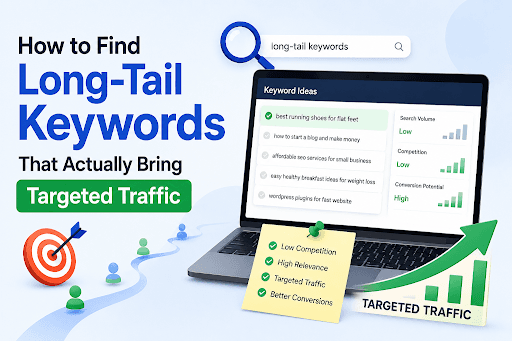
High search volume looks good in an SEO report, but it doesn't always bring the right visitors. Long tail keywords can be more useful when you want to reach people with a specific question, problem, or buying need.
The challenge is finding long tail searches that have enough demand to matter without chasing every obscure phrase with almost no traffic. A good long-tail keyword strategy focuses on intent, relevance, competition, and the information your audience actually needs.
Here's how to find those opportunities and turn them into content that can attract targeted organic traffic.
What are long-tail keywords?
Long-tail keywords are specific search queries that usually contain several words and describe a narrower need than a broad keyword.
For example:
- "running shoes" is broad
- "best running shoes for flat feet" is more specific
- "best running shoes for flat feet under $100" is even more specific
The longer phrase isn't automatically better. What matters is the intent behind it.
Someone searching for "running shoes" could be browsing, researching, or looking for a shop. Someone searching for "best running shoes for flat feet under $100" has already given you much more information about what they want.
That specificity is what makes long-tail searches useful for targeted traffic.
Why long-tail keywords can attract better traffic
Broad keywords often have a large audience, but that audience can be difficult to interpret.
A specific search gives you more context.
Compare:
"SEO tools"
with:
"SEO rank tracking tool for agencies"
The second query tells you something about the searcher's needs. They aren't simply learning what SEO tools are. They may be evaluating software for agency work.
This is why a smaller keyword can sometimes be more valuable than a high-volume term.
Long-tail searches can help you:
- Match content more closely to search intent
- Reach specific audiences
- Build content around real questions
- Find less competitive topics
- Create pages with a clear purpose
There is also a practical advantage: specific searches often give you a clearer idea of what the reader expects from the page.
Start with the problems your audience searches for
The best long-tail keywords usually come from real customer questions rather than keyword tools alone.
Think about the problems your audience has before they search for your product or service.
For an SEO platform, someone might search:
- how to track Google keyword rankings
- how to find competitor keywords
- how to check website SEO issues
- how to find low competition keywords
- how to monitor SEO rankings for multiple websites
These aren't random keyword variations. Each represents a task someone wants to complete.
Start by writing down the questions your customers ask, then use keyword research to see how those problems are expressed in search.
How to find long-tail keywords
A reliable process combines your own knowledge with keyword data.
1. Start with a broad topic
Choose a subject closely related to your business.
For example:
"keyword research"
Don't immediately try to rank for the broad term. Use it as a starting point for discovering more specific searches.
2. Expand the topic
Look for searches that add useful context:
- keyword research for beginners
- keyword research for local SEO
- keyword research for ecommerce
- how to do keyword research
- keyword research without paid tools
You can also look for question based searches around the topic.
3. Check the data
Not every long-tail query is worth targeting.
Review search volume, competition and related keyword data. Our Keyword Research Tool lets us research keywords and review information such as search volume, competition and related terms.
You can then compare possible targets instead of choosing keywords based purely on how specific they sound.
4. Check the search results
This step is easy to skip and often the most revealing.
Search the keyword yourself.
Look at the pages ranking on the first page. Are they blog posts, product pages, guides, category pages, or something else?
If Google consistently shows detailed guides, a short promotional page may not match the intent.
If the results are mostly product pages, a purely informational article may struggle to compete.
The search results give you a useful reality check before you create anything.
Look for low competition long-tail keywords, but don't obsess over difficulty
Low competition long-tail keywords can be attractive because you may have a better chance of ranking than with broad, highly competitive terms.
But low competition alone isn't enough.
A keyword can be easy to rank for and still be useless if nobody relevant searches for it or if the search has no connection to your business.
A better filter is:
Relevance + intent + realistic competition + useful demand
For example, a B2B marketing platform shouldn't create content around an easy keyword simply because the keyword has low competition.
The topic still needs to attract the right audience.
Use competitors to uncover long-tail opportunities
Your competitors can reveal searches you haven't considered.
Look at the keywords where relevant competitors rank and compare them with your own visibility.
You may find that a competitor ranks for specific searches such as:
- SEO reporting for marketing agencies
- how to track local keyword rankings
- competitor keyword research tools
These terms can reveal both keyword opportunities and content ideas.
Our Competitor Analysis Tool helps us investigate competitor keyword data and identify areas where competing websites have stronger organic visibility.
The important part is what happens after the discovery.
Don't copy the competitor's page. Look at what the searcher needs and ask whether your content can explain the subject more clearly or provide information that the existing results don't cover well.
Build content around the searcher's task
A common mistake is writing a long article simply because the keyword is long.
Length isn't the objective.
If someone searches "how to find long-tail keywords," they probably want a process they can follow. Give them one.
A useful structure might be:
- Explain what makes a keyword long-tail.
- Show where to find candidate searches.
- Explain how to evaluate intent and competition.
- Give examples.
- Explain how to choose which terms deserve content.
- Show how to measure the results.
This structure works because it follows the reader's task rather than forcing keywords into unrelated sections.
Add information that the existing results lack
Keyword targeting gets you to the right subject. Information gain gives your page something worth reading.
Before writing, review the current results and make a simple list:
What do the top pages already explain?
Then ask:
What would make this answer more useful?
It could be:
- A practical example
- A clearer workflow
- A useful comparison
- A mistake that competitors overlook
- A decision framework
- Original observations from working with the topic
- Answers to questions that appear repeatedly in related searches
For example, many articles might explain what long-tail keywords are. Fewer may explain how to decide whether a specific long-tail query deserves its own page or should be covered within a broader article.
That distinction is useful because it prevents unnecessary content creation.
Create one strong page instead of many thin pages
Suppose you find these searches:
- how to find long-tail keywords
- how to find long-tail keywords for SEO
- how to find low competition long-tail keywords
- long-tail keyword research process
Creating four short articles may not be the best approach.
If the searches have the same underlying intent, one well structured page can address them together.
Use the related phrases naturally as subtopics rather than creating separate pages just to target slightly different wording.
This helps the reader too. They don't have to open four articles to complete one task.
Long-tail keyword examples to guide your research
Here are some patterns you can use when looking for your own opportunities:
|
Broad topic |
More specific search |
|
Email marketing |
email marketing for small businesses |
|
SEO audit |
how to perform an SEO audit |
|
Keyword research |
keyword research for local businesses |
|
Rank tracking |
how to track keyword rankings |
|
Competitor analysis |
how to find competitor keywords |
|
Content marketing |
content marketing ideas for SaaS companies |
The exact keywords will vary by industry. The pattern is what matters.
Add context such as audience, location, problem, use case, product type, comparison, or desired outcome.
Those additions often turn a vague topic into a much clearer search.
Measure whether your long-tail strategy is working
Ranking for a long-tail keyword is useful, but rankings aren't the final goal.
Watch what happens after the page starts appearing in search.
Look at:
- Organic impressions
- Clicks
- Ranking positions
- Relevant organic traffic
- Engagement with the page
- Conversions where applicable
Our Website Rank Checker helps us track keyword positions over time. That lets you see whether the terms you've chosen are gaining visibility after publishing or improving a page.
If a page gets impressions but few clicks, review the search result and page title. If it ranks but attracts the wrong audience, revisit the keyword's intent. If it receives relevant traffic but doesn't lead to action, the problem may be further down the page rather than with the keyword itself.
Common long-tail keyword mistakes
Avoid these traps:
- Choosing keywords only because they have low competition
- Assuming every long query deserves its own page
- Ignoring search intent
- Writing around a keyword instead of answering the question
- Using awkward keyword variations repeatedly
- Copying competitor content
- Creating thin pages for closely related searches
- Measuring success only by ranking position
Good long-tail SEO is selective.
You don't need hundreds of tiny keywords. You need the right searches and pages that genuinely satisfy them.
Build around intent, not word count
Finding long tail keywords is relatively easy. Finding the ones worth building content around takes more judgement.
Start with real audience problems. Expand them into specific searches. Check the data and the search results. Then look for the information that existing pages aren't providing well.
That combination gives you a stronger long-tail keyword strategy: targeted searches, useful content and a clear reason for the page to exist.
We at DMCockpit provide keyword research, competitor analysis and rank tracking tools to support that workflow. Our tools can help you find and evaluate opportunities, but the quality of the final page still comes down to understanding what the searcher actually needs.
Frequently asked questions
1. How do I find long-tail keywords?
Start with a broad topic, expand it into specific questions and use keyword research data to evaluate search volume, competition and related terms. Then check the actual search results before choosing your targets.
2. What are long-tail keywords for SEO?
They are specific search queries that target a narrower need or intent. They can help SEO content reach people searching for particular problems, use cases or solutions.
3. Are long-tail keywords easier to rank for?
Some are less competitive than broad keywords, but this isn't guaranteed. Competition varies by topic, search intent and the websites already ranking.
4. How many long-tail keywords should I target on one page?
There isn't a fixed number. Group keywords when they share the same intent and can be answered naturally on one page. Create separate pages when the search intent is substantially different.
5. What makes a good long-tail keyword?
A good long-tail keyword is relevant to your audience, has clear intent, offers realistic ranking potential and connects to a topic where your business can provide useful information.
6. Should I use long-tail keywords in every blog?
Not necessarily. Use them when they represent genuine searches your audience makes. The goal is to answer useful questions, not to create content around every possible keyword variation.