
Your rankings have moved. But nothing obvious has changed.
There has been no major redesign. Your key pages are still live. The content team has not rewritten half the site, and there is no obvious technical failure explaining the shift.
This is where an SEO investigation has to widen. Backlinks are one area worth examining, not because every ranking decline is caused by bad links, but because a changing link profile can reveal issues and opportunities that are easy to miss when you only watch rankings.
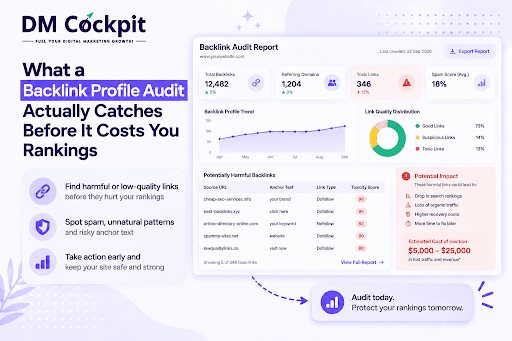
A proper backlink audit for toxic links goes beyond counting how many websites point to you. It looks for patterns: where links came from, which ones disappeared, what anchor text they use, whether unusual activity has appeared, and what competitors are earning while your own profile stays still.
A Backlink Audit Is Not Just a List of Domains
Opening a backlink report and sorting referring domains by a third-party authority or spam metric is not an audit.
The useful part begins when you ask questions about the data:
- Which domains have started linking to the site?
- Which valuable backlinks have disappeared?
- Are several links using unusually similar anchor text?
- Are links relevant to the site's subject?
- Did a sudden cluster appear over a short period?
- Which pages attract the strongest links?
- Where are competitors earning mentions that you are not?
No single metric gives the answer.
A low-authority website, for example, is not automatically harmful. A new industry publication, local organization, niche blogger, or small business may have modest third-party metrics while still providing a perfectly legitimate and relevant link.
The job is to find patterns that deserve investigation, rather than label every unfamiliar domain as a problem.
Evidence 1: Links That Look Manipulative or Unnatural
The word “toxic” gets used too casually in SEO.
A strange-looking backlink does not automatically damage a website. Google says that it can assess which links to trust in most cases, which is one reason SEOs should avoid treating every questionable backlink as an emergency.
What should make you investigate further is a combination of signals.
You might notice links from websites with no meaningful connection to your industry, large numbers of keyword-heavy anchors, suspiciously repetitive placements, or pages that appear to exist primarily to link elsewhere.
Context matters.
One irrelevant backlink may mean very little. Hundreds of similar links appearing through the same pattern deserve a closer look.
Evidence 2: Sudden Patterns That Deserve Investigation
Backlink changes become more informative when you look at them over time.
A backlink audit for toxic links becomes especially useful when unusual link growth, repetitive anchors, or irrelevant sources begin appearing together.
Suppose a site normally gains links gradually. Then hundreds appear within a short window. That does not prove manipulation, but it gives you a reason to investigate.
Look particularly at:
Link velocity
Has the rate of new backlinks changed significantly compared with the site's normal pattern?
Repetitive anchor text
Natural link profiles commonly contain a mixture of brand names, URLs, page titles and descriptive anchors. A concentrated pattern of commercial keyword anchors deserves inspection.
Unusual sources
Ask why these websites are linking to you. Is there a logical editorial, commercial or informational relationship?
Irrelevant domains
Relevance should be considered alongside quality. A legitimate mention from a related industry publication tells a different story from an unexplained link on an unrelated page.
Sitewide patterns
One referring domain can create hundreds or thousands of links through templates, navigation or other sitewide elements. That means raw backlink totals can be misleading.
The goal is not to panic when a graph spikes. It is to understand why it spiked.
Evidence 3: Valuable Links You've Lost
A backlink audit should not become an exercise in hunting only for “bad” links.
Sometimes the more important finding is what has disappeared.
A publisher may have removed an old article. A linked page may now return a 404. A website redesign may have changed URLs. An editorial mention could have been updated and your link removed.
Lost links deserve attention because some may have been sending referral traffic, supporting useful pages, or representing genuine industry recognition.
DM Cockpit's backlink functionality, for example, tracks websites that recently started or stopped linking to a site and provides backlink updates over time.
When a valuable link disappears, ask whether the underlying relationship or content opportunity can reasonably be recovered rather than simply recording another lost backlink.
Evidence 4: Competitors Are Earning Links You Aren't Seeing
Now turn the investigation around.
Your own backlink profile tells only half the story.
Imagine three competing sites regularly earning links from trade publications, resource pages, industry organizations and specialist blogs. Your website has comparable expertise but receives none of those mentions.
Nothing is technically “wrong” with your backlink profile. Yet the gap reveals an opportunity.
Competitor backlink analysis can help uncover:
- Publications covering your competitors
- Frequently linked competitor resources
- Industry directories or associations
- Research or data attracting citations
- Content formats earning natural references
- Domains relevant to your own outreach
DM Cockpit's backlink checker also supports competitor backlink analysis, helping marketers compare profiles and identify potential link opportunities.
A backlink audit therefore shouldn't ask only, “What could hurt us?”
It should also ask, “What are stronger competitors earning that we aren't?”
From Suspicious Links to a Review List
When something looks questionable, resist the urge to jump directly from detection to removal or disavowal.
A more defensible investigation follows five stages:
- Collect
Gather the relevant backlink, referring-domain, anchor and new/lost-link data. - Classify
Group links by relevance, source, anchor pattern and other useful signals. - Verify
Open questionable sources and understand the actual context. Do not make the decision from one third-party score alone. - Document
Record why a link or pattern deserves attention. This is particularly useful for agencies where another SEO may need to review the decision later. - Decide
Determine whether the finding needs action, continued monitoring, outreach or no action at all.
That last option matters. Sometimes investigation confirms that there is nothing worth changing.
Where a Disavow File Fits and Where It Doesn't
This is where a backlink audit for toxic links can go wrong if automated scores are treated as instructions rather than evidence requiring human review.
Google's guidance is cautious: most sites do not need to use the Disavow Links tool because Google can usually determine which links to trust. Its guidance says disavowal should be considered when a site has a considerable number of spammy, artificial or low-quality links and those links have caused, or are likely to cause, a manual action.
That makes disavowal very different from routine backlink housekeeping.
A third-party tool labeling a domain “toxic” is not, by itself, a reason to add that domain to a disavow file. The evidence needs human review.
Using the tool carelessly can also remove signals from links that were not actually causing a problem. Treat disavowal as an advanced response to a specific situation, not a monthly SEO cleanup task.
One Audit Is a Snapshot. Monitoring Shows the Movie.
An audit tells you what the backlink profile looks like today. Monitoring tells you how it is changing.
That distinction matters for agencies managing multiple websites. A quarterly audit may uncover a problem eventually, but ongoing visibility makes it easier to notice new and lost links, changing anchors and unusual patterns closer to when they occur.
The DM Cockpit SEO Backlink Checker brings backlink data such as referring domains, anchor information, new and lost backlinks, and competitor link insights into the review process.
But backlinks are only one part of an SEO investigation. If rankings move, you also need to rule out crawlability, indexability, internal links, page performance and other site-level issues. The DM Cockpit Website Audit Tool examines technical and on-page website health, including crawl directives, meta information, internal linking, Core Web Vitals and indexability signals.
Used together, the two views help prevent a common SEO mistake: blaming backlinks for a problem that actually started somewhere else.
Catch the Pattern Before It Becomes a Reporting Mystery
Backlink auditing is most useful when it changes the question from “Did we lose rankings because of bad links?” to “What changed in the link profile, and does the evidence suggest it matters?” That produces a much stronger answer for your own SEO team and for a client waiting for an explanation.
At DM Cockpit, we want backlink data to lead to that kind of investigation rather than another spreadsheet full of URLs. By monitoring backlink changes alongside broader website health, we help agencies and marketers spot patterns, investigate them in context and make SEO decisions based on evidence instead of assumptions.
Frequently Asked Questions
1. What is a toxic backlink?
“Toxic backlink” is commonly used by SEO platforms to describe a link showing potentially suspicious or low-quality characteristics. It is not a universal Google classification. A flagged link should be reviewed in context rather than automatically treated as harmful.
2. Do bad backlinks always cause rankings to fall?
No. A suspicious backlink appearing before a ranking decline does not prove that it caused the decline. Google says it can assess which links to trust in most cases, and ranking changes can also result from content, competition, technical issues, algorithm changes and many other factors.
3. How often should you perform a backlink audit?
There is no universal schedule. The right frequency depends on the site's size, backlink activity and SEO program. More important than repeatedly performing large one-off audits is monitoring meaningful changes so unusual patterns, valuable lost links and new opportunities do not remain unnoticed for months.
4. Should every suspicious backlink be added to a disavow file?
No. Google's guidance says most websites will not need the Disavow Links tool. It should not be used simply because a third-party SEO platform assigns a poor score to a link.
5. Why should I check competitor backlinks?
Competitor backlinks can reveal publications, resource pages, industry websites and content types already linking within your market. They can therefore expose realistic link-building opportunities rather than leaving your strategy based purely on guesswork.
6. Why should lost backlinks be monitored?
A lost backlink can indicate that content was removed, a URL changed, a link was updated or a previously useful mention disappeared. Monitoring lost links lets you investigate valuable losses and decide whether there is a sensible opportunity to recover the link or relationship.