
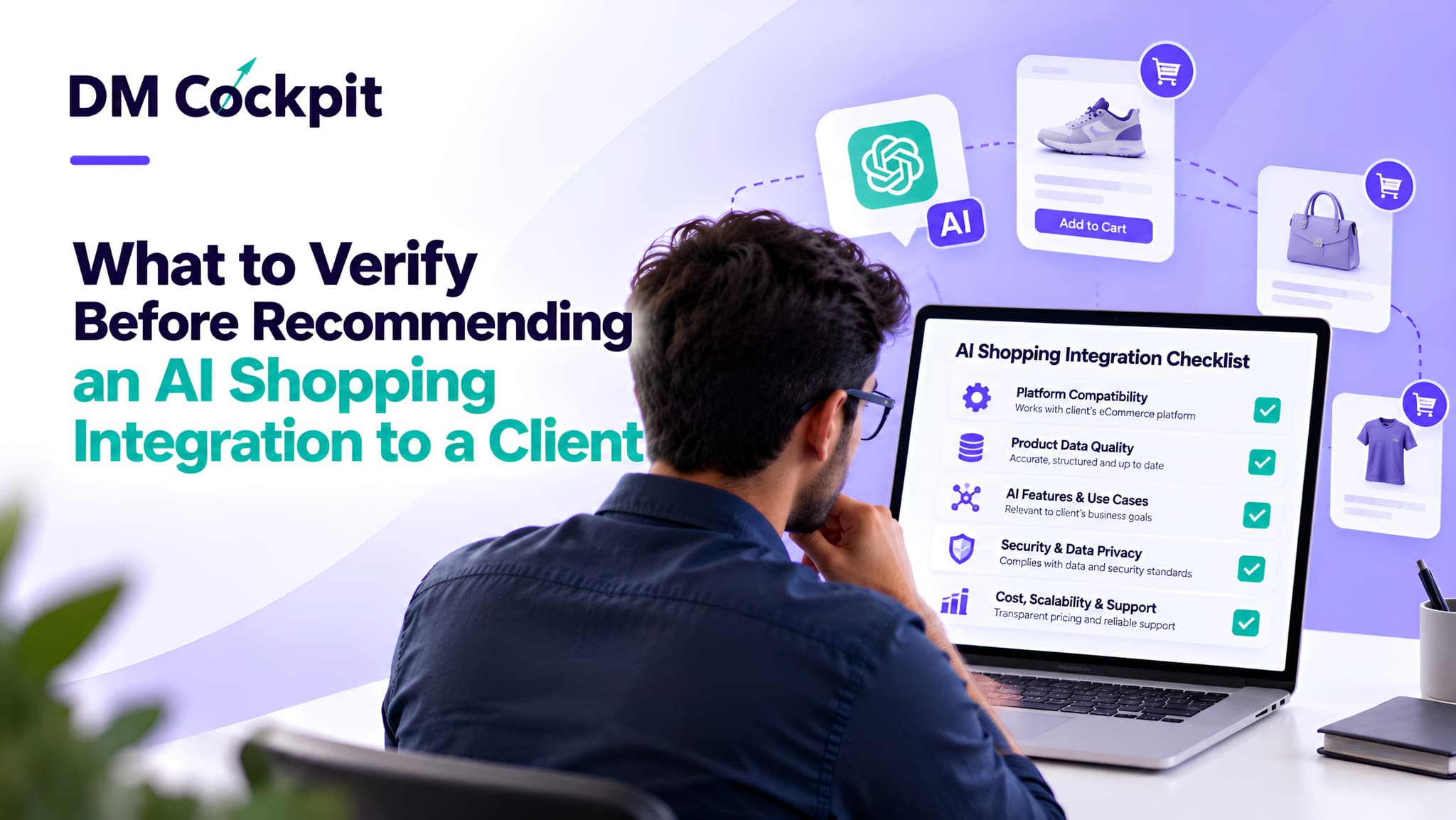
Now, AI shopping is shifting from merely suggesting things to really doing them. New systems may aid consumers in comparing products, creating shopping carts and even proceeding to checkout in certain settings. That leaves an easy to understand question for agencies: Do we need to integrate now?
That question needs more than a quick yes or no. AI shopping integration due diligence should happen before an agency recommends a new connection, platform or agent-based shopping experience. The technology is moving fast but the merchant control, authorization, measurement and platform support are not the same across all platforms.
A useful rule for agencies is simple: don't recommend an integration because the demo looks impressive. First, work out what happens when a real customer, real product data and a real transaction enter the process.
Start With the Question Clients May Skip
The first question shouldn't be, "Can we connect it?"
Ask:
What exactly are we allowing the AI system to do?
There is a meaningful difference between an AI experience that can:
- Discover a client's products
- Read product information
- Recommend products
- Add an item to a cart
- Access customer information
- Modify checkout details
- Complete a transaction after authorization
Those are not simply different features. They involve different levels of access and responsibility.
Google's existing Universal Commerce Protocol (UCP) is designed to enable an agentic shopping experience, rather than the Merchant of Record (MoR). Google's implementation documentation also mentions that the standard is still under development and that not all features of the specification are supported on all implementations.
That's why it's important for agencies to have an understanding of the scope before they recommend the technology.
The AI Shopping Due-Diligence Checklist
A practical review can be broken up into six areas.
|
Review Area |
What the Agency Needs to Verify |
|
Access |
What can the AI system see or change? |
|
Authorization |
Who approves actions and purchases? |
|
Product data |
Where does the system get product information? |
|
Merchant control |
What remains under the retailer's control? |
|
Measurement |
Can activity and conversions be tracked? |
|
Operations |
What happens when information or transactions go wrong? |
A convincing product demo does not answer all six.
1. Check Exactly What Access Is Being Requested
First, list the permissions you need for the integration.
Does it need product catalogue access only? Does it connect with customer accounts? Can it interact with a cart or checkout? Can it put information back into another system?
The concept is simple: access should equal the job the integration will perform.
According to Google's Merchant API documentation, there is a clear difference between authentication and authorization. Authentication is the process of establishing who is making a request, authorization is the process of determining what the authenticated party is authorized to do.
That is a distinction that is worth discussing with clients for agencies. The difference is that "system can connect" does not necessarily mean "understand what system is authorized to do.
2. Find the Human Approval Point
Next, map where the shopper gives permission.
If an AI agent finds a product, then one thing is different. The approval process becomes quite significant if it can move forward with a transaction.
Ask:
- Does the shopper review the final order?
- Can quantities, shipping options or other details change?
- At what stage is the purchase authorized?
- Is there a clear record of that authorization?
- What happens if the final transaction differs from the shopper's original request?
As AI agents start taking on transactional functions, these questions are becoming more pertinent.
Shopify, for instance, recently launched an "enhanced support" for its eligible merchants' browser-based AI agents, which can engage with the checkout process, while the buyer authorizes the transaction to be made. Meanwhile, retailers are playing varying roles in shopping agents, some are supporting them, some are limiting or prohibiting agents, and some are blocking agents.
It's not that one position is necessarily right. The rules are still in the process of being developed.
3. Audit the Product Experience Before Connecting Anything
Without a solid website, it doesn't matter how strong the AI shopping integration is.
Prior to concentrating on the new channel, review product pages and site experience for that channel.
Look for issues such as:
- Broken product URLs
- Inaccessible pages
- Incorrect redirects
- Missing or unclear page information
- Slow pages
- Poor mobile experiences
- Internal-linking problems
- Pages that should be discoverable but are not indexable
This is an area where a Website Audit Tool can support the preparation work. The audit feature works through an analysis of links, meta information, crawls directives, Core Web Vitals and indexability.
The integration could be new. The fundamentals are still important.
4. Verify Who Controls the Product and Customer Experience
This part of AI shopping integration due diligence can easily be missed when attention is focused on technical compatibility.
Ask the client what they expect to retain control over.
That may include:
- Product descriptions
- Availability information
- Shipping details
- Returns information
- Customer relationships
- Checkout experience
- Post-purchase communication
Then compare the given expectations with what integration does.
This matters because "AI shopping" is not one standard customer journey. One system may send a shopper back to the merchant. Another might provide additional support for the experience in an AI surface.
Agencies need to understand and document the real path, not assume that all integrations are the same.
5. Decide How You Will Measure It Before Launch
A new shopping surface becomes difficult to evaluate when measurement is discussed after launch.
Before recommending an integration, identify what data will be available.
Can the agency distinguish traffic from the AI experience? Can visits be tagged consistently? Can landing-page behavior be measured? Can completed conversions be connected to the original interaction?
Also identify what cannot be measured reliably.
That last step matters. Clients should understand that there is a distinction between evidence and an assumption of incomplete attribution.
Create a simple measurement document before launch containing:
- Available traffic signals
- Conversion events
- Referral information
- Campaign or URL conventions
- Reporting limitations
- The baseline against which results will be compared
That way the team cannot develop success criteria after the results are in.
6. Build a Failure Scenario
Don't only have to define what "due diligence" is when things go well.
Discuss some awkward questions.
What if the product information presented in an artificial intelligence system is outdated? What if an item becomes unavailable? What happens if a customer wants to cancel or change an order? Who is responsible for the customer support? How fast can integration be turned off if something goes awry?
This agency may not have all the answers. That's fine.
Its job is to ensure that the client is aware of the questions that must be answered by the commerce platform, the technology provider or the client's own team prior to launch.
Use a Go, Test or Wait Decision
Once the review is complete, avoid forcing every opportunity into a yes/no decision.
Go when the integration has a clear purpose, acceptable permissions, understood authorization, reliable underlying product experiences and workable measurement.
Test when the opportunity looks useful but evidence is limited. Limit scope and establish expectations prior to test.
Hold until you have answers to important questions regarding access, authorization, customer-experience and measurement.
Refusing to embrace AI commerce isn't the same as rejection. It may just require technology to advance or that the client is better equipped.
Recommend What You Can Defend
This will be an ongoing shift in AI shopping and what is needed today might not be what is needed tomorrow. Google explicitly says its Merchant API MCP Access Service is an "experimental alpha feature" and is subject to change.
In that case, AI shopping integration due diligence is not so much about forecasting a platform's triumphant rise to dominance as it is about making a prudent recommendation given the information at hand now.
At DM Cockpit, we believe that preparation begins with the understanding of the digital foundation of the new opportunity. Our Website Audit Tool can be used by agencies to audit technical website health such as indexability, internal links, page performance and other factors that can impact the experience users and emerging discovery systems will have when reaching your website. Sometimes, before new additions are placed on top of a client's marketing stack we can help to get a better understanding of the site that is beneath it all.
Frequently Asked Questions
1. What is an AI shopping integration?
An AI shopping integration connects a merchant's product or commerce environment with an AI-powered experience. Depending on the system, it may support product discovery, recommendations, cart interactions or parts of the checkout journey.
2. Should every ecommerce client start using AI shopping integrations?
Not automatically. The decision should depend on the client's customers, product data, website readiness, available platform capabilities, authorization controls and ability to measure the outcome.
3. What should an agency verify first?
Start with scope and permissions. Identify what the AI system can access, what actions it can perform and where the shopper or merchant must provide authorization.
4. Why does website health matter for AI shopping?
AI-driven discovery can still lead customers to product and landing pages. Broken links, poor performance, indexability problems or weak product pages can create problems regardless of how advanced the discovery channel is.
5. How can agencies measure an AI shopping test?
Define measurable signals before launch. These may include identifiable referral traffic, tagged landing-page visits, conversion events and sales data. Agencies should also document attribution gaps instead of assuming every sale can be traced accurately.
6. Is agentic commerce already standardized?
Not completely. Standards and protocols are developing, and implementation differs among platforms and merchants. Some current systems support deeper agent-led commerce, while other businesses restrict agent activity. Agencies should verify current documentation before recommending a specific integration.