
The very unique challenge of AI marketing in 2026 is that it is promising more than agencies can deliver.
A feature might be presented at a conference, go into testing a month later, and be touted online as something all agencies can use now. That leaves teams struggling to develop client strategies in a cluttered middle ground between what feels plausible and what's realistic for a campaign.
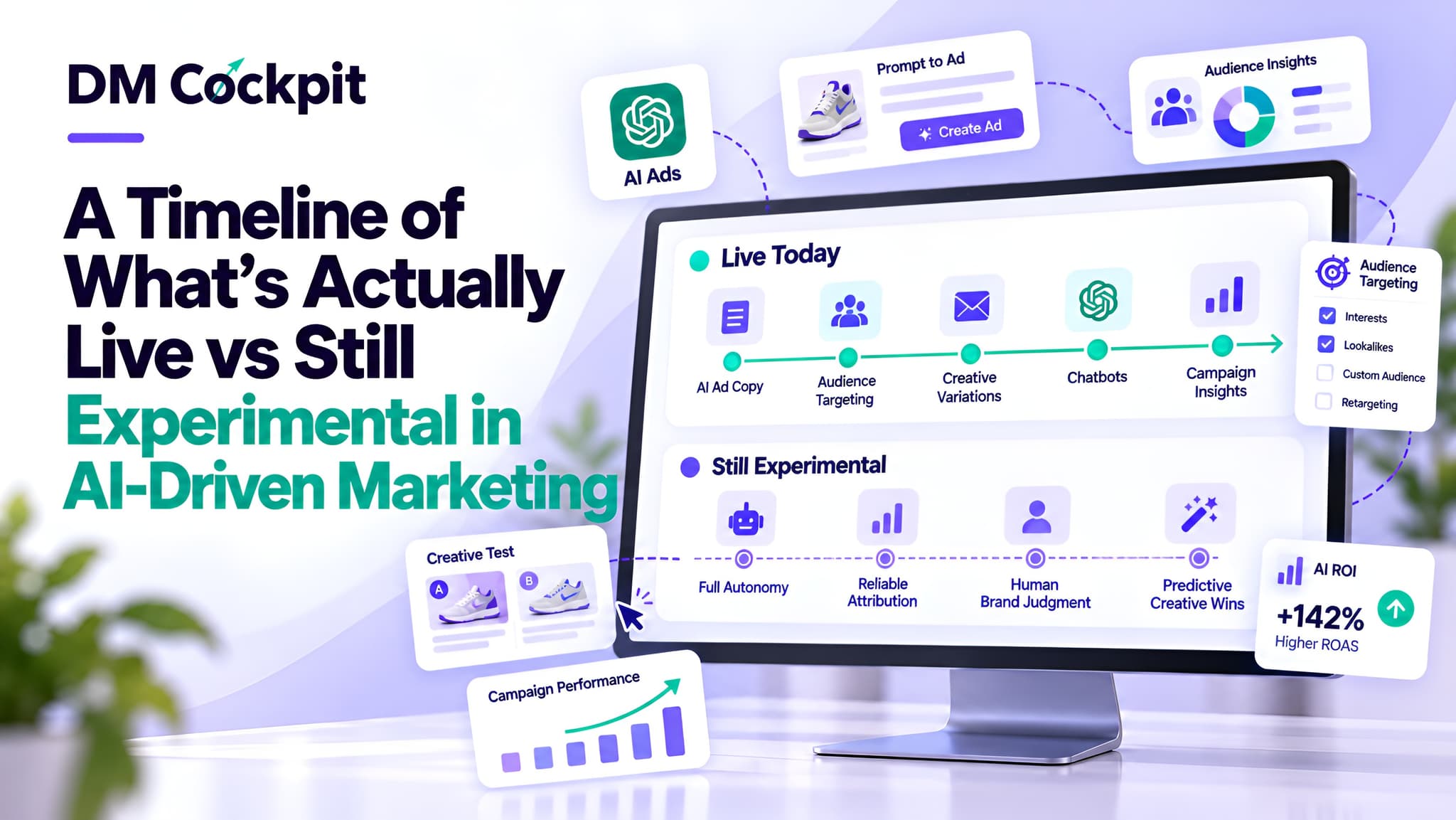
This AI marketing timeline 2026 categorizes the landscape into what agencies can use today, what's possible but requires some restrictions, and what can't even be considered an option yet.
This isn't a list of forecasts. Read our Top Digital Marketing Trends 2026 for more on the changes impacting search, video, data, measurement and AI operations. In this instance, the question is more limited: What can an agency do now?
The October 2026 Status Board
|
AI Marketing Area |
Current Status |
What Agencies Should Do |
|
AI-assisted ad targeting and optimization |
Live |
Use it, but keep human oversight |
|
Generative ad creative |
Live and expanding |
Test with brand controls and review |
|
Ads around/in AI search experiences |
Live with limitations |
Monitor through existing campaigns |
|
AI Max for Search |
Live and evolving |
Test against clear performance goals |
|
AI-generated campaign guidance |
Live / expanding |
Treat recommendations as inputs, not decisions |
|
Conversational AI ad formats |
Testing / expanding |
Watch availability before promising access |
|
Agentic shopping |
Early live rollout |
Evaluate merchant readiness carefully |
|
Fully autonomous marketing |
Not a practical default |
Keep humans responsible for strategy and approval |
The important word here is not AI. It is status.
Phase 1: AI Inside Existing Ad Campaigns: Live Now
The least experimental aspect of AI marketing is the least that's even considered experimental for many teams.
From bidding to targeting, campaign optimization, creative combinations, audience discovery to performance recommendations, machine learning and AI are already in use for advertising platforms.
Google's AI Max for Search is one such instance. It can complement Search campaigns with AI targeting and creative features and reports offer data on search terms, keywords, assets, and landing pages. Google is still developing controls and reporting, rather than considering the product to be finished.
Meta is going in the same general direction. AI is now more than ever a part of ad ranking, campaign optimization, creative generation and assistance to advertisers.
In the agency world, it's not a question of if but when AI will be used in campaign management.
It already has.
The practical questions are:
- Which decisions should remain under direct human control?
- What changes should require account-manager approval?
- How should AI-generated creative be checked against brand guidelines?
- Which performance changes came from automation?
- Can the agency explain those changes clearly to the client?
AI can handle more execution. Accountability still sits with the agency.
Phase 2: Advertising Inside AI Search: Live, but Don't Oversimplify It
This is where status labels become important.
Ads can appear above or below Google AI Overviews across markets where AI Overviews are available. Ads within AI Overviews have also expanded to supported countries, including the United States and India, for eligible formats and queries.
But an agency cannot simply create an "AI Overview campaign."
According to Google, advertisers are not currently able to target just AI Overview placements, opt out of them, or receive segmented reporting to isolate ads served in AI Overview.
That presents a significant difference:
Ad opportunity is up and running. The level of control and reporting that an agency is able to say that it has, is not quite there yet.
When a client asks, "Can you advertise us in AI answers?," the reply must contain more context than simply ‘yes' or ‘no'.
Describe the content that is available and how the ads are appearing in that content and what the reporting gaps are.
Phase 3: Generative Creative: From Experiment to Working Tool
AI-generated ad copy and imagery are no longer side experiments.
Google is integrating Gemini-powered creative capabilities into its advertising tools, including image and video creation in Asset Studio. In Q4 2025 alone, advertisers have generated almost 70 million creative assets using Gemini in AI Max and Performance Max.
That doesn't mean it's an agency that gives away their creative process.
A more realistic flow is as follows:
- The human team defines the campaign idea.
- AI produces variations or adapts existing assets.
- A marketer checks claims, tone, branding, and relevance.
- Approved variants enter testing.
- Performance data determines what stays.
The value is speed and variation. The risk is assuming generated automatically means approved automatically.
For an agency, those are two very different things.
Phase 4: AI Search Ad Formats: Testing Is Still Happening
Now we enter the less settled part of the AI marketing timeline 2026.
Google has been testing newer ad experiences in AI Mode, including formats designed to connect conversational product discovery with sponsored buying options. It has also introduced and expanded commerce concepts such as Direct Offers.
That matters, but "being tested" and "available as a standard agency media buy" are not interchangeable.
Before recommending an emerging format to a client, check:
- Is it generally available?
- Is it limited by market?
- Does the client's account have access?
- Which campaign types are eligible?
- Can placement performance be separated?
- What reporting is available?
- What does the agency actually control?
A product announcement should start a conversation, not automatically start a media plan.
Phase 5: Agentic Commerce: Real, but Early
Agentic commerce has moved beyond presentation slides.
Google has introduced infrastructure including the Universal Commerce Protocol and Universal Cart as it develops shopping experiences in which AI can assist with discovery and transactions. UCP-powered checkout has also begun rolling out for supported U.S. shopping experiences and participating merchants.
This doesn't mean that agencies should embark on an agentic-commerce project for each ecommerce client right away, though.
The readiness check is the first one.
Check if the client has consistent product data, clean feeds, correct availability data, good landing experience, correct measurement, and internal ownership of the integration.
Just because technology is becoming real, doesn't mean that all businesses are ready for technology.
Phase 6: Fully Autonomous Marketing: Keep This in the Experimental Column
The most aggressive form of AI-marketing is also the one that requires the most control of expectation.
AI tools are already able to create assets, identify audiences, optimise delivery, interpret information and suggest changes. But it's a much bigger challenge to have a system which determines its own brand strategy, understands all business constraints, approves all creative, allocates resources, and is responsible for handling exceptions and own the results.
There are still some questions that need a human agent to answer:
- Should we run this campaign at all?
- Does this message fit the brand?
- Is the platform's recommendation right for this client's wider business situation?
- What do we tell the client when performance changes?
Automation can make the actual execution faster. It is hardly a substitute for judgment.
A Simple Rule for Agency Teams: Label the Status
Instead of describing every new announcement as an "AI marketing opportunity," give it one of four internal labels:
LIVE: available and usable in normal client work.
LIMITED: live, but restricted by market, account, format, reporting, or control.
TESTING: officially being tested or gradually introduced.
WATCH: announced or strategically important, but not something the agency should build a client commitment around yet.
This minor, but very common, challenge is that sales calls may outpace delivery realities.
It will also provide an easier response for account managers whenever clients forward the latest AI announcement and inquire, "Why aren't we doing this?
What Agencies Should Watch Next
The key to the AI marketing timeline 2026 is that agencies don't have to pursue all the latest features. The distance between announcement, availability and operational maturity matters.
Before selling an idea, see if it is available. As an alternative to promising measurement, check reporting. Before recommending an integration, assess clients' readiness. Do not rely on human review for decision-making that impacts brand, strategy and accountability.
At DM Cockpit, we make it easy for agencies to keep SEO, ads, social media, analytics and reporting linked in the same client workflow. We think the real benefit is being able to see what's going on across client activity clearly and not just because it has AI features.
Frequently Asked Questions
1. Is AI marketing fully operational in 2026?
Many AI marketing capabilities are already operational, particularly in advertising optimization, targeting, creative assistance, analytics, and campaign management. More advanced conversational advertising and agentic commerce experiences are still developing or rolling out in stages.
2. Can agencies advertise directly inside AI search results?
Advertising can appear around and, in supported markets, within Google AI Overviews. However, advertisers do not currently get independent targeting specifically for AI Overview placements, and Google does not provide segmented reporting exclusively for those placements.
3. Is AI Max for Search still experimental?
AI Max for Search is available, with Google continuing to expand its controls and reporting. Google has also delayed the automatic migration of Dynamic Search Ads until February 2027, showing that the transition is still evolving rather than happening all at once.
4. Should agencies recommend every new AI advertising feature to clients?
No. Availability alone is not enough. Agencies should consider client objectives, market availability, measurement, account eligibility, brand controls, and whether the feature solves an actual campaign problem.
5. What is agentic commerce?
Agentic commerce uses AI agents to assist with parts of the shopping journey, potentially moving from product discovery toward actions such as checkout. Supporting infrastructure and early shopping experiences are already being introduced, but availability and merchant participation remain important considerations.
6. How often should an agency review the status of AI marketing features?
For fast-moving areas, a monthly review is sensible, with additional checks before presenting a new capability to a client. Platform documentation should be checked again immediately before making campaign or integration commitments.