
For years, the online shopping journey has followed a familiar path:
- Search
- Compare
- Product page
- Cart
- Checkout
Marketers built campaigns around those steps. Search ads captured demand. Shopping listings presented products. Landing pages provided more information. Remarketing tried to bring back people who left before buying.
Agentic commerce starts removing some of those steps.
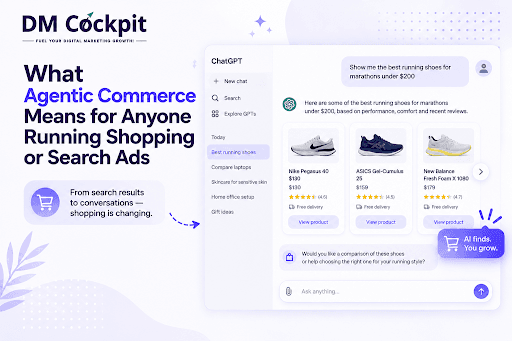
Instead of simply showing a shopper ten links and leaving the rest of the work to them, an AI agent can help interpret the request, compare suitable products, narrow the choices and, in some experiences, help move the shopper toward checkout.
That changes more than the shopping interface. For anyone managing search or shopping campaigns, it raises a bigger question: what happens when discovery, comparison and purchase begin happening within the same AI-assisted journey?
Understanding agentic commerce for marketers therefore starts with recognizing how AI could reshape the familiar path between product discovery and purchase.
Agentic Commerce Is More Than AI Product Recommendations
Agentic commerce describes shopping experiences in which AI systems can perform parts of the buying process on a user's behalf rather than simply provide information.
A shopper might say:
“Find me a lightweight carry-on suitcase suitable for international travel with a laptop compartment.”
Instead of making the shopper translate that requirement into several searches, an AI system may interpret the intent, evaluate available product information, compare options and help the person take the next action.
This distinction matters. Product recommendations are only one part of the story. The larger change is that AI is moving from answering toward acting.
Google describes its Universal Commerce Protocol (UCP) as a common language that allows platforms, agents and businesses to support agentic commerce from discovery through checkout and beyond.
DM Cockpit has already covered ChatGPT product cards, conversational recommendations and shopping discovery in its ChatGPT Shopping & Ecommerce AI Updates article. Rather than repeating that discussion, the important issue here is what happens when AI-assisted discovery connects directly with commerce infrastructure, search and advertising.
Watch the Transaction Infrastructure, Not Just the Chatbot
It is easy to focus on whichever AI assistant consumers happen to be using. For marketers, the infrastructure underneath these experiences may ultimately be just as important.
UCP: Giving Agents and Merchants a Common Language
The Universal Commerce Protocol (UCP) is designed to let commerce systems communicate with AI agents through a common standard.
Google introduced UCP in January 2026 with Shopify, Etsy, Wayfair, Target and Walmart, alongside support from other commerce companies. Google says the protocol covers the broader commerce journey, including discovery, buying and post-purchase interactions.
Its capabilities have continued expanding. Google says UCP can support real-time product information such as inventory and pricing, multi-item carts and identity-linked experiences. Google has also connected UCP with its Universal Cart across services including Search and Gemini.
For marketers, the implication is straightforward: product information increasingly needs to work for machines as well as shoppers.
An attractive product page remains important. But an AI agent also needs reliable information to understand what the product is, whether it fits the shopper's request and what actions are available.
Copilot Checkout: When Comparison and Checkout Share an Interface
Microsoft's Copilot Checkout provides another example of this shift.
Eligible shoppers can discover, compare and purchase participating merchants' products directly within Microsoft Copilot. The merchant remains the merchant of record, while existing commerce systems continue handling functions such as payments and fulfillment. As of September 2026, Microsoft says Copilot Checkout is available to eligible English-language merchants selling to U.S. buyers, rather than being a worldwide capability.
Microsoft has also added UCP-ready feed support to Microsoft Merchant Center in the U.S., connecting structured merchant information with agent-driven product discovery.
That distinction matters for advertisers. The traditional assumption that every interested shopper must leave the discovery environment and navigate a merchant website before purchasing is no longer universal.
The Customer Journey Starts Losing Steps
Consider how much digital advertising has been designed around a sequence of separate destinations.
Traditional journey
- Search
- Ad
- Merchant Website
- Browse
- Cart
- Checkout
Now compare that with a possible agent-assisted journey:
Agentic journey
- Intent
- Agent Evaluates
- Product Selection
- Transaction
This does not mean every shopping journey will suddenly become four steps long. Consumers will still visit websites, browse search results, compare products manually and move between channels.
What changes is that those behaviors are no longer mandatory in every case.
An AI interface can potentially absorb activities that previously generated separate searches, page views and site interactions. That means marketers may eventually need to think beyond simply winning the click.
What Changes for Search and Shopping Advertisers?
When thinking about agentic commerce for marketers, four long-standing advertising assumptions deserve another look.
1. Where Discovery Happens
Product discovery is spreading across conventional search results, AI-assisted search and conversational interfaces.
Google is already building commerce experiences across Search and Gemini, while Microsoft is extending shopping through Copilot.
The challenge becomes being discoverable across multiple environments rather than optimizing for one results page alone.
2. How Products Become Understandable
A compelling headline cannot compensate for unreliable underlying product information.
AI systems may need structured signals covering details such as product identity, availability, variants and merchant policies to evaluate whether an item fits a user's request.
Google has also introduced richer Merchant Center attributes intended to provide conversational product details for its AI surfaces.
3. Where Comparison Occurs
Comparison has traditionally happened across search results, shopping tabs, marketplace listings and merchant websites.
An agent can potentially conduct more of that comparison before the shopper reaches the merchant.
Consequently, marketers need to think about why a product should be selected, not only whether its ad can attract a click.
4. How Marketers Observe Competitors
A standard SERP is relatively visible. Marketers can search a keyword and inspect competing results and ads.
Agent-driven interfaces are more contextual. Different prompts can produce different recommendations and journeys.
That makes traditional competitor observation useful, but no longer sufficient by itself.
Your Product Data Becomes Part of the Advertising Strategy
Shopping marketers have always cared about feeds. Agentic commerce increases their strategic importance.
This makes agentic commerce for marketers partly a product-data challenge, because AI systems need reliable information to interpret, compare, and surface suitable products.
Consider two listings for the same type of product.
One contains vague descriptions, inconsistent attributes and outdated availability information. The other clearly identifies its specifications, variants, availability and other relevant details.
A human shopper might investigate both manually.
An AI system trying to narrow several hundred possibilities needs dependable signals to determine which options satisfy the request.
Microsoft now describes trusted product information as a foundation of agentic commerce, while Google is expanding the information merchants can provide for conversational discovery.
This does not mean stuffing feeds with more keywords. It means making product information accurate, complete, consistent and understandable.
The practical catalogue-cleanup process deserves its own checklist. For advertisers, the strategic point is simpler: feed quality is moving closer to media strategy because product data can influence whether an AI system can understand and act on what a merchant sells.
Competitor Intelligence Gets Harder When the Interface Changes
Search marketers are accustomed to asking:
- Which keywords does a competitor rank for?
- Which pages attract their organic traffic?
- Where do our keywords overlap?
- Which messages appear in competing ads?
- Which pages receive paid traffic?
Those questions remain valuable. What changes is the environment around them.
When discovery spreads across conventional SERPs, AI answers and agent-driven commerce experiences, competitor research needs to provide a broader baseline of who already owns visibility around important customer needs.
The DM Cockpit Competitor Analysis Tool helps marketers examine areas such as competing keywords, organic visibility, top-performing pages, keyword overlap and advertising-related insights. That information can help establish the competitive picture marketers need before assessing how emerging AI interfaces might alter discovery.
The goal is not to predict every recommendation an AI agent will make. It is to understand the competitive signals you can observe and recognize when those signals begin changing.
Follow the Journey, Even When the Journey Changes
Agentic commerce does not make search ads, shopping campaigns or merchant websites irrelevant. It changes the number of ways a consumer can move from wanting something to buying it. Some journeys will remain familiar; others may compress discovery, comparison and checkout into a much tighter experience.
For marketers, that makes adaptability more useful than chasing every AI announcement. At DM Cockpit, we focus on helping marketers see the digital signals they can actually measure, from rankings and competitor activity to advertising and analytics data. As acquisition journeys become more fragmented, having that wider view can make it easier to separate meaningful changes from temporary noise.
The interface may keep changing. The marketer's job remains much more familiar: understand where demand appears, how competitors are capturing it, and what the available evidence says to do next.
Frequently Asked Questions
1. What is agentic commerce?
Agentic commerce is an approach to digital commerce in which AI agents can perform parts of the shopping journey on a user's behalf. Depending on the platform and available integrations, this can include interpreting intent, finding products, comparing options, building a cart or helping complete a transaction.
2. What is UCP in agentic commerce?
UCP stands for Universal Commerce Protocol. It provides a common language through which AI agents, commerce platforms, merchants and related systems can interact. Google describes it as supporting the commerce journey from discovery and checkout to post-purchase activities.
3. How could agentic commerce affect search and shopping advertising?
It can change where products are discovered, where comparisons occur and how quickly consumers move from intent to purchase. Advertisers may therefore need to pay greater attention to structured product information, AI-assisted discovery and visibility beyond conventional search results.
4. What is Microsoft Copilot Checkout?
Copilot Checkout allows eligible shoppers to complete purchases from participating merchants within Microsoft Copilot. Merchants remain the merchant of record. Microsoft currently limits merchant eligibility to English-language sellers serving U.S. buyers and says expansion to other markets is planned, although it has not provided a timeline.
5. Will agentic commerce make ecommerce websites unnecessary?
No. Websites still provide product information, brand experiences, support and direct customer relationships, and not every consumer or transaction will move through an AI agent. Agentic commerce adds another purchasing path rather than eliminating existing ones.
6. How should marketers prepare for agentic commerce?
Start with fundamentals that remain useful regardless of which AI platform grows fastest: maintain accurate product feeds, keep product and availability information consistent, understand the customer intents surrounding your products, monitor competitors and follow how major search and commerce platforms introduce agent-driven discovery and transaction capabilities.