
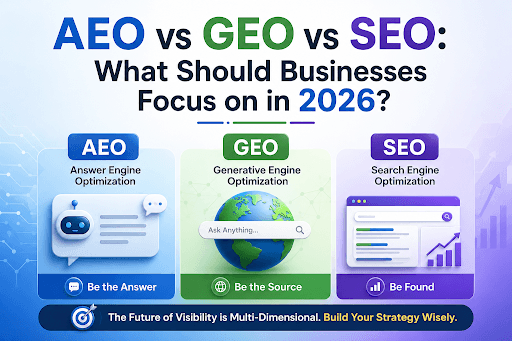
If you're comparing AEO vs GEO vs SEO, you're probably trying to answer a practical question: where should your marketing team invest its time in 2026? The answer isn't to abandon SEO for the latest AI search acronym. Strong SEO remains the foundation, while answer engine optimization, generative search optimization and broader AI SEO practices help adapt your content to how people now search and consume information.
The bigger shift is not simply where content ranks. Search engines and AI systems increasingly need to understand whether a page adds something useful to the information already available. That makes information gain an increasingly important principle for content teams.
Here's how the three approaches differ, where they overlap and how to build a search strategy that works across traditional and AI driven search.
AEO vs GEO vs SEO: What's the difference?
The terms overlap, but each describes a slightly different focus.
|
Approach |
Main focus |
Primary objective |
|
SEO |
Search engines and organic search |
Improve discoverability, rankings and qualified organic traffic |
|
AEO |
Questions and answer based search |
Provide direct, useful answers that can satisfy specific queries |
|
GEO |
Generative search experiences |
Make content useful and credible enough to be referenced in AI generated responses |
Search engine optimization (SEO) covers the fundamentals: technical accessibility, content relevance, keyword targeting, internal linking, site structure, backlinks and user experience.
Answer engine optimization (AEO) puts greater emphasis on answering specific questions clearly. A page targeting "What is technical SEO?" should not make the reader search through 1,500 words to find the definition.
Generative search optimization (GEO) focuses on search experiences where AI systems synthesize information from multiple sources into a response. Google describes AI Overviews and AI Mode as experiences that can use multiple related searches and surface supporting links from the wider web.
The terminology isn't perfectly standardised, either. Google has itself addressed common misconceptions around "AEO" and "GEO", which is another reason to focus on the underlying principles rather than chasing labels.
Why SEO still matters in 2026
AI search hasn't made traditional SEO irrelevant.
Google's guidance says that pages need to be indexed and eligible to appear in Search to be considered as supporting links in AI Overviews and AI Mode. It also continues to recommend familiar SEO fundamentals, including crawlability, internal linking, good page experience and content available in text form.
That means the first step in an AI search optimization strategy is still surprisingly familiar.
Your website needs to be:
- Crawlable and indexable
- Technically sound
- Easy for search engines to understand
- Structured around genuine search intent
- Internally linked logically
- Useful to the people reading it
- Supported by relevant, authoritative content
Our Website Audit Tool can help with this foundation by checking areas such as meta tags, internal links, crawl directives, indexability, Core Web Vitals and page performance.
This matters because no amount of AI focused content optimisation can compensate for a website that search engines struggle to crawl, understand or index.
Information gain: the part most AI SEO strategies miss
Here's where the discussion gets more interesting.
Search engines already have access to an enormous amount of information. If your article simply rewrites what the first ten results already say, what does it add?
That's the information gain problem.
Information gain means contributing something useful that wasn't adequately covered by existing content. It might come from original analysis, first hand experience, a clearer framework, a new example, a useful comparison or a more specific explanation of a complicated problem.
Consider two articles about keyword research.
Article A says:
"Keyword research helps businesses find terms people search for."
Article B explains how to identify keywords with commercial intent, separate informational queries from comparison queries, group related terms by parent topic and decide which opportunities are realistic based on competition.
Article B gives the reader more to work with.
That is the kind of thinking businesses should bring to GEO, AEO and SEO alike.
A useful test before publishing is:
If a reader has already read three competing articles, what will they learn from ours that they didn't know before?
That question can change the entire content strategy.
How information gain improves AI search optimization
AI systems can summarise common knowledge very efficiently. That makes generic content less valuable.
If every page says the same thing, there's little reason for an AI generated response to rely heavily on any one of them.
Instead, create content that contains distinctive, useful material:
- Original research or analysis
- Specific examples from your industry
- Practical processes
- First hand observations
- Clear comparisons
- Expert interpretation
- Useful data with a transparent source
- Answers to follow up questions competitors overlook
- Strong explanations of why something works, not just what to do
This doesn't mean stuffing every article with "unique" opinions. Information gain should come from genuine usefulness.
For example, instead of writing another generic article about SEO audits, explain how to prioritise technical issues. A missing meta description on a low value page isn't necessarily as urgent as an indexability problem affecting a key service page.
That distinction is far more useful than another checklist of 50 SEO factors.
What changes with AEO?
AEO is partly about matching the way people phrase questions.
Traditional keyword research might identify:
"website audit tool"
But related searches could reveal questions such as:
- What does a website audit check?
- How often should you audit a website?
- What technical SEO problems should I fix first?
- How do I check whether my pages are indexable?
- Can a website audit improve SEO?
These questions shouldn't automatically become five thin articles.
A stronger strategy may be one authoritative resource that answers the main question and covers the related questions in meaningful depth.
Our Keyword Research Tool can support this research process by showing related keywords, long tail variations, keyword difficulty, search volume and competitor keyword opportunities.
The goal isn't to collect hundreds of keywords.
It's to understand the information your audience is actually looking for.
How to prepare content for generative search
There is no guaranteed "GEO format".
Google says there are no additional technical requirements or special schema required specifically for inclusion in AI Overviews or AI Mode.
Instead, focus on making your content easy to understand and genuinely worth referencing.
Answer the main question early
Don't bury the answer underneath a long introduction.
Give readers the essential answer first, then add context, examples and nuance.
Cover the next question too
Someone searching "AEO vs SEO" will probably ask what AEO means, whether SEO still matters, how AI search changes content strategy and what they should measure.
Good content anticipates those questions naturally.
Use specific evidence
Claims become more useful when they are supported by examples, original research, credible sources or direct experience.
Build connected topic coverage
One article rarely establishes meaningful authority by itself.
Build supporting content around related subjects and connect those pages through relevant internal links.
Keep important information in text
If a critical explanation exists only inside an image, chart or video, it becomes harder for search systems and users to access that information. Google recommends making important content available in textual form.
What should businesses measure?
Don't make "appeared in AI" your only KPI.
Search visibility still needs to connect to business performance.
Track:
- Organic impressions
- Organic clicks
- Keyword rankings
- SERP features
- Non branded search visibility
- Organic conversions
- Engagement on important landing pages
- Branded search trends
- Competitor movement
- Relevant AI search visibility where reliable measurement is available
Our Website Rank Checker can help monitor keyword rankings and performance trends over time, including competitor ranking information.
This is particularly useful when evaluating an AI SEO change. Don't assume a change worked because an AI result appeared once. Look for broader evidence across rankings, visibility, traffic and conversions.
So, what should businesses focus on in 2026?
The best answer to AEO vs GEO vs SEO is not "pick one."
Think of the relationship this way:
SEO provides the foundation.
AEO improves how clearly you answer questions.
GEO adapts your content for generative search experiences.
Information gain gives people and search systems a reason to value your content.
A practical workflow looks like this:
- Research the market. Identify keywords, questions, competitors and search intent.
- Find the information gap. Ask what existing results fail to explain well.
- Create something better. Add original insight, examples, evidence or a more useful framework.
- Fix technical barriers. Make sure important pages can be crawled, indexed and understood.
- Connect related content. Build useful internal links between pages covering the same topic.
- Track performance. Monitor rankings, visibility, traffic and conversions.
- Improve the content. Update pages when you have something genuinely useful to add.
DMCockpit brings several of these measurement tasks together, including keyword research, rank tracking, website auditing, competitor analysis and analytics reporting. Its SEO platform also provides ranking tracking, SEO reports, Google Analytics and Search Console integrations, website auditing and backlink tracking.
That makes it easier to evaluate the fundamentals behind an AI SEO strategy instead of treating AI visibility as a separate marketing channel.
The real priority: create content worth finding
The biggest mistake businesses can make in 2026 is treating AEO or GEO as a shortcut around good SEO.
There isn't a special paragraph structure that guarantees an AI citation. There isn't a magic number of headings that makes content "AI optimised."
What works across all three approaches is stronger content supported by a technically healthy website.
Research the questions people ask. Understand the intent behind them. Find where existing content falls short. Then give readers something genuinely useful.
That's where information gain becomes the common thread between SEO, AEO and GEO.
For businesses managing this process, DMCockpit provides the data needed to research keywords, monitor rankings, audit websites and evaluate SEO performance from one platform. Explore the DMCockpit SEO tools to see how those capabilities can fit into your search strategy.
FAQs
1. Is AEO replacing SEO in 2026?
No. AEO builds on SEO by focusing more heavily on direct answers and question based search. Technical SEO and strong content remain foundational.
2. What is the difference between AEO and GEO?
AEO generally focuses on providing useful answers to specific queries, while GEO focuses on visibility within generative search experiences. The terms overlap and are not universally defined.
3. Is GEO just another name for AI SEO?
Not exactly. AI SEO is a broader term for adapting SEO to AI driven search and marketing environments. GEO usually refers more specifically to generative search visibility.
4. What is information gain in SEO?
Information gain is the additional value your content contributes beyond what readers can already find elsewhere. It can come from original analysis, evidence, experience, examples or a better explanation.
5. Does Google require special GEO or AEO schema?
No. Google says there are no additional technical requirements or special schema required for AI Overviews or AI Mode.
6. How do I optimise content for AI search?
Start with strong SEO fundamentals, then answer real questions clearly, add original information, demonstrate relevant expertise and make important content accessible in text.
7. Should businesses invest in GEO instead of SEO?
No. Businesses should treat GEO as part of a broader search strategy. Strong technical SEO, useful content, information gain and clear answers support visibility across both traditional and AI driven search.