
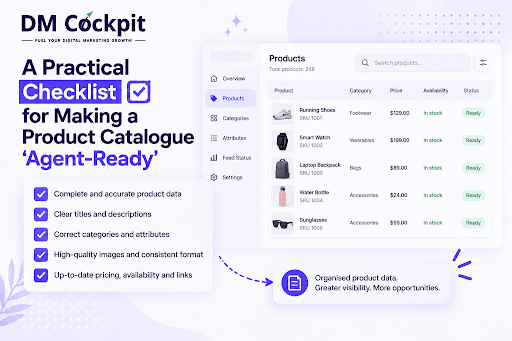
Your products can look perfectly clear to a shopper and still be confusing to a machine.
A customer looking at a product page can usually work things out from context. They can see that one shirt is navy, another is black, or that a laptop comes with different memory configurations. An AI-powered shopping system, search engine, or commerce platform does not interpret a catalogue quite the same way. It depends heavily on consistent product attributes, identifiers, structured information, and signals that agree with one another.
That makes catalogue quality increasingly important as product discovery becomes more automated. The following practical review can help marketers find the gaps before those gaps interfere with how products are understood or surfaced.
This agent ready product feed checklist focuses on the product-data issues that deserve attention when making a catalogue clearer and more reliable for machine-driven discovery.
What Does “Agent-Ready” Actually Mean?
An agent-ready catalogue gives machines enough accurate and consistent information to understand what a product is, distinguish it from similar products, recognize its variants, and connect it to the correct landing page.
This does not mean optimizing a catalogue for one particular AI platform. Think of it more broadly as making product information clear, structured, current, and machine-readable.
Before the Checklist: Inspect the Catalogue Like a Machine
Forget the polished product photography and persuasive copy for a moment.
Look at each product as a collection of data points.
Can a system confidently determine its name? Brand? Identifier? Category? Variant? Availability? Image? Correct URL?
Google's product-data guidance, for example, organizes catalogue information through individual attributes and emphasizes accurate product information. Product identifiers and variant attributes also help systems distinguish one item from another.
That is the mindset behind this agent ready product feed checklist.
Check 1: Can Every Product Be Identified Clearly?
Start with identification. Ambiguity at this level can spread into everything that follows.
For each catalogue item, check:
- Product name: Is it specific and consistent?
- Identifier: Does the item have the appropriate unique identifier?
- Brand: Is the brand clearly stated and consistently formatted?
- Variant: Can one version be distinguished from another?
- Category: Is the product classified appropriately?
- URL: Does the link lead to the correct product or variant?
- Image: Does the image represent the submitted item accurately?
Avoid changing naming conventions unnecessarily between your feed and website.
For example, if a catalogue calls an item “Classic Running Shoe – Navy – Size 9,” while the corresponding page makes the variant difficult to identify, machines may have more work to do to reconcile the information.
The goal is simple: one product should have one clear identity wherever its information appears.
Check 2: Are Important Attributes Complete?
A technically valid product entry is not necessarily a useful one.
Ask whether you have supplied the attributes needed to understand and differentiate the product.
The important fields will vary by category.
|
Product type |
Useful distinguishing information |
|
Clothing |
Size, color, material, pattern |
|
Furniture |
Material, dimensions, finish |
|
Electronics |
Model, capacity, display size, configuration |
|
Footwear |
Size, color, material |
|
Home appliances |
Model, dimensions, capacity, key configuration |
Completeness matters because attributes provide context. Google, for example, uses attributes such as material and size to describe products and help distinguish variants.
Do not fill missing fields with vague placeholders merely to make the feed appear complete. Accurate information is more useful than artificial completeness.
Check 3: Do Feed Data and Landing Pages Agree?
Now compare what the feed says with what shoppers actually see.
Look specifically for mismatches involving:
- Product title
- Variant
- Availability
- Condition
- Images
- Product identifiers
- Other important product attributes
This is one of the easiest catalogue problems to overlook because feeds and websites may be managed through different workflows.
If a product changes on the website but its submitted information remains outdated, two versions of reality begin to exist.
Google specifically requires structured product information to match what customers can see on the landing page. Its Merchant Center documentation also explains that structured data can help update product information when certain website and submitted-data mismatches occur.
Treat consistency as an ongoing requirement, not a one-time setup job.
Check 4: Are Availability Signals Reliable?
An agent should not have to guess whether something can actually be purchased.
Review how quickly product availability changes are reflected across your systems.
Pay particular attention to:
- Recently unavailable products
- Items returning to stock
- Discontinued lines
- New products
- Individual variants that become unavailable
- Catalogue entries that still point to outdated pages
A parent product being available does not automatically mean every size, color, or configuration is available.
Availability is therefore both a customer-experience issue and a data-quality issue.
Check 5: Can Variants Be Distinguished Properly?
Variants deserve their own audit.
Suppose a laptop comes with several memory configurations. If each version is treated inconsistently, a system may struggle to understand whether it is looking at separate products or variations of the same product.
Check that:
- Each variant can be uniquely identified.
- Shared products are grouped appropriately.
- Variant-defining attributes are supplied.
- The corresponding URL represents the correct selection.
- Product information does not accidentally mix attributes between variants.
Google uses item group IDs to associate related variants and unique IDs to distinguish individual items. Its current guidance also provides a variant option attribute for explicitly identifying properties that separate one variant from another.
That makes variant hygiene particularly worth reviewing as commerce interfaces become more conversational.
Check 6: Is Structured Data Helping Machines Interpret the Page?
Product feeds are only part of the picture. Your website itself can communicate product information in machine-readable form.
Structured data can help platforms understand details on product pages more reliably. Google states that product structured data can communicate information directly from a website and can support functions such as automatic item updates and product-data creation through website crawling.
The important point here is alignment, not adding as much markup as possible.
Check whether structured information accurately reflects the visible product and whether important values remain consistent.
This article is intentionally not a full schema tutorial. For the implementation and SEO side, see our guide to schema markup and rich results in 2026.
Check 7: Are Technical Errors Hiding Otherwise Good Products?
A clean catalogue cannot compensate for a website that prevents important pages from being properly discovered or accessed.
Check for issues such as:
- Broken product links
- Indexability problems
- Missing or problematic page elements
- Internal-linking issues
- Slow or poorly performing pages
- Image-related issues
- Pages returning unexpected errors
This is where catalogue auditing needs to connect with technical site health.
DM Cockpit's website audit tool can help identify issues across crawled pages, including indexability, links, meta information, Core Web Vitals, and other technical SEO signals.
A product cannot benefit much from beautifully maintained attributes if the page supporting it has serious technical problems.
The 10-Minute Agent-Readiness Review
Before digging into individual errors, run this quick catalogue-level check.
Use this agent ready product feed checklist to identify catalogue-level gaps before moving into individual product or feed issues.
|
Review Area |
What to Check |
|
Product identity |
Each product has a clear title, identifier, brand, and category. |
|
Product attributes |
Important category-specific details are complete and consistently populated. |
|
Data consistency |
Product feeds and landing pages show matching information. |
|
Availability |
Stock and availability changes are reflected reliably across product data. |
|
Variant identification |
Sizes, colours, models, or other variants can be distinguished clearly. |
|
Variant grouping |
Related product variants are grouped logically without creating confusion. |
|
Structured data |
Product structured data accurately reflects information visible on the page. |
|
Product URLs |
URLs lead users and systems to the correct product or specific variant. |
|
Accessibility |
Important product pages are crawlable, accessible, and indexable. |
|
Catalogue monitoring |
Product data is reviewed regularly so errors and inconsistencies can be identified early. |
You do not need every field to be perfect before improving agent readiness. Instead, use this review to identify where incomplete, inconsistent, or outdated product information could make it harder for search engines, shopping systems, and AI agents to understand your catalogue correctly.
Clean Data Is Becoming Marketing Infrastructure
Product discovery is changing, but one principle remains remarkably stable: systems make better decisions when they receive clear information. As AI-assisted search and commerce develop, catalogue hygiene is moving beyond a back-office feed task. It increasingly sits alongside SEO, website health, and digital visibility.
At DM Cockpit, we help marketers look beyond individual pages and identify technical weaknesses that can quietly affect website performance. Our website auditing capabilities make it easier to spot issues across a site and turn them into an actionable review rather than waiting for visibility problems to reveal themselves. A cleaner technical foundation, paired with reliable product information, puts marketers in a much stronger position for whatever the next discovery interface looks like.
Frequently Asked Questions
1. What makes a product feed agent-ready?
An agent-ready product feed contains clear, accurate, consistent, and sufficiently detailed information that machines can interpret reliably. Product identity, variants, attributes, availability, URLs, and alignment with landing pages are particularly important.
2. Does an agent-ready catalogue need structured data?
Structured data is an important machine-readable signal on product pages, but it is not a substitute for maintaining accurate product information elsewhere. The feed, website content, structured information, and actual product state should work together rather than contradict one another.
3. How should product variants be handled?
Each variant should be distinguishable through the attributes that actually change, such as size, color, material, or configuration. Related variants should also be grouped appropriately while retaining their individual identities.
4. What happens when product attributes are missing?
Missing attributes can reduce the amount of information available to systems trying to understand, categorize, filter, or differentiate an item. The importance of a missing attribute depends on the product category and the platform using the data.
5. Is product schema the same thing as a product feed?
No. Product structured data communicates machine-readable information from the webpage, while a product feed or product data source submits organized catalogue information to a platform. They can complement each other, and consistency between them is important.
6. How often should an agent-ready product catalogue be audited?
There is no single schedule that suits every catalogue. Review it whenever important product information changes and perform broader checks regularly. Fast-moving catalogues with frequent availability, variant, or product changes generally need closer monitoring than small, relatively stable catalogues.